 Sudden Valley Siding
 Sunnyland's Exterior Challenge
Sunnyland sits close enough to Bellingham Bay that salt-laden air is a daily fact of life for the siding, trim, and fasteners on every home in the neighborhood. Add in Whatcom County's long stretch of driving rain off the Sound and the shaded, damp conditions that let moss and algae take hold on north- and west-facing walls for much of the year, and you've got a climate that is genuinely hard on exterior building materials. Homes here don't fail because owners neglected them — they fail because the wrong product was asked to do a job it wasn't built for.
Salt air accelerates corrosion on fasteners and metal flashing, and it breaks down the surface finish on materials that aren't engineered to resist it. Wind-driven rain doesn't just wet a wall — it pushes moisture sideways and upward, finding every gap, lap joint, and butt seam that wasn't installed to spec. And moss, once established on a shaded wall, holds moisture against the siding surface for weeks at a time, which is exactly the condition that rots wood-based products and delaminates poorly bonded engineered siding. Any siding decision for a Sunnyland home has to account for all three at once.
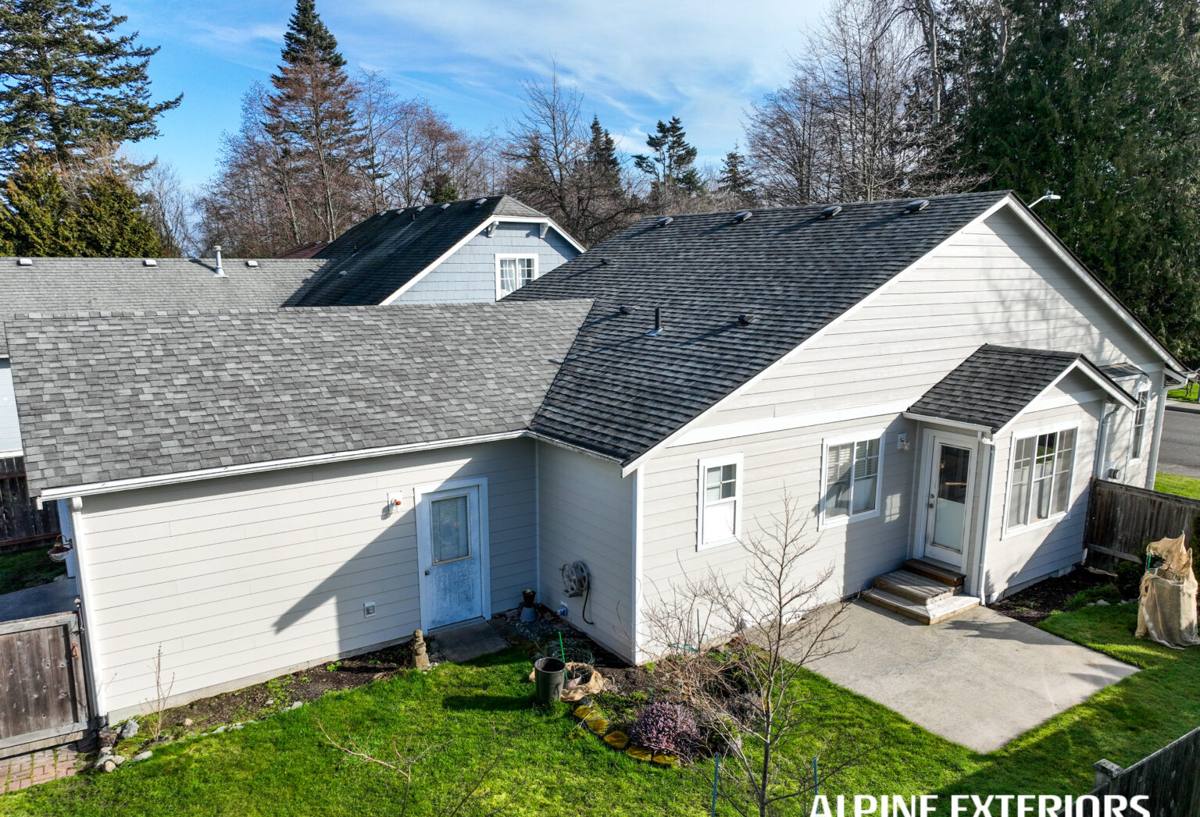
Why We Only Install James Hardie Fiber Cement
We install James Hardie fiber cement siding exclusively. We don't install vinyl, LP SmartSide, Cemplank, Allura, primed spruce, or cedar — not because those products don't have a place somewhere, but because we've made a professional judgment that fiber cement from James Hardie is the material that consistently holds up to conditions like Sunnyland's without turning into a maintenance project for the homeowner.
Fiber cement is non-combustible, doesn't swell or rot when it takes on moisture the way wood-based products can, and holds its factory-applied ColorPlus finish far longer than field-painted alternatives — which matters directly here, since a finish that's baked on and UV-cured resists the salt exposure and constant damp better than a coating applied on-site or reapplied every few years. James Hardie also engineers regional HZ5 product lines specifically for wetter, cooler climates like ours, which is a level of climate-specific engineering most competing products simply don't offer.
None of this means fiber cement is maintenance-free or foolproof. It has to be installed correctly — proper clearances, correct fastener patterns, sealed cut edges, and flashing detail that actually sheds water — or it will underperform just like anything else. That installation discipline is where most of the real-world failures we see on other people's siding jobs actually come from, and it's the part we control.
What This Means in Practice
- No sourcing decisions where we sell one product but privately recommend another
- One warranty structure, one installation standard, one set of details our crews know cold
- A finish system (ColorPlus) matched to the color and texture the homeowner actually chose, factory-applied rather than site-painted
- A material that doesn't feed moss the way wood substrates and some composite panels can
Full Exterior Services in Sunnyland
Siding is our specialty, but exterior systems don't work in isolation — a roof that's shedding water onto a wall, or a window that's letting moisture behind the cladding, will undo even a perfect siding installation. That's why we handle siding, roofing, windows, and decks as a connected exterior, not four separate trades that don't talk to each other.
Siding Replacement
Full tear-off and replacement with James Hardie lap, shingle, or panel siding, sized and detailed for the specific exposure of each wall on the house — a shaded north wall facing chronic moss pressure gets different attention than a south-facing wall taking direct weather.
Roofing
Roof condition and siding condition are linked. Poor roof drainage, undersized gutters, or missing kick-out flashing at roof-to-wall intersections is one of the most common reasons siding rots or stains prematurely, so we look at the roof whenever we're scoping a siding job.
Windows
Window replacement done alongside siding lets us integrate flashing and water-management details properly at the rough opening, instead of patching new siding around old, failing window flashing.
Decks
Decks and ledger boards attach directly to the exterior wall and are a common point of hidden water intrusion behind siding if not flashed correctly — something we address when it intersects with siding work.
Common Sunnyland Housing Stock
Sunnyland's homes span a mix of eras and styles typical of established Bellingham-area neighborhoods — older bungalows and cottages alongside mid-century and more recently updated homes. Older homes in particular were often built with materials that were standard for their era but weren't engineered for today's understanding of moisture management, so a siding replacement is frequently the first real opportunity to correct decades-old water-management issues: missing house wrap, inadequate flashing, or siding installed tight to grade without proper clearance.
Newer or previously remodeled homes sometimes carry vinyl or engineered wood siding that's showing its age faster than expected under the salt air and moss exposure common to the area — warping, fading, or soft spots at butt joints are the usual signs we get called out for.
What Correct Installation Looks Like Here
The single biggest factor in how long siding lasts in a climate like this isn't the product line — it's whether it went on correctly. For Sunnyland specifically, that means:
- Proper starter strip and ground clearance so splash-back and standing moisture don't sit against the bottom course
- Correctly lapped and sealed butt joints, since driving rain finds any joint that wasn't detailed to shed water
- House wrap and flashing integration at every window, door, and penetration — not just at the field of the wall
- Fastener selection and placement that resists the corrosive effect of salt air over decades, not just years
- Attention to shaded, low-airflow wall sections where moss and algae growth is most likely to take hold
Cost Factors for a Sunnyland Siding Project
| Factor | Why It Matters Here |
|---|---|
| Home size and wall complexity | More corners, dormers, and cut lines mean more labor and material waste |
| Existing siding removal | Older wood or asbestos-era siding may require extra care and disposal handling |
| Moisture damage found underneath | Rot repair to sheathing or framing, common on shaded or poorly flashed walls, adds scope once uncovered |
| Siding profile chosen | Lap, shingle, and panel styles have different material and labor costs |
| Trim and accessory package | Corner boards, trim, and soffit work priced separately from field siding |
| Roofing/window coordination | Combining trades can reduce total disruption and cost versus separate projects |
Exact numbers depend on what we find once the old siding comes off, which is why we don't quote firm pricing without a walkthrough — but these are the variables that actually move the number.
Choosing a Local Contractor
A crew that works Whatcom County regularly knows what a Sunnyland wall exposed to salt air and moss actually needs versus a generic installation spec written for a drier climate. That local pattern recognition — knowing which walls in this neighborhood tend to hold moisture, which older homes tend to have hidden rot at grade, how much clearance actually matters here — comes from doing this work in this specific climate, not from a manual.
When vetting any exterior contractor, ask directly what products they install and why, whether they carry manufacturer certification for the siding they're proposing, and whether they'll put the workmanship warranty in writing separate from the material warranty. A contractor who's vague on any of those three is worth a second look.
Living With Fiber Cement Siding in a Salt-Air, Moss-Prone Climate
James Hardie siding is low-maintenance, not no-maintenance. In Sunnyland's conditions, that means an occasional gentle rinse to keep salt residue and organic buildup from accumulating, especially on shaded walls where moss is most likely to establish. It does not mean repainting on a recurring cycle the way field-finished siding demands — the ColorPlus finish is designed to hold its color and integrity far longer under UV and moisture exposure than a site-applied coat.
Keeping gutters clear and grading water away from the foundation also does more for siding longevity here than almost anything else a homeowner can control, since standing water at the base of a wall is the single most common cause of premature siding failure in this climate.
If you're weighing a siding replacement in Sunnyland — or want a second opinion on damage you've already spotted — we're happy to walk the exterior with you and give you a straight answer, no pressure. Reach out for a free estimate using the form below.