 Sudden Valley Siding
 Siding in Acme: A Different Kind of Climate Test
Acme sits in the rural, tree-covered stretch of Whatcom County east of Bellingham, tucked into the valleys that feed toward Lake Whatcom and the South Fork Nooksack. Homes out here don't face the same exposure as a house on the open coast, but they face something just as hard on siding: heavy tree cover, long stretches of shade, and a marine-influenced, moisture-laden air mass that rolls through this part of Western Washington for most of the year. Add in the driving rain that comes through the valley in fall and winter, and you have a climate that is quietly rough on exterior materials even when it never feels dramatic.
We've worked on homes throughout this part of the county, and the pattern is consistent. It isn't one big storm that damages siding here — it's the slow, cumulative effect of dampness that never fully dries out between rain events, combined with shade and organic debris that give moss and algae a long growing season. A siding product that handles a drier climate, or even a windier coastal spot, doesn't necessarily hold up the same way in a shaded valley community like Acme.
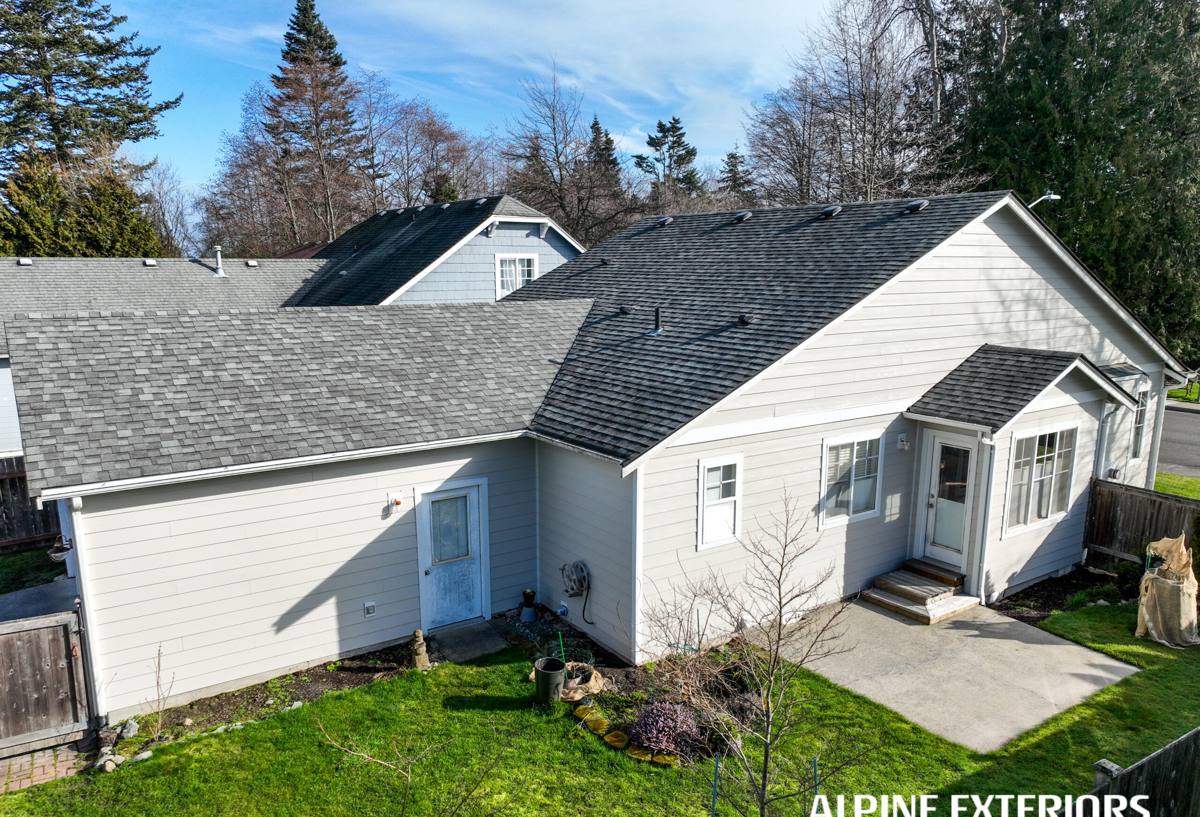
Why Moss and Moisture Are the Real Enemy Out Here
Moss doesn't just look bad on a wall — it holds moisture directly against the siding surface for weeks at a time. On materials that aren't dimensionally stable or that rely on paint film to keep water out, that constant dampness is what eventually leads to swelling, soft spots, or paint failure. In a community with heavy tree canopy like Acme, siding rarely gets the kind of full-sun drying time that homes in open, exposed areas get.
The other factor is splash-back and ground-level moisture. Homes set close to tree lines or on lots with limited drainage tend to see more moisture wicking up from grade, more organic buildup at the base of walls, and more shaded, slow-drying corners where mildew and moss take hold first. None of this is unique to any one house — it's a function of the region's rainfall pattern and the amount of forest cover that defines this part of Whatcom County.
What We Look For on an Acme Inspection
- Moss or algae buildup concentrated on north-facing or shaded wall sections
- Soft or swollen spots near the bottom courses of siding, close to grade
- Paint or finish failure that shows up faster on shaded elevations than sunny ones
- Caulk and trim gaps that have opened up from repeated wet-dry cycling
- Gutter and downspout issues dumping extra water onto specific wall areas
- Roof-to-wall flashing details that may be feeding moisture behind the siding
Signs Your Siding Is Losing the Ground
Most siding failure doesn't announce itself with a dramatic event. It shows up as a slow accumulation of small signs, and by the time several of them appear together, the underlying material is usually further along than the surface suggests.
| What You See | What It Usually Means |
|---|---|
| Persistent moss regrowth after cleaning | Surface is holding moisture; may indicate underlying material is staying damp longer than it should |
| Soft, spongy panels when pressed | Moisture has penetrated the substrate — common failure point for wood-based or engineered wood products |
| Peeling or bubbling paint | Moisture is trying to escape through the finish, often a sign of trapped water behind the siding |
| Visible gaps at seams and trim | Material has expanded and contracted repeatedly, opening pathways for water entry |
| Dark streaking below windows or rooflines | Water is being channeled onto the wall from above, accelerating wear in that zone |
Our Standard for This Climate: James Hardie Fiber Cement
We install James Hardie fiber cement siding exclusively. That's a deliberate decision, not a limitation on what we're able to offer. We've made the call that in a climate like Whatcom County's — long wet seasons, heavy shade in communities like Acme, and a lot of moss and organic moisture pressure — fiber cement is the material that holds up the way homeowners expect siding to hold up over decades, not just years.
Fiber cement is dimensionally stable. It doesn't swell, rot, or delaminate the way wood-based and engineered wood siding products can when they stay damp for extended periods. Hardie's ColorPlus finish is baked on at the factory under controlled conditions, which gives it more consistent coverage and better fade and moisture resistance than field-applied paint. And because it's non-combustible, it adds a layer of fire resistance that matters increasingly in this region, especially for properties near timber and brush.
Why We Don't Install Everything on the Market
We get asked from time to time about vinyl, LP SmartSide, or other engineered wood products, and we're straightforward about it: those products aren't necessarily bad at what they're designed to do, but they involve trade-offs we're not willing to put our name behind in this climate. Vinyl can warp and fade, and its seams and moisture handling are more forgiving in drier regions than they are here. Engineered wood products are wood-based at the core, which means moisture management is the whole game — if a seal fails or water finds a path in, the clock starts on eventual rot. In a shaded, wet community like Acme, we'd rather not gamble a homeowner's siding investment on that.
| Factor | James Hardie Fiber Cement | Engineered Wood / Vinyl |
|---|---|---|
| Moisture behavior | Dimensionally stable, doesn't swell or rot | Wood-based products can absorb moisture and degrade; vinyl can trap moisture behind panels |
| Finish durability | Factory-baked ColorPlus finish, long fade resistance | Field-applied paint or factory coatings with shorter repaint cycles |
| Fire resistance | Non-combustible | Combustible (wood) or heat-sensitive (vinyl) |
| Typical lifespan when installed to spec | Multiple decades | Varies; often shorter in consistently wet, shaded climates |
| Warranty structure | Strong transferable manufacturer warranty | Varies by product and manufacturer |
More Than Siding: How the Exterior Works Together
Siding doesn't fail in isolation. In our experience, most premature siding problems trace back to something else on the exterior — a roof that's shedding water in the wrong direction, gutters that are undersized or clogged, or aging windows that are letting moisture track into the wall assembly around the frame. That's part of why we handle roofing, windows, and decks alongside siding: it lets us look at a home's exterior as one connected system instead of a list of separate products.
For a property in Acme, that often means checking roof-to-wall flashing details, confirming gutters are actually moving water away from the foundation and siding base, and looking at window flashing where it meets the new siding plane. A deck built onto the side of the house is another common trouble spot — ledger board connections and deck-to-wall transitions are exactly the kind of detail that needs to be done right to keep water from getting behind the siding at that joint.
What a Local Crew Adds in a Community Like This
Acme isn't a dense subdivision — it's a spread-out, tree-lined community where lot conditions, drainage, and sun exposure vary a lot from one property to the next. A crew that works this part of Whatcom County regularly has a feel for which details matter most on a given lot: how much shade a wall gets through the year, where moss tends to build up first, and what the local rainfall pattern does to a house over a full winter, not just a single storm.
That local familiarity also matters for practical reasons — knowing the roads, understanding typical lot access and staging space for a job, and being available for a follow-up visit without a long drive. It's a smaller thing than the material choice, but it adds up over the life of a project.
How the Replacement Process Works
Every property is different, but the general sequence for a full siding replacement follows the same logic everywhere we work.
- On-site inspection of existing siding, trim, flashing, and any moisture-affected areas
- Assessment of underlying sheathing and framing for damage that needs addressing before new siding goes on
- Confirmation of a proper weather-resistive barrier and flashing details at windows, doors, and roof lines
- Installation of James Hardie panels or planks per manufacturer specification, including correct fastening and clearances
- Factory-finished ColorPlus material means no field painting is required for color, though caulking and trim work are finished on site
- Final walkthrough to check seams, corners, and transitions where siding meets roofing, windows, or decking
Installation quality matters as much as the material itself. Fiber cement performs the way it's designed to when it's fastened correctly, given proper clearance from grade and hard surfaces, and flashed correctly at every penetration. Cutting corners on any of those details can undercut even the best siding product.
What Affects Cost
We don't publish fixed prices because every home's siding scope is different, but the main factors that drive cost are consistent across projects.
| Factor | Why It Matters |
|---|---|
| Home size and wall complexity | More square footage and more corners, gables, and trim detail increase labor and material |
| Condition of existing sheathing | Hidden rot or water damage found during tear-off adds repair scope |
| Siding profile and trim package | Lap width, board-and-batten, and trim detail choices affect material cost |
| Access and site conditions | Tree cover, slope, and staging space on a lot can affect labor time |
| Scope beyond siding | Coordinating flashing, gutter, or trim work at the same time can save cost versus separate projects |
The most reliable way to get an accurate number is a walk-through of the actual property, since generic estimates rarely hold up once the specifics of a home are on the table.
Let's Take a Look at Your Home
If your siding is showing moss buildup that won't quit, soft spots, or paint that's failing faster on the shaded side of the house, it's worth having a second set of eyes on it before it turns into a bigger repair. We'll walk the property, tell you honestly what we see, and put together a free, no-pressure estimate using the form below.