 Sudden Valley Siding
 Cedar Has Real Appeal — Let's Start There
Nobody needs to convince a Whatcom County homeowner that cedar siding looks good. It has warmth that manufactured products spend a lot of marketing budget trying to imitate. Fresh-milled cedar has a natural grain, a rich color range, and a texture that photographs beautifully and ages into a look plenty of people genuinely prefer. If you grew up around cedar-shingled homes on Lake Whatcom or in the older Bellingham neighborhoods, the pull toward it is understandable. It's a real wood product with real character, and we're not going to pretend otherwise.
What this page is about isn't whether cedar can look great. It's about what it takes to keep it looking great for the next 20 years in a climate like ours — and why, after weighing that maintenance burden against what our customers actually want from a siding investment, we made the decision to install James Hardie fiber cement instead of cedar on every home we side.
What Cedar Actually Requires, Year After Year
Cedar is a natural, organic material, and it behaves like one. Unlike fiber cement or vinyl, it's not inert — it's wood that expands, contracts, absorbs moisture, and breaks down under UV exposure. To keep it performing and looking the way it did on install day, cedar needs an ongoing maintenance relationship, not a one-and-done finish.
The Refinishing Cycle
Cedar siding needs to be refinished on a recurring schedule, whether that's a semi-transparent stain, a solid-body stain, or paint. Depending on the product and the exposure of a given wall, that cycle typically lands somewhere between every 3 and 7 years. South- and west-facing walls that take direct sun and driving rain wear out faster than shaded north walls. That means a homeowner isn't just budgeting for one refinishing job — they're budgeting for a recurring one, indefinitely, for as long as they own the home.
Cleaning Before You Ever Get to Refinishing
Before any refinishing happens, the siding has to be properly cleaned — algae, mildew, and moss growth washed off, old failing finish removed or feathered, and the wood given a chance to dry out fully before new coating goes on. Skipping this step and just recoating over dirty or moisture-laden wood is one of the most common reasons cedar finishes fail early.
Moisture, Moss, and the Whatcom County Problem
This is where our climate makes cedar's maintenance demands harder than the national averages you'll find in a lot of siding literature. Sudden Valley sits close to Lake Whatcom, in a marine climate that combines salt-tinged air moving in off the Sound, long stretches of driving rain, and a moss season that can run from fall through spring. That combination is tough on any exterior material, but it's particularly unforgiving on wood siding.
Moss and Algae Growth
Moss doesn't just grow on roofs here — it finds a foothold on any shaded, moisture-retaining wood surface, including siding under eaves, behind landscaping, and on north-facing walls that don't get enough sun to dry out between rain events. Once moss or algae takes hold on cedar, it holds moisture directly against the wood fibers, which accelerates rot from the surface inward. Left unaddressed over a wet Whatcom County winter, that's exactly the kind of slow damage that isn't visible until a board is already compromised.
Driving Rain and Wind-Driven Moisture
Storms coming off the water don't just fall straight down — wind-driven rain gets pushed sideways into wall assemblies, testing every seam, joint, and end-cut on a cedar installation. Any spot where the factory or field-applied finish has worn thin becomes an entry point. Because cedar is a hygroscopic material, it absorbs that moisture into the wood itself rather than shedding it, which is a big part of why finish maintenance can't be treated as optional here the way it might be in a drier inland climate.
What Happens When Maintenance Slips
Every cedar installation we've seen that's failed early failed for the same basic reason: the maintenance cycle got pushed back a year, then two, then five, often because a house changed hands or a homeowner got busy. Wood doesn't wait patiently for attention — deterioration compounds.
- Faded or chalking finish lets UV rays degrade the wood surface directly
- Cracked or checked boards let water behind the finish layer
- Moss and algae buildup traps moisture against the wood
- Soft or spongy spots signal rot has already started beneath the surface
- Insect activity (carpenter ants, some beetle species) often follows moisture damage
- Individual board replacement gets harder to match as original stock weathers and changes color
None of this means cedar is a bad product — it means cedar is a product that punishes deferred maintenance more than most, and our climate creates more opportunities for maintenance to get deferred than a drier region would.
The Real Cost Picture Over Time
A lot of siding comparisons only look at install-day price, which understates what a homeowner actually pays over the life of the siding. Here's how the ongoing burden typically compares:
| Factor | Cedar Siding | James Hardie Fiber Cement |
|---|---|---|
| Refinishing cycle | Every 3-7 years depending on exposure | ColorPlus factory finish backed by a long-term finish warranty; repainting not on a fixed cycle |
| Moisture behavior | Absorbs moisture into wood fibers | Engineered to resist moisture absorption and swelling |
| Moss/algae vulnerability | High on shaded, damp walls | Lower; hard, non-organic surface doesn't feed growth the way wood can |
| Insect/rot risk | Present if moisture intrudes | Non-organic material, not a food source for wood-boring insects |
| Fire performance | Combustible wood product | Non-combustible fiber cement |
| Board replacement/matching | Color/weathering mismatch common over time | Factory-matched color consistency across replacement boards |
This isn't a claim that cedar is defective — it's a straightforward look at what each material asks of a homeowner over 20-30 years of Pacific Northwest weather.
Fire and Insurance Considerations
Wildfire smoke and ember exposure have become a bigger part of Western Washington summers in recent years, and insurance underwriting has started to reflect that. Cedar, like any wood siding, is a combustible material. James Hardie fiber cement is non-combustible, which is increasingly something both homeowners and insurers are paying attention to when evaluating exterior materials — not just for direct wildfire exposure, but for general fire-spread behavior in siding-to-siding contact situations like attached structures or close-set neighborhoods.
Where Cedar Still Makes Sense
We're not opposed to cedar as a material category. It has legitimate uses even on homes we side with fiber cement — cedar accents, porch ceilings, gable details, or trim elements in protected, well-detailed locations where the maintenance burden is smaller and the aesthetic payoff is high. The distinction we draw is between using cedar as an accent versus relying on it as the primary weather barrier for an entire home's exterior, which is a much bigger and more constant maintenance commitment.
Why We Install James Hardie Instead
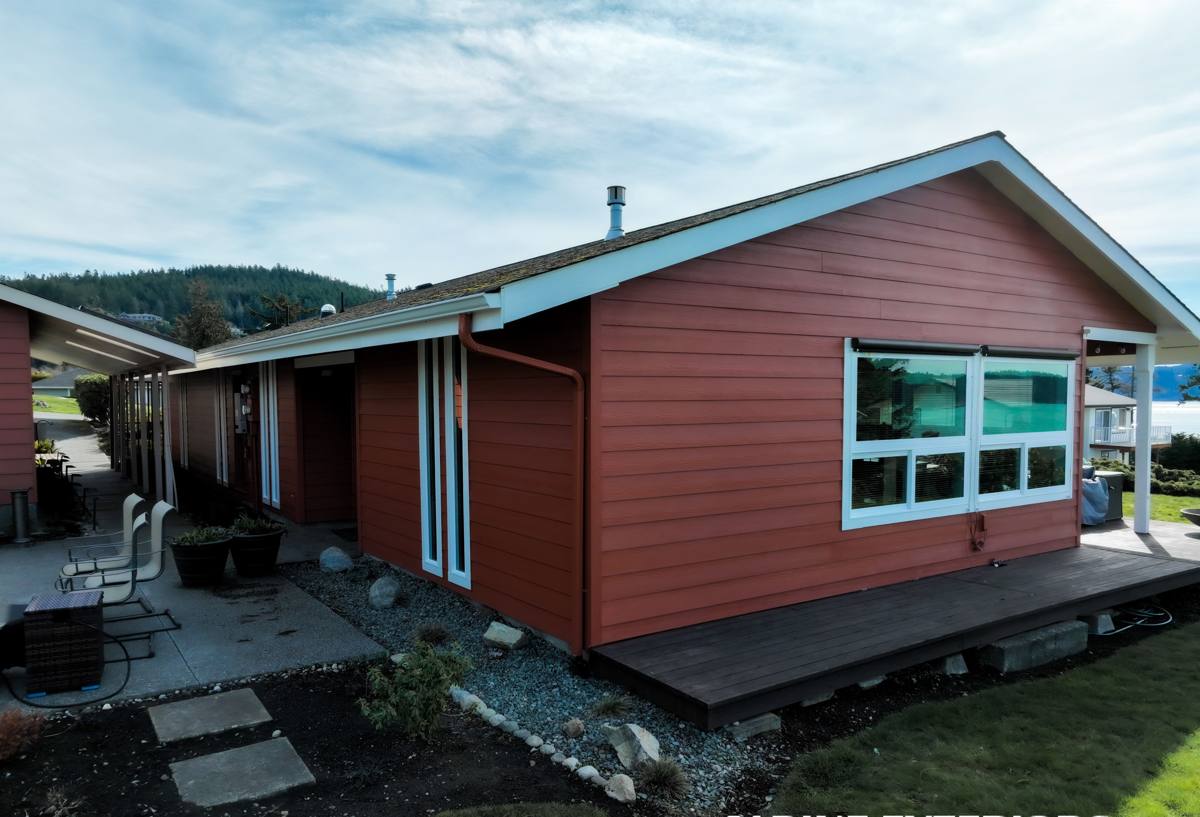
When we standardized our siding installations on James Hardie, it wasn't a marketing decision — it came out of watching how different products actually perform on homes in this specific climate over time. Hardie's HZ5 product line is engineered for exactly the wet, moss-prone, moisture-heavy conditions common in Western Washington. It's non-combustible, holds its factory ColorPlus finish far longer than field-applied wood coatings, and comes with a strong transferable warranty that reflects the manufacturer's confidence in long-term performance. For homeowners who want a siding decision they can make once and then mostly not think about again, that combination is hard to match with a natural wood product.
A Simple Way to Think About the Trade-Off
- Cedar: real wood character, a recurring refinishing commitment, higher vulnerability to moss and moisture damage in our climate
- James Hardie: engineered for regional moisture and fire conditions, factory finish warranty, minimal recurring maintenance
- Both: legitimate exterior materials — the right choice depends on how much ongoing upkeep a homeowner wants to take on
Questions Worth Asking Before You Choose Cedar
If you're still weighing cedar against fiber cement for a Sudden Valley or wider Whatcom County home, these are the practical questions we'd encourage any homeowner to ask themselves and any contractor bidding the job:
- How many walls of the house get direct afternoon sun versus staying shaded and damp most of the year?
- Who is realistically going to handle refinishing on a 3-7 year cycle — and what does that cost when you include labor, not just materials?
- Is there mature landscaping or tree cover close to the house that will keep certain wall sections perpetually damp?
- What does the manufacturer's or installer's warranty actually cover, and for how long?
- How does the material perform in a wildfire-smoke or ember-exposure scenario relevant to current insurance underwriting?
- Are you buying this house to stay in it long-term, or is resale timing a factor in how much upkeep you want to commit to?
Get an Honest Look at Your Home
Every home in Sudden Valley sits a little differently — sun exposure, tree cover, proximity to the lake, and wall orientation all change how hard a siding material has to work here. We're happy to walk your property, point out where moisture and moss pressure are already showing up on your current siding, and give you a straightforward read on what a James Hardie installation would look like for your home. There's no pressure and no sales script — just a real assessment. Reach out for a free estimate whenever you're ready to talk it through.