 Sudden Valley Siding
 Why Color Is a Bigger Decision Than It Looks
Picking a siding color feels like the fun part of a re-side project, right up until you realize it's also one of the most permanent decisions you'll make about your home. Siding color sets the tone for the whole property, has to work with your roof, trim, stone, and landscaping, and — unlike paint on a wall — isn't something you casually redo every few years. On a home overlooking Lake Whatcom or tucked into the trees around Sudden Valley, color also has to survive real weather: salt-tinged air pulled up from the Sound, driving winter rain, and long stretches of shade and moisture that keep moss and algae active most of the year.
This guide focuses specifically on James Hardie's color system — how it's built, what holds up here, and how to think through the choice for your home. We only install James Hardie fiber cement, so everything below reflects what we actually work with on Whatcom County roofs and walls, not a generic manufacturer overview.
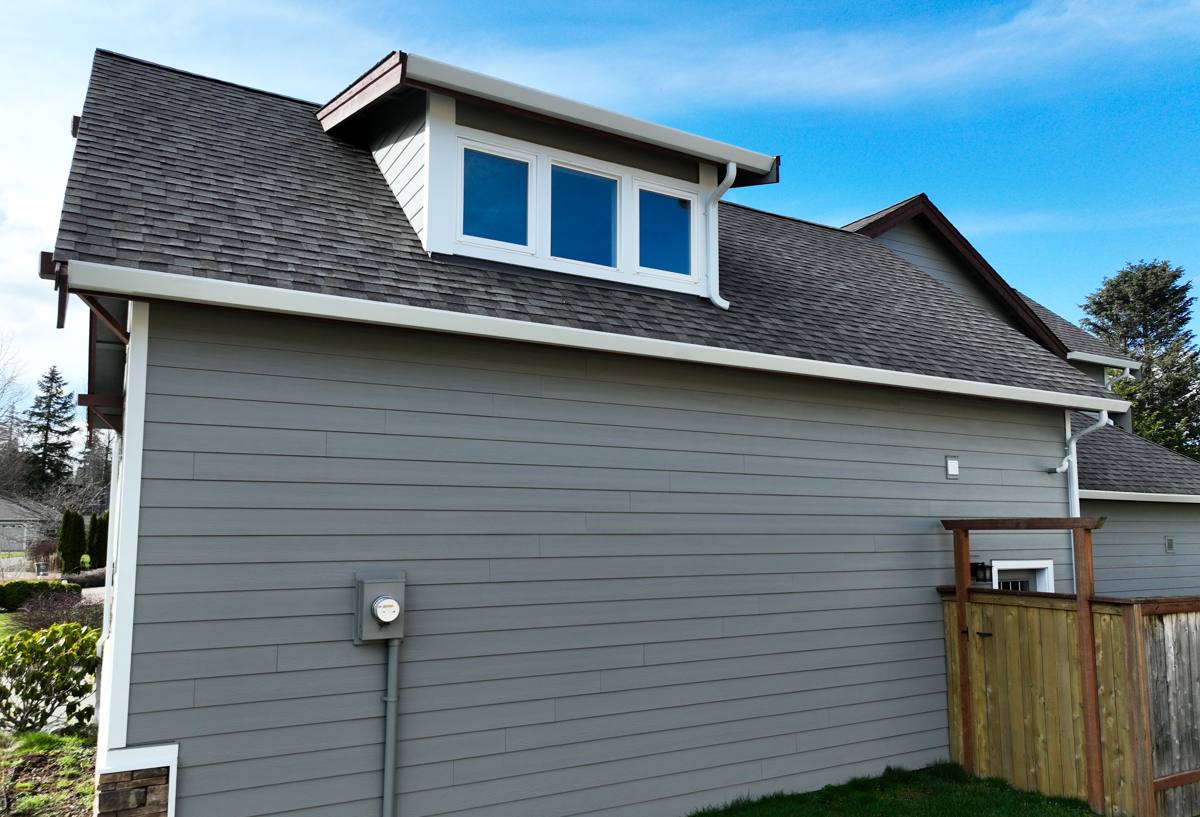
ColorPlus Technology: What Makes Hardie Color Different
Most siding gets its color from field-applied paint — a crew primes and paints the boards on site, or the boards arrive primed and get painted after installation. James Hardie's ColorPlus Technology takes a different approach: color is baked onto the fiber cement at the factory, in a controlled environment, using multiple coats cured before the boards ever reach a job site.
Why That Sequence Matters
Field-applied paint has to contend with whatever the weather is doing that week — humidity, temperature swings, dust, and the skill of whoever is holding the sprayer. Factory-applied, baked-on finish skips all of that variability. It also means the color goes on before the board is cut, nailed, and handled on site, so touch-up needs are limited to cut edges and the occasional nail head rather than entire wall sections.
What This Means for Homeowners
- More consistent color from board to board, since it's not dependent on job-site conditions
- A finish engineered specifically to bond to fiber cement, rather than a generic exterior paint
- A longer color warranty than what's typically offered on field-painted siding
- Fewer repaint cycles over the life of the siding, which matters on a property where scaffolding and ladder access aren't always simple
The Sudden Valley Climate Factor
Whatcom County siding takes a specific kind of beating. Sudden Valley sits close enough to the water that salt air is a real factor on metal fasteners, trim, and any finish that isn't built to resist it. Winters bring driving, wind-blown rain rather than gentle straight-down rain, which pushes moisture into every seam, corner, and lap joint on a wall. And because so many lots here are wooded and shaded, especially on the lake-facing and forested sides of the neighborhood, moss and algae have a long season to take hold — often eight or nine months out of the year in the shadier spots.
None of that is a reason to panic about siding choice, but it is a reason to be deliberate about it. A finish that's only rated for "typical" exterior exposure gets tested harder here than it would in a drier inland climate. James Hardie's HZ5 product line is engineered for this kind of climate zone — freeze-thaw cycles, sustained moisture, and coastal-influenced weather — which is part of why we don't deviate from Hardie for homes in this area.
Color and Moss: What Actually Helps
Color itself doesn't stop moss growth — that's a function of shade, moisture, and surface texture more than pigment. But lighter, smoother-finish colors tend to show moss and algae staining sooner and more visibly than mid-tone or textured colors, simply because the contrast is higher. If your lot is heavily shaded by fir and cedar, that's worth factoring into your color decision, not as a dealbreaker, but as something to have a straight conversation about before you commit.
James Hardie's Color Families
James Hardie's ColorPlus palette runs from crisp whites to deep charcoals, with a solid range of warm neutrals and a handful of muted greens and blues in between. Rather than list every shade, it's more useful to think in families, since that's how most homeowners actually narrow down a choice.
| Color Family | General Character | Common Pairings |
|---|---|---|
| Whites & off-whites | Clean, classic, reflects heat well | Black or dark bronze trim, black windows |
| Warm neutrals (tan, khaki, beige) | Blends with wooded and stone settings | Brown or cedar-tone trim, stone accents |
| Cool grays | Modern, understated, hides some dust and pollen | White trim, black roofing |
| Deep charcoal & near-black | High contrast, strong curb presence | Wood-tone accents, metal roofing |
| Muted blues & greens | Softer, works well against evergreen backdrops | White or cream trim |
Because ColorPlus is baked onto the board rather than mixed to order, you're choosing from a fixed palette rather than an unlimited swatch book. That's a trade-off worth understanding up front: you get factory-grade durability and a strong warranty, but you're picking from a curated set of colors rather than a custom-mixed one.
Matching Color to Hardie Product Lines
Color decisions don't happen in a vacuum — they interact with which Hardie products you're using where.
HardiePlank Lap Siding
The most common choice for full wall coverage, available in a wide range of ColorPlus colors and several plank widths and textures (smooth, cedarmill). This is usually where the primary body color gets decided.
HardieShingle
Used for accent gables, dormers, or full shingle-style walls. Shingle texture reads differently than lap siding in the same color — it tends to look slightly deeper and more textured, which is worth seeing in a real sample rather than judging from a swatch alone.
HardieTrim
Trim boards are almost always chosen in a contrasting or complementary color to the field siding — white trim against a deep charcoal body, or a warm cream trim against sage green, for example. Trim color has an outsized effect on how "finished" a home looks, often more than the body color itself.
HardiePanel
Vertical panel siding, often used on modern designs or as an accent alongside lap siding. Popular for board-and-batten style accents on entries, gables, or garage walls.
Choosing a Color for a Sudden Valley Home
A few practical factors tend to matter more here than in a generic subdivision:
- Tree cover: Homes under heavy fir and cedar canopy often read differently in real light than they do on a sample board in full sun. See the color in shade before deciding.
- Lake and water views: On lake-facing elevations, homes are seen from a distance and from the water — bolder contrast (dark body, light trim, or vice versa) tends to read better at distance than subtle tone-on-tone combinations.
- Neighboring homes: Sudden Valley has a mix of styles and eras. There's no single "expected" palette, which gives more freedom than a strict HOA-controlled color list, but it's still worth a walk or drive around your specific street before finalizing.
- Roof color: Since re-siding doesn't usually mean re-roofing, your existing roof color is a fixed constraint. Bring a roof sample or photo to any color conversation.
What Color Costs — and Doesn't Cost
One advantage of ColorPlus is that, unlike custom paint mixing, color choice generally doesn't change your material cost — you're selecting from the standard palette, not paying a premium for a specific shade. Where cost does shift is around product selection and detailing, not the color itself.
| Factor | Cost Impact |
|---|---|
| Standard ColorPlus color selection | No added cost — included in panel/plank pricing |
| Mixing multiple product lines (plank + shingle + trim accents) | Moderate increase — more cut pieces, more labor detail |
| Field-painting cut edges and touch-ups | Minor — standard part of correct installation |
| Custom job-site painting over primed Hardie boards | Adds cost and forfeits some ColorPlus warranty benefits |
That last row matters: primed Hardie boards that get field-painted are a legitimate option in some situations, but they don't carry the same factory finish warranty as ColorPlus, and the field-paint job is only as good as the crew and conditions on the day it happens. For most homeowners in this climate, factory-finished ColorPlus is the more durable, lower-maintenance route.
A Practical Checklist Before You Commit
- Get a real ColorPlus sample board — not just a printed or digital swatch — and view it in your own yard, in both sun and shade
- Check the color against your existing roof, and against any stone, brick, or masonry that isn't being replaced
- Consider how much shade your walls get and whether a mid-tone or textured finish makes more sense than a bright white in a moss-prone spot
- Decide on trim and body color together, not separately — the contrast between them does as much visual work as either color alone
- Ask about the specific ColorPlus warranty terms for the color and product line you're choosing, since coverage details can vary
- Walk your street or nearby Sudden Valley blocks to see how similar colors read at a distance, especially if your home faces the lake
Getting It Right the First Time
Because ColorPlus is a factory finish, there isn't a quick, low-cost way to change your mind a year in — repainting fiber cement siding is possible but it's a real project, not a weekend touch-up. That's exactly why we spend time on this decision up front with actual sample boards, in your actual light, against your actual roof and trim, rather than rushing to a swatch-book pick. It's a small amount of extra time that saves a homeowner from living with a color that only looked right in the store.
If you're planning a siding project in Sudden Valley or elsewhere in Whatcom County and want to talk through color, product lines, or how James Hardie holds up against our local rain and salt air, we're happy to walk through it with you. Reach out for a free, no-pressure estimate — there's a form right below this page to get started.