 Sudden Valley Siding
 Serving Happy Valley Homeowners
Happy Valley sits in the mix of wooded lots, lakeside slopes, and mature tree canopy that defines the Sudden Valley area of Whatcom County. Homes here were built for the view and the quiet, but that same setting — shade, moisture, and proximity to the water — puts real wear on an exterior. We do siding, roofing, windows, and decks for homeowners throughout this part of the county, and we've built our business around one product for siding: James Hardie fiber cement. This page walks through what the local climate does to a home's exterior, how we approach a siding job here, and why we don't install anything but Hardie.
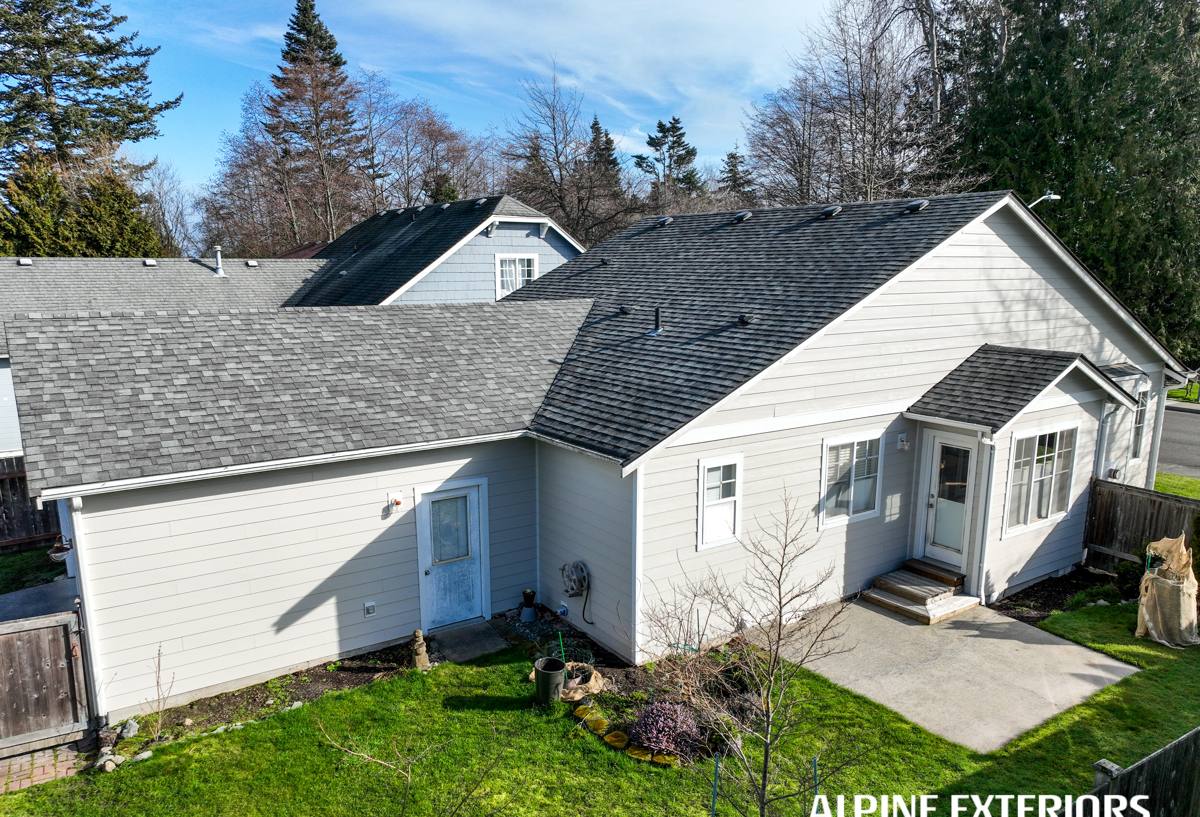
What Whatcom County Weather Does to Siding
Salt air, driving rain, and a long moss season are not marketing language for this area — they're the three things that age a home's exterior faster than homeowners expect. Whatcom County sits close enough to Bellingham Bay and the Salish Sea that airborne salt is a real factor on exposed siding and trim, especially on the sides of a house that face open water or prevailing wind. Layer on top of that a wet season that runs long by national standards, with wind-driven rain that gets pushed sideways into wall assemblies rather than falling straight down, and you have conditions that punish any siding material with weak seams, absorbent cores, or paint that can't hold up to constant damp-dry cycling.
Then there's moss. The combination of shade from mature evergreens, high humidity, and mild temperatures that never really dry things out for long stretches makes this one of the more moss-friendly climates in the country. Moss and algae don't just look bad — they hold moisture against the siding surface for weeks at a time, which accelerates rot in wood-based products and stresses paint films and caulked joints on almost anything installed on a wall.
None of this is unique to Happy Valley specifically, but the combination of lake proximity, tree cover, and coastal air puts this pocket of Whatcom County on the harder end of what a siding system has to tolerate.
Why This Matters for Material Choice
A lot of siding failures we get called out to inspect aren't installation failures — they're material failures. Wood-based composite products, primed spruce, and even some vinyl systems struggle in exactly the conditions this area produces: sustained moisture exposure, limited direct sun to dry things out, and salt-laden air working on fasteners and finishes. That's the backdrop for every recommendation we make on this page.
Signs Your Home's Siding Needs Attention
Most siding problems in this climate develop slowly, behind a surface that still looks okay from the street. Walk your exterior a couple of times a year and look for the following:
- Dark streaking or green/black staining that keeps coming back after cleaning
- Soft spots or slight give when you press on the siding, especially near the bottom courses
- Cracking, bubbling, or peeling paint that reappears within a season or two of repainting
- Visible gaps opening up at seams, corners, or where siding meets trim
- Warping, cupping, or boards that no longer sit flat against the wall
- A noticeable jump in heating bills without another explanation
- Moss or algae buildup that seems to return faster each year
Any one of these on its own might be minor. Several together, especially on the sides of the house that face prevailing weather, usually mean it's time for a real inspection rather than another round of caulk and touch-up paint.
Why We Install Only James Hardie Fiber Cement Siding
We get asked why we don't offer LP SmartSide, vinyl, Cemplank, Allura, or cedar. The honest answer is that we looked at how those products actually perform in this specific climate over years of ownership, not just how they perform on a spec sheet or in a showroom, and we standardized on one material.
Wood-based composite siding, even the engineered kind, still has a wood-strand core. In a climate with a long wet season and heavy shade, any breach in the factory coating or field-cut edge sealing gives moisture a path into that core, and once it's in, it doesn't dry out quickly here. Primed spruce and cedar carry the same fundamental vulnerability, just without the engineered strand structure — they're natural wood, and natural wood in constant damp conditions needs a maintenance commitment most homeowners underestimate when they buy the house.
Vinyl siding avoids the moisture-absorption problem, but it brings its own trade-offs: it can warp or distort with temperature swings, it's installed with expansion gaps that some homeowners find visually unappealing up close, and its color is baked into a thin plastic panel that fades over time with no practical way to refinish it short of replacement.
Fiber cement products from other manufacturers get closer to what we want, but James Hardie is the one we've found consistently backs its product with the strongest factory finish warranty, the most consistent manufacturing quality control, and the deepest track record in the Pacific Northwest specifically. Hardie is non-combustible, doesn't expand and contract the way vinyl does, and its ColorPlus factory finish is baked on and cured under controlled conditions rather than field-applied — which matters a great deal when the paint has to survive salt air and months of damp weather every year.
The James Hardie Product Lines We Use
Hardie makes several distinct product lines, and part of doing this job right is matching the right line to the right part of the house. James Hardie also engineers its siding in different formulations for different climate zones — one built for regions with hard freeze-thaw cycles and one for milder, wetter zones like ours — and we install the version specified for this area, not a generic national product.
| Product Line | Typical Use | What It Offers |
|---|---|---|
| HardiePlank lap siding | Primary wall cladding | The most common profile; traditional lap look, wide range of textures and widths |
| HardieShingle | Accent areas, gables | Staggered or straight-edge shingle look without the maintenance of real wood shingles |
| HardiePanel | Modern/board-and-batten styling | Large vertical panels, often paired with battens for a clean, contemporary elevation |
| HardieTrim | Corners, window and door surrounds, fascia | Matches the siding's durability so trim doesn't become the weak point in the system |
Color is another piece of this. ColorPlus finishes come in a curated palette baked on at the factory, which is a large part of why the finish holds up better against fading and moisture than field-applied paint. Homeowners who want a fully custom color can still have their Hardie siding field-painted, but most choose ColorPlus specifically to avoid ever having to repaint the siding on a maintenance schedule.
What Correct Installation Involves
Fiber cement siding is only as good as the installation behind it. Hardie's warranty and performance depend on the product being installed to the manufacturer's specifications, and in a climate like this one, a few details matter more than they would somewhere drier:
- Proper drainage plane and weather-resistive barrier behind the siding, with correct overlaps and taping at seams
- Flashing at every window, door, and horizontal trim transition so water is directed out and away rather than trapped behind the cladding
- Correct fastener type, spacing, and penetration depth — under- or over-driven nails are one of the most common causes of premature siding failure
- Proper clearance between the bottom of the siding and grade, decks, roof lines, and hardscape, so the material isn't sitting in standing water or splash-back
- Sealed and primed field-cut edges wherever a factory edge has been cut on site
- Correct joint treatment at butt seams, using the manufacturer's specified caulk or H-channel approach rather than whatever's on hand
Skipping any one of these doesn't usually cause an immediate problem — it causes a problem three, five, or ten years down the road, which is exactly the kind of failure that's hardest to trace back to its cause. We install to spec because we're the ones who get the callback if it's not done right.
Beyond Siding: Roofing, Windows, and Decks
Siding doesn't work in isolation — it's one piece of the building envelope, and the same climate pressures that wear on siding wear on the rest of the exterior too. We handle roofing, window replacement, and deck construction for the same reason we're particular about siding: a home's exterior is a system, and a weak point in one area eventually creates problems in another. A roof that's shedding water improperly can drive moisture down into a wall assembly. Old, poorly sealed windows undermine even a brand-new siding job by leaving gaps for water and air infiltration right at the rough opening. Decks in this climate face their own moss and moisture challenges, and poor deck-to-house flashing is a common source of hidden rot at the band board.
When we look at a Happy Valley home for a siding estimate, we're looking at the whole envelope, not just the walls, because that's usually where the real story is.
Cost Factors for a Siding Replacement
Every home is different, and we don't quote a job without walking the property, but the factors below are what typically move the price of a siding replacement up or down.
| Factor | Why It Affects Cost |
|---|---|
| Home size and wall complexity | More square footage and more corners, gables, and dormers mean more material and labor |
| Existing siding removal | Tear-off and disposal of old material adds labor beyond the new install itself |
| Hidden moisture or rot damage | Sheathing or framing repairs found once old siding comes off are common and necessary before new siding goes on |
| Siding profile and texture | Lap width, shingle patterns, and board-and-batten styling vary in material and labor cost |
| Trim and color complexity | Multiple colors, custom trim details, and accent bands add time |
| Site access | Steep lots, limited driveway access, or lake-facing elevations near water can affect staging and labor |
The hidden-damage line item is worth calling out specifically: in a climate this wet, it's not unusual to find moisture damage behind old siding that wasn't visible from the outside. We build that possibility into how we scope a job and communicate with homeowners rather than surprising them mid-project.
Why a Local Crew Matters
A crew that works Whatcom County exteriors regularly knows which elevations of a Happy Valley home take the worst of the weather, how moss actually behaves on a shaded lakeside lot versus an open one, and what a normal permitting and inspection process looks like in this county. That kind of familiarity shows up in small decisions throughout a project — where extra flashing attention is worth it, which details tend to fail first locally, how to sequence a job around a wet forecast instead of fighting it. It's the difference between a crew that's installed siding somewhere and a crew that's installed siding here.
Get a Free, No-Pressure Estimate
If your Happy Valley home is showing signs of siding wear, or you're planning ahead before a small problem becomes a bigger one, we're happy to take a look. There's no pressure and no obligation — just a straightforward walk-through of what we see and what your options are. Use the form below to request a free estimate.