 Sudden Valley Siding
 Yew Street Sits in a Tough Microclimate
Homes along Yew Street and throughout Sudden Valley don't deal with weather the way a house on the dry side of the Cascades does. Whatcom County sits under a steady flow of marine air off the Puget Sound region, and that air carries moisture and salt content that settles on exterior surfaces year-round. Add in the driving rain that comes through in fall and winter storms, and the tree cover that shades much of Sudden Valley near Lake Whatcom, and you get a house exterior that's almost never fully dry for long stretches of the year.
That combination is exactly why siding, trim, and paint choices that work fine in a drier inland climate tend to underperform here. Moisture doesn't just fall on a house in this area — it lingers on it, soaks into anything porous, and gives moss, algae, and mildew the conditions they need to take hold.
The Long Moss Season
In a lot of Western Washington neighborhoods, moss is treated as a roof problem. In Sudden Valley, it's a whole-exterior problem. Shaded siding, north-facing walls, and anything tucked under overhanging trees can stay damp long enough for moss and green growth to establish on siding surfaces, not just shingles. Once moss gets a grip on a porous or poorly sealed surface, it holds moisture against the wall constantly, which accelerates rot, paint failure, and — on the wrong substrate — swelling and delamination.
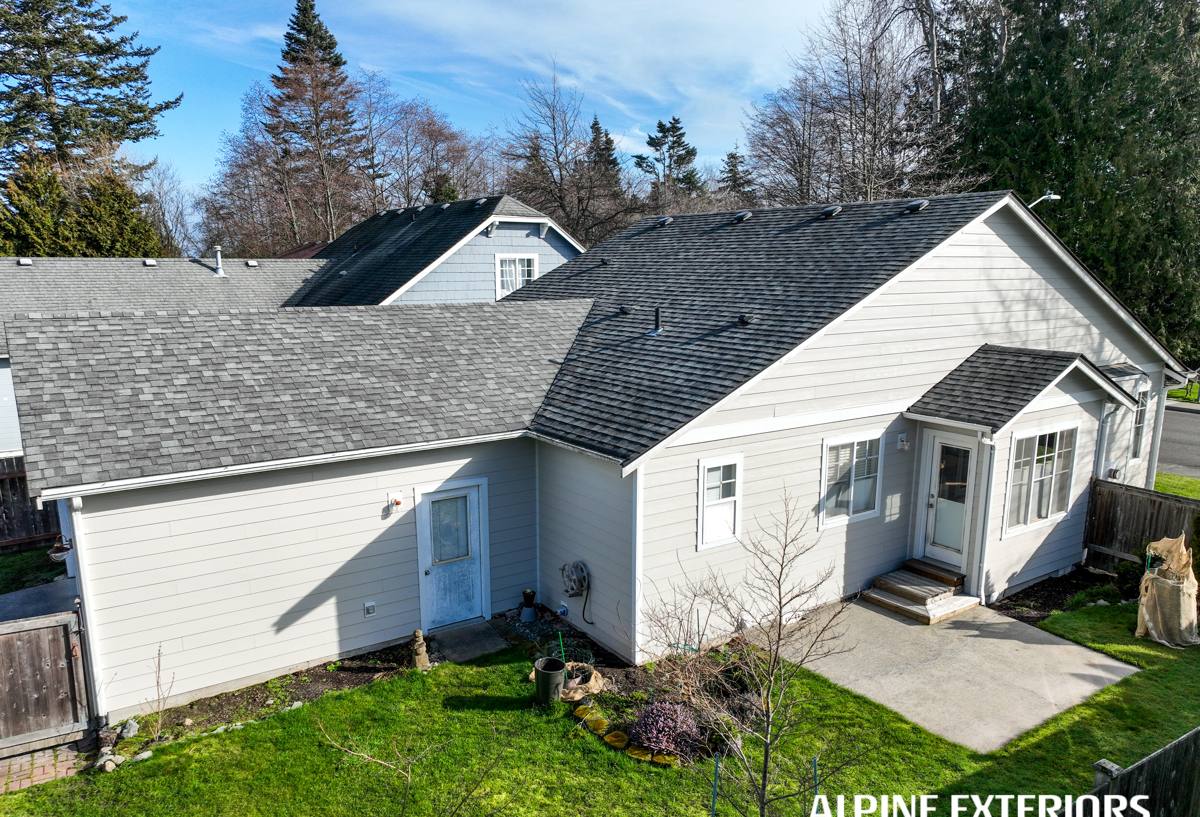
Why Material Choice Matters More Here Than in Drier Climates
Every siding material handles moisture differently, and in a climate like Sudden Valley's, that difference shows up fast. Wood-based products need consistent paint maintenance to keep water out of the fibers. Vinyl doesn't rot, but it can warp, fade, and doesn't hold paint if a homeowner ever wants to change the look. Engineered wood products depend heavily on correct installation and diligent caulking and painting to keep moisture out of the edges and seams — skip a maintenance cycle in a wet climate like this one, and problems compound quickly.
We made a deliberate decision as a company to install only James Hardie fiber cement siding. We don't install vinyl, LP SmartSide, Cemplank, Allura, primed spruce, or cedar. That's not a knock on every homeowner who has one of those products on their house today — plenty of them are maintained well and hold up fine. It's a statement about what we're willing to put our name behind, on homes that sit in one of the wetter, mossier climates in the state.
What Fiber Cement Does Differently
James Hardie siding is non-combustible fiber cement — it doesn't absorb water the way wood or wood-based products do, and it doesn't warp or soften from repeated wet-dry cycles the way some engineered products can if a seam or cut edge is compromised. It's also dimensionally stable, meaning it doesn't expand and contract with moisture the way wood fiber does, which matters in a climate where a wall assembly might go from soaked to sunny and back again multiple times in a single week during shoulder seasons.
ColorPlus Finish and the Maintenance Question
One of the biggest practical differences homeowners notice with James Hardie's ColorPlus factory finish is how much less repainting it needs compared to field-painted wood or engineered siding. In a climate with a long moss season and near-constant humidity, that matters — every repaint cycle is a chance for moisture to get behind the material if it's not done exactly right, and it's an ongoing cost most homeowners would rather not budget for every few years. ColorPlus finish is baked on at the factory under controlled conditions, which gives it more consistent adhesion and fade resistance than a field-applied coat, especially on a house that gets shaded, damp exposure for much of the year.
Beyond Siding: The Full Exterior Envelope
Siding doesn't work in isolation. On a Sudden Valley property, the roof, windows, and even decking all interact with the same moisture load, and problems in one area often show up as damage in another. We handle siding, roofing, windows, and decks as one connected system rather than treating each as a separate trade, because that's how water actually moves through a house.
- Roofing: a roof that's shedding water properly, with clean flashing and gutters that aren't overwhelmed by moss and debris, keeps water away from the top of the siding and fascia where a lot of hidden rot starts.
- Windows: window flashing and trim details are one of the most common points where water gets behind siding, regardless of what siding material is installed. Correct integration matters as much as the siding itself.
- Decks: ledger board connections and any decking that ties into the house wall need the same moisture-management thinking as the siding above them — a poorly flashed ledger is a slow, hidden leak waiting to happen.
What Correct Installation Looks Like
Fiber cement siding performs the way it's supposed to only when it's installed to the manufacturer's specifications — proper clearances off the ground and roofline, correct fastener placement, properly caulked and painted cut edges, and flashing details that actually direct water away from the wall rather than trapping it. In a climate that gives water every opportunity to find a weak point, installation quality is the difference between siding that lasts decades and siding that causes callbacks within a few years.
This is also where hiring locally pays off. A crew that works in Whatcom County day in and day out has installed siding through actual Sudden Valley winters, not just read a spec sheet. They know which walls on a shaded, tree-covered lot need extra attention to ventilation and flashing, and they're not guessing at how the local climate behaves.
What to Ask Before You Hire
- Are they manufacturer-certified or specifically trained on the siding system they're installing?
- Do they carry current liability insurance and workers' compensation coverage?
- Will they provide a written scope of work, not just a verbal estimate?
- How do they handle flashing at windows, doors, and deck ledgers — can they explain their approach, not just say "we'll seal it"?
- What's the warranty structure, and is it transferable if you sell the home?
Cost Factors to Understand
Siding replacement cost depends on more than square footage. The table below outlines the main variables that move a project's price up or down, so a quote makes sense in context rather than as a single number.
| Factor | Why It Matters |
|---|---|
| Existing siding removal | Tear-off and disposal of old wood, vinyl, or damaged siding adds labor and dump fees before new material goes up. |
| Underlying sheathing condition | Rot or water damage found once old siding comes off may need repair before new siding can be installed properly — common in wet climates like this one. |
| Home shape and trim detail | Multiple gables, dormers, and trim-heavy elevations take more time to flash and finish correctly than a simple rectangular footprint. |
| Product line and profile | Hardie's various plank widths, textures, and colors carry different material costs. |
| Access and site conditions | Steep lots, tree cover, and limited equipment access — common around Lake Whatcom properties — can affect labor time. |
Signs It's Time to Look at Your Siding
Homeowners on Yew Street and elsewhere in Sudden Valley don't need to wait for visible failure to start the conversation. A few early indicators are worth a closer look:
- Persistent green or black staining on siding, especially on shaded or north-facing walls
- Paint that's peeling, bubbling, or chalking well before its expected repaint cycle
- Soft spots, or siding that flexes when pressed at the bottom edges near grade
- Visible gaps or separation at seams, corners, or trim boards
- Musty odors near exterior walls inside the home, which can indicate moisture intrusion
How We Approach a Sudden Valley Project
We start with an honest look at the existing exterior — siding, but also the roofing, window flashing, and any decking tied into the wall — because a siding-only fix on a house with an unrelated moisture source doesn't hold up long in this climate. From there we walk through material options, but since we only install James Hardie fiber cement, that part of the conversation is straightforward: which Hardie product line and profile fits the home's design, what color options make sense, and what the HZ climate-engineered formulation means for a property that sees this much rain and shade.
We also talk through realistic timelines and what to expect during tear-off, especially if there's a chance we'll find sheathing issues once old siding comes down. No homeowner should be surprised mid-project by a problem that could have been flagged up front.
If you're weighing a siding project on Yew Street or anywhere else in Sudden Valley, we're happy to take a look and talk through what we're seeing — no pressure, no obligation. The estimate form below is the easiest way to get started.