 Sudden Valley Siding
 Storm Damage Looks Different Around Lake Whatcom
Homes around Lake Whatcom sit inside a tree canopy, on sloped lots, and close to open water that funnels wind in ways a flat subdivision roof never has to deal with. When a storm rolls through Whatcom County, the damage on a Sudden Valley roof is rarely one clean, obvious problem. It's usually a mix of things: a few shingles peeled back on the windward side, a limb strike that cracked but didn't puncture the deck, flashing that worked loose around a chimney or skylight, and moisture that's already started working its way into a seam nobody noticed yet. Add in marine air pushing inland from Bellingham Bay, near-constant moisture from fall through spring, and a moss season that can run most of the year in the shaded lots near the water, and you've got a roof that ages differently than one on the dry side of the county.
Storm damage repair here isn't just "find the hole and patch it." It's understanding how wind, water, and organic growth interact on this specific kind of lot, and fixing the problem in a way that holds up through the next round of weather, not just until the next inspection.
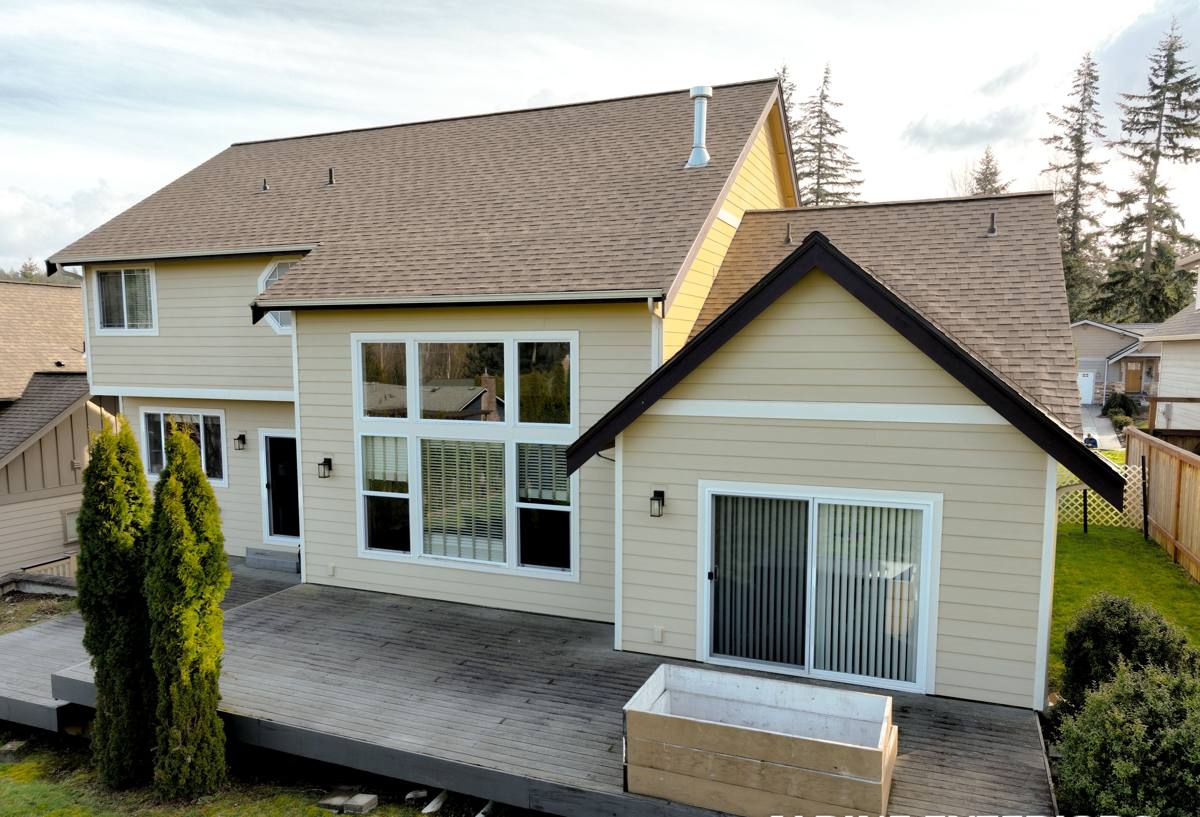
What Actually Counts as Storm Damage
Homeowners often assume storm damage means a visibly torn-off section of roof. Most of the calls we get are less dramatic than that, but just as serious if left alone.
Common types we see after wind and rain events
- Shingles lifted, creased, or torn loose at ridges, edges, and valleys where wind uplift is strongest
- Granule loss from wind-driven rain, which shows up as bald spots and shortens the shingle's remaining life
- Flashing pulled away or bent at chimneys, skylights, and roof-to-wall intersections
- Limb and debris impact from the fir and cedar cover common around the lake, sometimes cracking decking without breaking through
- Fastener back-out, where nails work loose under repeated wind flex and shingles start to chatter or lift
- Moss and debris damming water in valleys and behind chimneys, which isn't "storm damage" in the classic sense but often turns a minor storm event into a leak
A lot of this is invisible from the ground. That's why an honest inspection after a significant wind or rain event matters more than waiting for a stain to show up on the ceiling.
Why Local Experience Matters for This Kind of Repair
Lake and canopy exposure
A roof tucked under fir and cedar on a Lake Whatcom lot holds moisture longer than an open roof in town. Repairs that don't account for that — sealing things up tight without addressing drainage and airflow — can trap moisture instead of shedding it. We look at the whole system, not just the damaged spot, because a patch that ignores the surrounding moss and shade conditions tends to fail again within a season or two.
Access and lot conditions
Sloped, wooded lots around the lake often mean tighter staging areas, longer ladder runs, and more care needed around landscaping and septic systems than a typical in-town job. A crew that already works this area knows what to expect before the truck even shows up, which keeps the job efficient and keeps your property intact.
Whatcom County code and permitting
Most storm damage repairs are minor enough not to trigger a permit, but larger repairs — especially anything involving structural decking or a significant percentage of the roof surface — can fall under county requirements. We know when a repair crosses that line and handle it correctly instead of guessing.
What a Correct Storm Damage Repair Involves
A repair done right isn't just swapping out the shingles you can see. Here's what we actually check and address:
Inspection
We walk the roof (or use a lift/drone where walking isn't safe) and check not just the obviously damaged area but the surrounding field, valleys, penetrations, and the underside of the decking where accessible from the attic.
Decking and structure
If a limb or heavy wind event cracked or soaked the plywood or board decking underneath, replacing shingles over damaged decking just hides the problem. We check for soft spots, delamination, and water staining before closing anything up.
Underlayment and moisture barrier
In a wet climate like ours, what's under the shingle matters as much as the shingle itself. Ice-and-water shield at valleys, eaves, and penetrations, and a synthetic or felt underlayment across the field, are what keep a small future leak from becoming a bigger one.
Flashing
Flashing failures cause more slow, hidden leaks than missing shingles do. We re-set or replace flashing at every intersection disturbed by the repair — chimneys, skylights, walls, and valleys — rather than caulking over a bent piece and calling it done.
Shingle matching
We match the existing shingle profile and color as closely as the manufacturer's current lineup allows. Older roofs sometimes have discontinued colors or profiles; when that's the case, we'll tell you honestly what your options are rather than promising an invisible match we can't deliver.
Our Process for Lake Whatcom Storm Repairs
- Contact and initial assessment — you describe what happened or what you noticed, and we schedule a look, prioritizing active leaks and safety hazards.
- On-site inspection and documentation — we photograph the damage from the roof and, where relevant, the attic, so you have a clear record for your own files or an insurance claim.
- Emergency mitigation if needed — for active leaks or exposed decking, we tarp or dry-in the area to stop further damage before the full repair is scheduled.
- Written scope and estimate — you get a plain-English explanation of what's damaged, what needs to be done, and what it costs, before any work starts.
- Repair — decking, underlayment, flashing, and shingles addressed in the correct order, not just the visible layer.
- Final walk-through — we show you what was done and flag anything else worth keeping an eye on, like moss buildup or aging flashing nearby that wasn't part of this repair.
Repair or Replace? What Actually Drives That Decision
Not every storm-damaged roof needs a full replacement, and not every roof that "just needs a patch" should get one. The honest answer depends on a handful of factors:
| Factor | Points Toward Repair | Points Toward Replacement |
|---|---|---|
| Age of roof | Under 10-12 years, most shingle types | Nearing or past manufacturer-rated lifespan |
| Extent of damage | Isolated area, single slope or section | Widespread across multiple slopes |
| Decking condition | Solid, dry, no rot found | Soft spots, delamination, or repeated past leaks |
| Shingle availability | Current profile/color still made | Discontinued line, poor match likely |
| Moss/moisture history | Managed, minimal growth | Heavy, longstanding moss with trapped moisture |
| Insurance scope | Claim covers targeted repair | Adjuster scopes full replacement |
We'll give you a straight recommendation based on what we actually find — not the answer that happens to be the bigger invoice.
Working With Your Insurance Claim
Storm damage repair often overlaps with a homeowners insurance claim, and having clean documentation makes that process go a lot smoother. A few things worth doing on your end:
- Photograph any visible exterior damage yourself as soon as it's safe to do so, before repairs begin
- Note the approximate date and type of storm event (high wind, heavy rain, falling debris)
- Keep any tarping or temporary repair invoices — insurers often reimburse mitigation costs separately
- Ask your adjuster directly whether they're scoping a repair or a full replacement, and get that in writing
- Get a written contractor estimate that itemizes decking, underlayment, flashing, and shingle work separately, not a single lump sum
We're happy to provide documentation and meet an adjuster on-site if that helps your claim move faster, but we work for you, not the insurance company.
Moss, Moisture, and the Long Game
A one-time storm repair fixes the immediate problem, but around Lake Whatcom, moss and standing moisture are often what set the stage for storm damage to matter more than it would elsewhere. Moss holds water against the shingle surface, degrades the mat underneath over time, and dams water in valleys right where wind-driven rain is already testing your flashing. Part of a proper repair is looking at whether moss growth or poor drainage contributed to the damage, and telling you honestly whether a simple cleaning and gutter check now saves you a bigger repair call after the next storm.
Why It Matters That We Already Work This Area
A contractor who only shows up in Sudden Valley when there's storm damage to chase doesn't know the shade patterns, the typical decking age for this part of the county, or which flashing details tend to fail first on lakeside lots. We work in this area regularly, which means we're not learning the terrain on your dime, and we're not disappearing once the check clears. Storm damage repair is exterior work, and roof, flashing, fascia, and siding all meet at the same edges — so a crew that understands the whole envelope, not just shingles in isolation, catches problems a roof-only outfit can miss.
If you've had a recent storm come through and want an honest look at your roof — whether that's a quick check for peace of mind or a real repair — reach out for a free, no-pressure estimate using the form below.