 Sudden Valley Siding
 Why Cordata's Location Puts Extra Stress on Siding
Homes in the Cordata area deal with three climate stresses at once, and most siding products are only built to handle one or two of them well. There's salt-laden marine air moving through Whatcom County off the water, long stretches of driving, wind-pushed rain rather than gentle vertical rainfall, and a moss-and-algae season that stretches across most of the year thanks to mild, wet winters and heavy tree cover. Any one of those is manageable. All three together, decade after decade, is what actually determines whether a siding job still looks and performs the way it should ten or twenty years after install day.
Salt Air and Corrosion
Marine air carries fine salt particles further inland than most homeowners expect, and it doesn't take direct waterfront exposure to feel the effect. Salt accelerates corrosion in fasteners, metal flashing, and trim connectors, and it breaks down paint film and caulk faster than it would in a dry inland climate. When those small components fail first, water finds its way behind the siding long before the siding itself shows obvious damage.
Driving Rain and Wind-Driven Moisture
Rain in this part of western Washington rarely falls straight down. Wind pushes it sideways into wall assemblies, which means siding can't just be "face-sealed" and left to shed water off the surface. If there's no real drainage path behind the cladding, wind-driven rain gets forced past seams, laps, and trim joints, and the moisture problem starts on the sheathing side where nobody can see it until it's already serious.
The Long Moss Season
Shaded lots, tree cover, and mild wet winters add up to an extended moss and algae season. Moss holds moisture directly against a wall surface far longer than open sun and wind exposure would allow. For any material that isn't dimensionally stable and fully protected on every surface, that constant dampness is exactly the condition that starts rot, delamination, or coating failure.
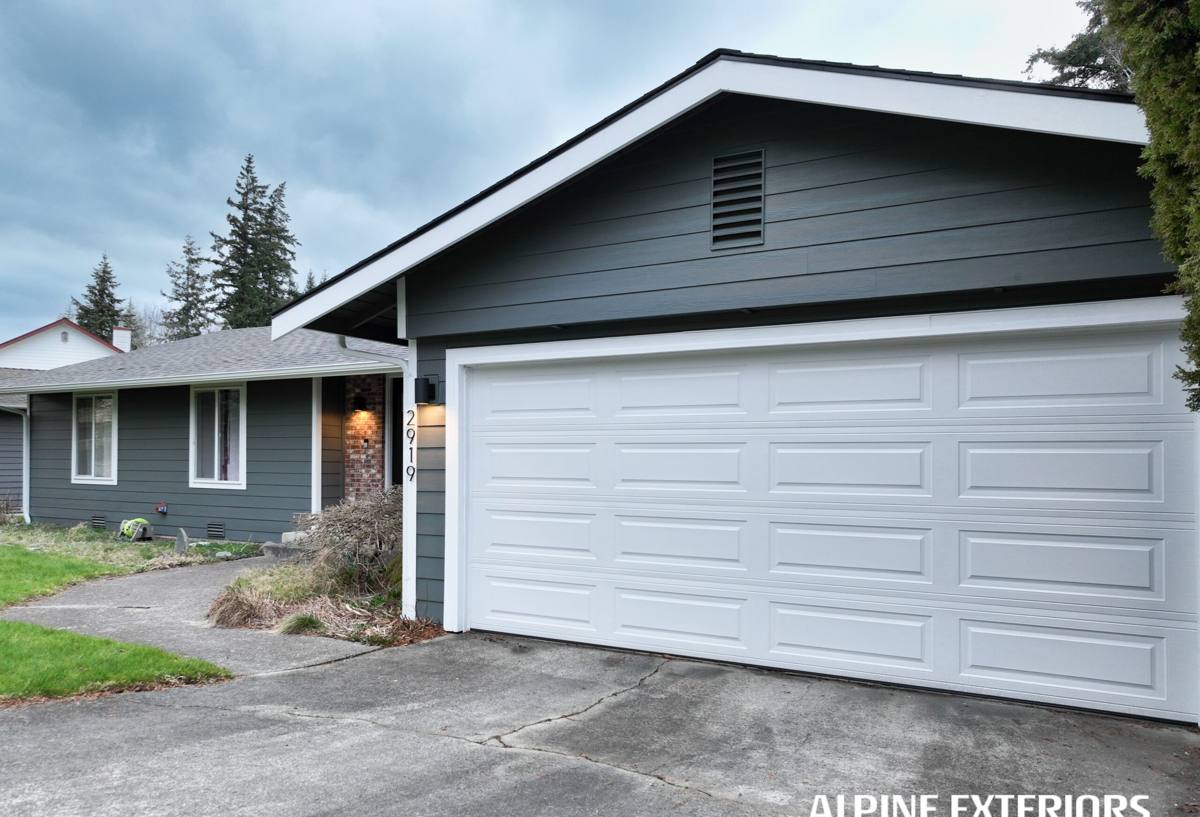
What a Correct Siding Installation Has to Get Right Here
Product choice matters, but installation quality is what actually determines whether a house stays dry. A correct job in this climate isn't about a few extra caulk beads — it's a system, and every layer of that system has to do its job for the whole wall assembly to hold up.
Weather-Resistive Barrier and a Real Rain Screen Gap
Behind the siding, a continuous weather-resistive barrier needs to be lapped correctly, shingle-style, so water always drains down and out rather than pooling at a seam. In a climate with this much wind-driven rain, a drainage gap between the barrier and the siding — a true rain screen — gives any moisture that does get past the cladding somewhere to go besides straight into the wall.
Flashing at Every Penetration and Transition
Windows, doors, deck ledgers, hose bibs, light fixtures, roof-to-wall transitions — every one of these is a place where water pressure concentrates and where a shortcut shows up as a leak years later. Flashing has to be integrated with the weather-resistive barrier in the correct order, not just caulked over the top of finished siding as an afterthought.
Fasteners and Fastening Pattern
Given how much corrosion accelerates near salt air, fastener selection isn't a place to save money. Corrosion-resistant fasteners, driven at the manufacturer's specified pattern and depth, keep panels secure and keep small metal failures from becoming the reason water gets behind the wall.
Why We Install Only James Hardie Fiber Cement
We standardized on James Hardie siding and don't install vinyl, LP SmartSide, or other fiber cement brands. That's not a marketing position — it's a decision based on what actually holds up under the conditions described above. Hardie's fiber cement is non-combustible, dimensionally stable when it gets wet, and finished at the factory with ColorPlus coating rather than relying entirely on a job-site paint job to hold color and protect the substrate for years in damp, shaded conditions.
Built for This Specific Climate: HZ5
Hardie engineers its products by climate zone, and Whatcom County falls into the HZ5 category — built for regions with damp, moisture-heavy conditions and freeze-thaw cycling rather than for hot, humid Southern exposure. That's a meaningful distinction: a product engineered for the wrong climate zone can perform worse here even if it's the same general material family. Installing the version actually engineered for this environment isn't a minor detail — it's the whole point of matching product to place.
How Hardie Compares to Other Siding Options Here
No siding material is perfect everywhere, but some hold up to Whatcom County's specific combination of salt air, driving rain, and moss exposure better than others. Here's how the major categories compare on the factors that actually matter in this climate.
| Factor | James Hardie Fiber Cement | Vinyl Siding | Wood / Engineered Wood |
|---|---|---|---|
| Moisture behavior | Dimensionally stable; doesn't swell, rot, or warp when wet | Doesn't absorb moisture, but can trap it behind panels if installed poorly | Absorbs moisture; prone to swelling and rot without diligent maintenance |
| Moss/algae resistance & cleanability | Hard, stable surface; tolerates soft-washing without damage | Resists staining but can crack or discolor under pressure washing | Porous surface holds moss and algae; harder to clean without damaging finish |
| Fire resistance | Non-combustible | Combustible; can melt or deform near heat | Combustible |
| Color retention | Factory-baked ColorPlus finish resists fading and chalking | Color is through-body but can fade and chalk over time | Requires repainting/restaining on a recurring schedule |
| Fastener/trim corrosion sensitivity | Low, when correct fasteners are used | Low, but panels rely on trim pieces that can crack | Higher; corroded fasteners can streak and stain wood siding |
| Typical warranty structure | Long, transferable manufacturer warranty on the substrate and finish | Varies widely by manufacturer and thickness | Limited or no meaningful material warranty |
Our Siding Installation Process for Cordata Homes
Every job follows the same disciplined sequence, because skipping a step is exactly how water problems get built into a wall for the next twenty years.
- On-site assessment. We walk the exterior, check for existing moisture damage, and note the exposures that matter most — which walls take the worst wind-driven rain, which stay shaded and moss-prone.
- Tear-off and sheathing inspection. Old siding comes off and the sheathing underneath gets inspected before anything new goes up. Hidden rot or soft spots get addressed here, not covered over.
- Weather-resistive barrier and rain screen installation. The barrier is lapped correctly and a drainage gap is built in so any moisture that does get past the cladding has somewhere to drain.
- Flashing and trim integration. Every window, door, and penetration gets flashed and integrated into the barrier system before siding installation begins.
- Hardie panel or plank installation. Installed to manufacturer specification — correct fastener type, spacing, and clearances — not just "close enough."
- Caulking, touch-up, and cleanup. Seams get sealed where specified, ColorPlus touch-up is applied where needed, and the site is cleaned of debris and old material.
- Final walkthrough. We go over the finished work with the homeowner before calling the job done.
Cost Factors for Siding Replacement in This Area
Every home is different, so we won't quote a number without seeing the house, but these are the variables that actually move the price on a Cordata siding job.
| Cost Factor | Why It Matters |
|---|---|
| Home size and total wall area | More square footage means more material, labor, and fastening time |
| Tear-off vs. installing over existing siding | Full tear-off adds labor and disposal cost but allows sheathing and barrier repair underneath |
| Hidden sheathing or rot repair | Moisture-damaged sheathing found during tear-off has to be repaired before new siding goes on |
| Trim and architectural detail | Homes with more corners, gables, and window/door trim take longer to flash and finish correctly |
| Plank vs. panel product selection | Different Hardie profiles carry different material and installation costs |
| Factory ColorPlus finish vs. field paint | Factory-finished product costs more up front but avoids a full repaint cycle later |
Keeping Hardie Siding Performing After Installation
A correct installation does most of the work, but a small amount of upkeep keeps siding performing at its best through Whatcom County's wet winters and mossy shoulder seasons.
- Soft-wash north-facing and shaded walls periodically to keep moss and algae from establishing
- Check caulk lines at windows, doors, and trim joints once a year and re-seal any that have cracked or pulled away
- Keep gutters clear and make sure downspouts direct water away from the foundation and walls, not down the siding face
- Trim back vegetation and tree limbs that shade walls and restrict airflow
- Watch for chalking or fading on older paint-finished trim and address it before it becomes a bare-wood exposure
- Have flashing at penetrations and roof-to-wall transitions checked every few years, especially after major wind events
Warning Signs Worth a Call
Bubbling or peeling paint near seams, soft spots when you press on siding near the bottom of a wall, persistent moss that comes back within weeks of cleaning, and staining below windows or trim are all worth having looked at before they turn into a larger repair.
Why a Crew That Already Works Cordata and Sudden Valley Matters
A contractor who already works in this part of Whatcom County knows which walls on a typical local lot take the worst of the wind-driven rain, which sides stay shaded long enough to grow moss fastest, and how to detail flashing accordingly instead of applying a generic approach to every elevation. That familiarity also extends to local permitting expectations and inspection standards, and to having an established relationship with Hardie product supply so color-matched trim and touch-up material are available when they're needed — not back-ordered for weeks. None of that replaces a correct installation, but it's the difference between a crew guessing at local conditions and one that's already accounted for them.
If you're weighing a siding replacement for a home in the Cordata area, we're happy to take a look and put together a free, no-pressure estimate — just fill out the form below.