 Sudden Valley Siding
 Sehome's Weather Is Harder on Siding Than It Looks
Sehome sits in the same marine climate belt that shapes every home around Sudden Valley and the rest of Whatcom County: salt-tinged air moving in off the water, rain that comes in sideways more often than straight down, and a stretch of gray, damp months long enough to grow moss on almost anything that holds still. None of that is dramatic weather. It's the slow, steady kind that doesn't break a house in one storm — it wears down whatever siding is on the wall, one wet season at a time.
That's the context we install in every day. A siding choice that looks fine in a showroom or performs well in a drier climate can behave very differently after a decade of this. Understanding what the climate actually does to a wall is the first step in choosing siding that's still doing its job in twenty years, not just in year one.
Salt Air and Metal Fasteners
Airborne salt accelerates corrosion on anything metal — nails, flashing, house wrap staples, trim fasteners. Over time, corroding fasteners loosen their grip, and a siding system is only as good as what's holding it to the wall. This is one of the reasons fastener choice and fastening pattern matter as much as the siding material itself in this area.
Wind-Driven Rain and Wall Assemblies
Rain that hits a wall at an angle behaves differently than rain that falls straight down. It gets pushed into laps, seams, and butt joints instead of simply running off. A siding system built for this climate needs to shed that water at every horizontal and vertical joint, not just tolerate it on the face of the panel.
Moss, Mildew, and North-Facing Walls
Shaded, north-facing walls in this region can stay damp for days after a storm passes. That's exactly the environment moss, algae, and mildew need to take hold. Siding material that absorbs moisture gives these organisms something to grow on and into; siding that doesn't hold water gives them nothing to work with.
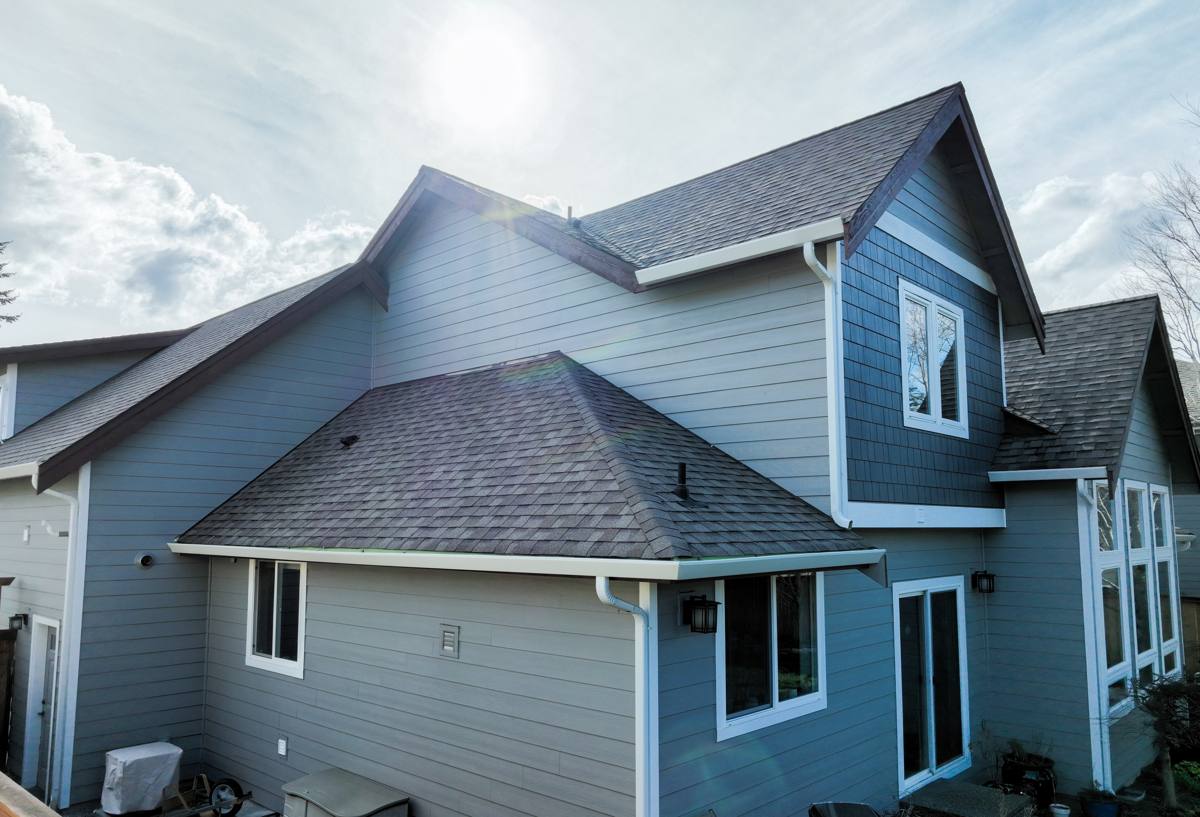
Why We Standardized on James Hardie for This Climate
We install James Hardie fiber cement siding exclusively — not vinyl, not LP SmartSide, not cedar, not other fiber cement brands. That's not a marketing position; it's a decision built around what actually holds up in Whatcom County's weather.
Hardie's siding is engineered from cement, sand, and cellulose fiber. It doesn't absorb water the way wood-based products can, it doesn't soften or warp in prolonged damp conditions, and it's non-combustible. Hardie also builds region-specific product lines under its HardieZone system — HZ5 for colder, drier climates and HZ10 for warmer, wetter, more humid regions like the Pacific Northwest coast. HZ10 formulations are engineered specifically to resist the kind of moisture cycling Sehome sees for months at a stretch.
The factory-applied ColorPlus finish is part of that equation too. It's baked on under controlled conditions rather than brushed or sprayed on site, which means better adhesion and a finish that resists fading, chipping, and the kind of surface breakdown that gives moss and mildew a foothold. A finish that stays intact is a wall that's harder for organic growth to colonize.
What a Correct James Hardie Install Looks Like Here
Buying the right material is only half the job. Fiber cement siding installed without attention to local conditions can still underperform — trapped moisture and poor flashing detail cause problems regardless of what's on the outside of the wall. In a climate like this, a handful of details matter more than they would somewhere drier.
A Working Weather-Resistive Barrier
Every wall gets a code-compliant weather-resistive barrier behind the siding, lapped correctly at every seam so water is directed out and down rather than into the sheathing. In an area that gets driving rain as often as Sehome does, this layer is doing real work, not just satisfying an inspection checklist.
Proper Fastening
Hardie publishes specific fastener requirements — type, length, spacing, and placement — for different exposure conditions. We follow those specs rather than treating fastening as an afterthought, because in a coastal-influenced climate, fastener corrosion is one of the most common causes of siding failure that has nothing to do with the siding material itself.
Flashing and Joint Details
Butt joints, window and door transitions, and anywhere two planes of the wall meet are where water intrusion actually starts. Correct flashing at these points — installed before the siding goes on, not caulked over afterward as a substitute — is what keeps wind-driven rain from finding its way behind the panel.
Clearance and Drainage
Siding installed too close to grade, decks, or roof lines traps moisture against the bottom edge of the panel. We maintain proper clearances and drainage paths so water has somewhere to go instead of sitting against the siding.
Our Process for a Sehome Project
Every job starts with a walk-around of the existing exterior, not just a measurement of square footage. We're looking at where moisture has historically collected, which walls take the worst of the wind-driven rain, where moss has been recurring, and what condition the sheathing and framing are in underneath the current siding. That assessment shapes the install plan — it tells us where extra attention to flashing and drainage is worth it.
From there: removal of the old siding, inspection and repair of any water-damaged sheathing or framing found underneath (this is common on homes that have carried moisture-absorbent siding for years), installation of the weather barrier, and then the Hardie siding itself, fastened and flashed to spec. We finish with trim, caulking at the joints that need it, and a cleanup that leaves the site as clear as we found it.
We also work around the calendar this climate imposes. Fiber cement can be installed in cooler, damper conditions more forgivingly than some materials, but we still plan installation windows around active rain rather than fighting it, both for the quality of the work and for keeping the site dry during the process.
How James Hardie Compares for This Climate
| Factor | James Hardie Fiber Cement | Vinyl | Wood / Engineered Wood (cedar, LP SmartSide) |
|---|---|---|---|
| Moisture absorption | Does not absorb water; won't swell or rot | Doesn't absorb water, but seams and panels can flex and gap over time | Absorbs moisture; prone to swelling, rot, and delamination if the finish fails |
| Salt air / corrosion resistance | Material itself doesn't corrode; fasteners matter | Material doesn't corrode; hardware can | Vulnerable if moisture reaches the wood fiber |
| Moss and mildew resistance | Factory finish resists surface growth | Can trap moisture behind panels, encouraging growth | Organic material; readily hosts moss and mildew if damp |
| Fire resistance | Non-combustible | Combustible; can melt or ignite | Combustible |
| Typical warranty structure | Long-term, transferable manufacturer warranty on material | Varies widely by product tier | Often limited or finish-only warranties |
No material is immune to this climate. The difference is how much ongoing maintenance and risk each one carries once it's on the wall for a decade or more.
What Drives Cost on a Sehome Project
Every home is different, so we don't quote sight unseen — but the same handful of factors move the price on nearly every job:
- Square footage of wall area and the home's overall complexity (corners, gables, dormers)
- Condition of the sheathing and framing once the old siding comes off
- Amount of trim, fascia, and detail work involved
- Siding profile and ColorPlus color selection
- Site access and staging conditions
- Whether existing paint, caulking, or old fasteners need to be dealt with as part of tear-off
We won't give a number until we've actually looked at the house, but we're upfront about the range of what a fiber cement replacement typically involves before we ever get to a formal estimate.
Maintenance That Actually Matters Here
James Hardie siding is low-maintenance, not no-maintenance — and in a climate like Sehome's, a little attention goes a long way.
- Rinse siding periodically, especially shaded or north-facing walls, to keep moss and algae from establishing
- Keep gutters clear so overflow doesn't run down the face of the siding
- Trim back vegetation that keeps a wall shaded and damp longer than it needs to be
- Check caulking at trim and joints every couple of years and replace it if it's cracked or pulling away
- Address any small chips or fastener issues early, before moisture gets behind the panel
Signs a Home's Existing Siding Needs Attention
- Soft spots, bubbling, or visible warping in the siding
- Moss or dark streaking that comes right back after cleaning
- Paint that won't hold or peels within a year or two of repainting
- Visible gaps at trim or joints where wind-driven rain could get behind the panel
- Rising heating bills that suggest moisture is compromising wall insulation
Why Local Experience Matters for This Job
A siding crew that mainly works drier inland climates doesn't always plan flashing, drainage, and fastening the same way a crew that works Whatcom County's coastal weather every week does. Knowing which walls in this area take the worst of the driving rain, how long the moss season really runs, and how salt-influenced air treats hardware over time isn't something you get from a manufacturer's install manual alone — it comes from doing this work here, repeatedly, and seeing what holds up.
That's the standard we hold every Sehome and Sudden Valley project to: install James Hardie the way it's engineered to be installed, adjusted for what this specific climate actually does to a house.
If your home in Sehome or the surrounding Sudden Valley area needs new siding, we're happy to take a look and walk you through what we'd recommend — no pressure, no obligation. Use the form below to request a free estimate.