 Sudden Valley Siding
 Why Lake Whatcom's Climate Is Tough on Roofs
Homes around Lake Whatcom sit in one of the shadier, damper corners of Whatcom County. Heavy tree cover along the shoreline, humidity that hangs over the water, and the long stretch of low-angle rain that runs from fall through spring all add up to conditions that are hard on any roofing material — and unforgiving of a roof that wasn't detailed correctly the first time. The broader Whatcom County region also sits close enough to Bellingham Bay and the Puget Sound that salt-laden marine air moves through on a regular basis, adding a corrosion factor to the moisture problem that inland climates simply don't deal with.
Moss Is the Long-Term Threat
The tree canopy that makes Lake Whatcom and Sudden Valley such a nice place to live is also what feeds a long moss season. Needles and leaf litter collect in valleys and around vents, hold water against the roof surface, and give moss and algae exactly the foothold they need. On asphalt shingles, moss works into the granule surface and lifts tabs over a few seasons. On a poorly detailed metal roof, the same debris traps water against seams and fasteners instead of letting it drain the way it's supposed to.
Driving Rain and Wind-Blown Water
Rain here doesn't always fall straight down. Wind moving across the lake and through the surrounding valley pushes water sideways into laps, seams, and flashing details that were never built to take that kind of pressure. A roof that would hold up fine in a drier part of the state can start leaking within a few seasons here if the underlayment, flashing, and fastening weren't planned around wind-driven rain from day one.
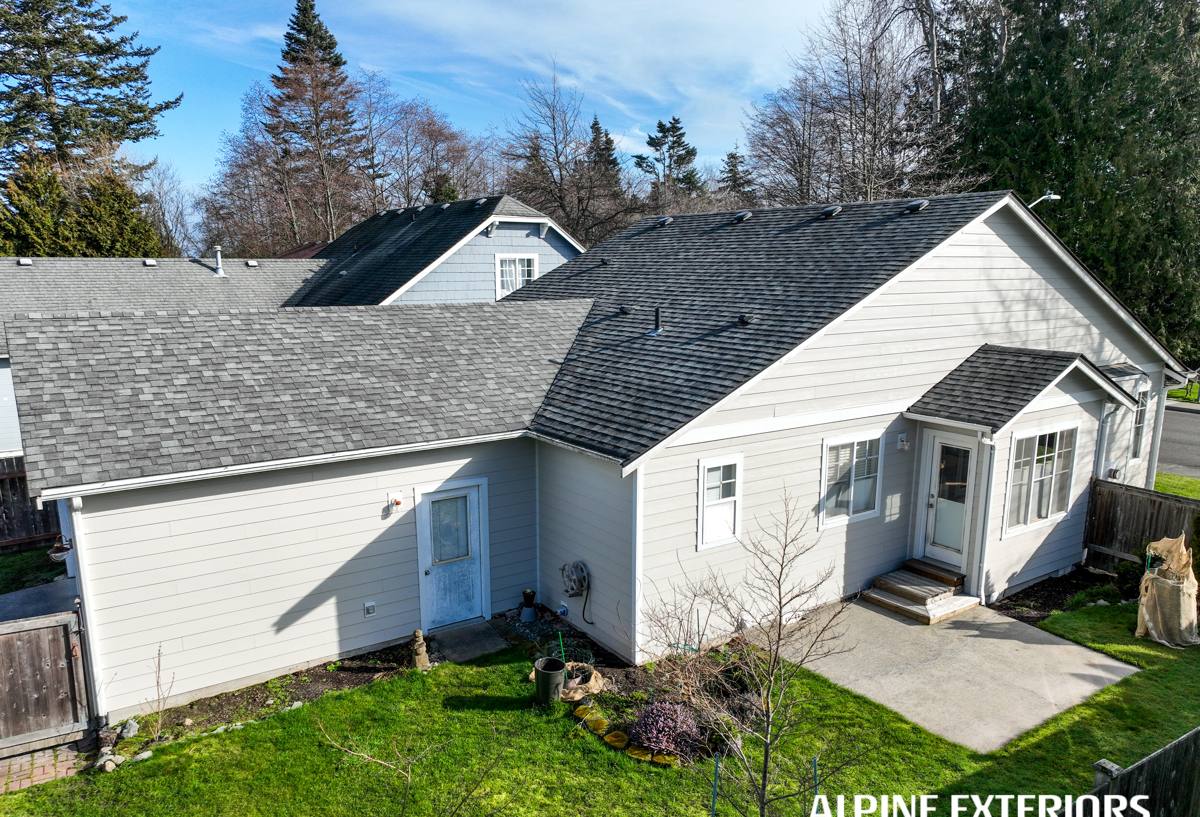
Why Metal Roofing Makes Sense Here
Metal isn't the right call for every home or every budget, but for the conditions around Lake Whatcom it solves several problems at once. It sheds needles, moss spores, and standing water instead of holding onto them the way a textured shingle surface does. It has no organic mat or granule layer for algae to colonize, so moss has a much harder time taking hold even in deep shade. It handles the freeze-thaw swings of our shoulder seasons without the cracking and granule loss that ages asphalt roofs early. And most quality metal systems carry finish warranties in the 30-to-50-year range, against 20-to-30 for asphalt, so it's a roof you're not likely to be replacing again while you own the house.
That doesn't mean metal is maintenance-free — it still needs clear valleys, sound sealant at penetrations, and an occasional check of fasteners or seams, which we cover further down. What it does is remove the single biggest recurring failure point we see on Lake Whatcom homes, which is organic buildup slowly breaking down the roof surface itself.
What a Correct Metal Roof Installation Actually Involves
Metal roofing is unforgiving of shortcuts in a way that shingles sometimes aren't. Get the details below wrong and the panels themselves can be fine while the roof still leaks.
Underlayment Comes First
A synthetic, high-temperature underlayment (or self-adhered ice-and-water membrane at eaves, valleys, and penetrations) goes down over clean, properly prepared decking before a single panel is set. This is the roof's real waterproofing layer — the metal on top is the shield, but the underlayment is what actually keeps the house dry if wind ever drives water up under a seam.
Flashing Is Where Roofs Actually Fail
Valleys, chimneys, skylights, and wall-to-roof transitions are where the overwhelming majority of roof leaks start, on metal or shingles alike. Flashing has to be formed and layered correctly, not just caulked and hoped for — sealant is a backup, not the primary defense. Around a shaded, moisture-heavy lake property, we pay particular attention to valleys and any spot where debris is likely to pile up against a flashing edge.
Fastening and Panel Movement
Metal expands and contracts more than most people realize across a Washington year's temperature swing. Exposed-fastener panels need the right screw pattern and neoprene washers seated correctly, replaced on a maintenance cycle since washers are the first thing to age. Standing seam systems use concealed clips that let the panel float as it moves, which is part of why they hold up longer with less ongoing attention.
Ventilation Still Matters
A tight, well-flashed metal roof over a poorly ventilated attic can trap moisture underneath instead of keeping it out — condensation on the underside of cold metal is a real issue in a humid, shaded environment like this one. Ridge and soffit venting, or a properly designed vented assembly, has to be part of the plan, not an afterthought bolted on after the panels are up.
Choosing the Right Panel System
There isn't one "correct" metal roof for every Lake Whatcom home — the right system depends on the roof's pitch, the home's style, and the budget. Here's how the common options compare for this climate specifically:
| Panel Type | Fastener Exposure | Typical Lifespan | Relative Cost | Best Fit |
|---|---|---|---|---|
| Standing seam | Concealed clips, no exposed screws | 40-60+ years | Highest | Steep or complex rooflines, long-term owners, maximum leak resistance |
| Exposed-fastener (5V, corrugated, ribbed) | Screws through the panel face | 25-40 years with washer replacement | Moderate | Simple gable roofs, budget-conscious projects, outbuildings |
| Stone-coated steel | Concealed or partially exposed, varies by profile | 30-50 years | Moderate to high | Homeowners who want a shake or tile look with metal's performance |
For most primary residences around the lake, we lean toward standing seam or a quality stone-coated system, since the concealed-fastener designs age better under the amount of shade and moisture this area gets. Exposed-fastener panels can still be the right call on a simpler roof or a tighter budget — the tradeoff is a maintenance schedule that has to actually be kept.
Our Process for a Lake Whatcom Roof
The steps don't change much from job to job, but the details we watch for do, given what this climate does to a roof:
- On-site inspection. We check the decking, existing ventilation, valley and flashing condition, and how much shade and debris load the roof actually deals with before recommending a system.
- Tear-off or prep. Old roofing comes off down to sound decking wherever code and condition require it; any soft or water-damaged sheathing gets replaced rather than covered over.
- Underlayment and ice/water membrane. Installed at eaves, valleys, and every penetration before panels go down.
- Panel layout and installation. Panels are run and fastened to spec for the profile chosen, with attention to expansion allowance and consistent seam alignment.
- Flashing, trim, and penetrations. Formed and layered at every valley, wall transition, vent, and chimney — the step that determines whether the roof actually stays dry.
- Cleanup and walkthrough. Site cleared of debris and fasteners, and we walk the finished roof with you so you know what to watch for going forward.
Repair or Replace? Reading the Signs
Not every issue on an aging roof means a full replacement, and we'd rather tell you that up front than sell a job you don't need.
| Situation | Repair Usually Makes Sense | Replacement Usually Makes Sense |
|---|---|---|
| Leak source | Isolated to one flashing detail or penetration | Multiple, spread across different parts of the roof |
| Fasteners | A section of aged or backed-out screws on an otherwise sound panel roof | Widespread washer failure across most fastener rows |
| Panels | Isolated denting or a single damaged panel | Rust-through, or panels near the end of their coated finish life |
| Underlying deck | Decking is dry and sound where inspected | Decking shows rot, soft spots, or repeated water staining |
If your current roof is asphalt and simply nearing the end of its service life, that's also a natural point to consider switching to metal rather than replacing like-for-like — especially on a Lake Whatcom lot with heavy tree cover, where the next asphalt roof will face the same moss pressure as the last one.
Keeping a Metal Roof Performing in This Climate
A well-installed metal roof needs far less attention than shingles, but "less" isn't "none." A simple seasonal routine goes a long way here:
- Clear needles and leaf litter from valleys and around penetrations at least once a year, more often on heavily treed lots
- Keep gutters and downspouts flowing freely so water isn't backing up under the eave edge
- Trim back branches that overhang the roof to cut down on debris load and reduce impact risk during storms
- Do a visual check of exposed fasteners or sealant at penetrations every year or two, and after any major windstorm
- Watch for any dark streaking or moss starting in shaded valleys — catching it early is a five-minute cleaning job instead of a repair
- After any significant wind event, look for lifted panel edges or displaced flashing rather than waiting for a leak to show up inside
Why Hiring a Crew That Already Works Lake Whatcom Matters
A roofer who mostly works drier, less-shaded parts of Whatcom County can still put up a technically fine metal roof and have it underperform here, simply because they're not used to designing for this much moss pressure and wind-driven rain. Working Lake Whatcom and Sudden Valley regularly means we already know which valley and flashing details need extra attention on a shaded, tree-heavy lot, how local permitting and inspection typically goes, and what to expect from the private roads and driveway access that come with a lot of properties around the lake.
It also means we're close by if a question comes up after the job is done — not a crew that has to drive across the county to look at a warranty item. For a community like Sudden Valley, where many homes share similar exposure and lot conditions, that local track record is worth more than a lower bid from someone unfamiliar with what this climate actually does to a roof over time.
If you're weighing a metal roof for a Lake Whatcom home — or just want an honest read on whether your current roof needs repair or replacement — we're happy to take a look and put together a free, no-pressure estimate using the form below.