 Sudden Valley Siding
 Siding Built for a Lake Whatcom Winter, Not Just a Lake Whatcom Summer
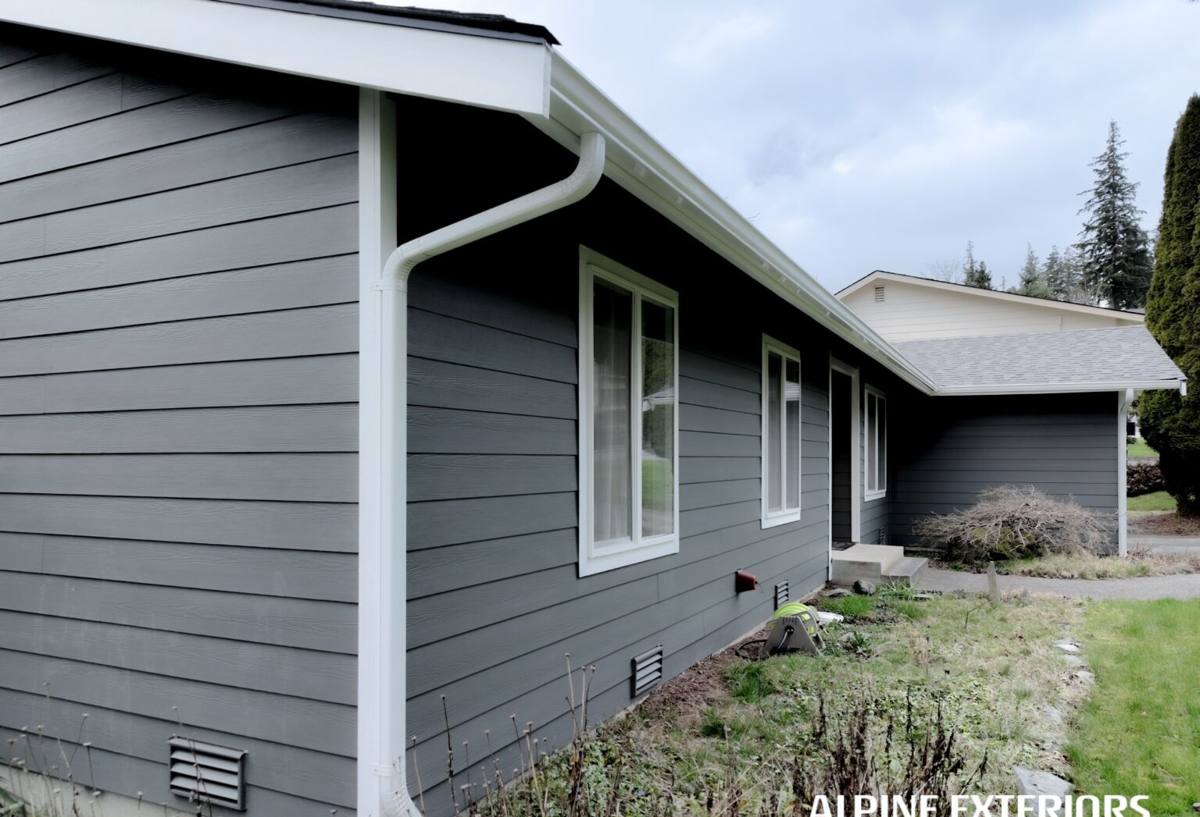
Sudden Valley sits in a pocket of Whatcom County that looks easy on siding in July and is hard on it the other nine months of the year. Homes here deal with driving rain off the water, damp air that never fully dries out between storms, and shade pockets under fir and cedar canopy where moss and algae get a head start every fall. Add the marine air that moves inland from Bellingham Bay and the greater Puget Sound region, and you've got a climate that punishes any siding material with a weak moisture story. We install fiber cement siding for homes around Lake Whatcom because it's the one product we trust to hold up to all of that without babysitting.
This page is specifically about fiber cement siding for the Lake Whatcom / Sudden Valley area — not a general overview. If you live here, this is what actually matters for your house.
What This Climate Actually Does to Siding
Before talking about the product, it helps to understand the failure pattern we see repeatedly on older homes in this area:
- Moss and algae staining on north-facing and tree-shaded walls that never get direct sun to dry them out
- Swelling and soft spots at butt joints and lower courses where wood-based or composite sidings absorb standing moisture
- Paint and finish failure years ahead of schedule because the substrate underneath is wicking water instead of shedding it
- Caulk joints that crack and open from repeated wet-dry, freeze-thaw cycling through the shoulder seasons
- Fascia and trim rot that starts small and spreads before anyone notices, because it's happening behind the paint film
None of this is unique to any one brand of siding — it's what a wet, shaded, marine-influenced climate does to any material that isn't engineered for it. The difference is how well a given product resists it, and how forgiving it is when a caulk joint eventually fails or a gutter overflows during a heavy rain event.
Why Fiber Cement Is the Right Call Here
James Hardie fiber cement is a cement-and-cellulose composite, not a wood product and not a plastic one. That matters in a moss-and-rain climate for a few concrete reasons:
It doesn't rot
Fiber cement has no organic wood fiber for fungus to feed on the way solid wood or wood-based composite panels do. Moss and algae can still grow on the surface in shaded, damp spots — that's a cleaning issue, not a structural one — but the board itself isn't decomposing underneath the growth.
It's dimensionally stable
Wood and wood-composite sidings expand and contract with moisture content, which is exactly what stresses caulk joints and paint film in a climate that swings between soaked and dry all winter. Fiber cement moves far less with moisture, so joints and finish hold up longer between maintenance cycles.
The factory finish is part of the system
Hardie's ColorPlus finish is baked on at the factory under controlled conditions, not brushed or sprayed on-site in whatever weather window a crew can find. In an area where you might get three dry days in a row in November, that's not a small advantage — it's the difference between a finish that's cured properly and one that's still trying to cure while it's already getting rained on.
It's non-combustible
Not a Lake Whatcom-specific issue day to day, but worth noting for anyone thinking about wildfire exposure and insurance considerations that increasingly factor into siding choice across the Pacific Northwest.
What a Correct Fiber Cement Install Looks Like Here
Fiber cement is only as good as the install behind it. In a wet climate, the details that get skipped on a rushed job are exactly the details that cause callbacks two winters later.
Weather-resistive barrier and flashing first
The siding is the last line of defense, not the only one. A correct install starts with a properly lapped weather-resistive barrier, flashed and taped window and door openings, and kick-out flashing anywhere a roof line meets a wall — a detail that's easy to skip and expensive to fix once water's found its way behind the siding.
Proper clearances
Hardie specifies minimum clearances between the bottom of the siding and roof lines, decks, patios, and grade. In a climate with this much standing moisture and splash-back potential, we don't shave those clearances to make a job look tighter — it's the first place rot starts on a home that otherwise looks fine.
Fastening and joint treatment to spec
Correct fastener type, placement, and joint treatment (factory-primed and painted joints, proper caulk selection, or Hardie's engineered joiners) all affect how the assembly sheds water over the following years. This is the kind of thing that's invisible on install day and very visible five years later if it's done wrong.
Ventilation behind the cladding
A drainage plane or rainscreen gap behind the siding gives incidental moisture somewhere to go besides sitting against the sheathing. On a shaded, damp lot like a lot of Sudden Valley properties, that airflow is what keeps a wall assembly drying out between storms instead of staying saturated all winter.
How We Approach a Lake Whatcom Job
- On-site assessment — we look at sun exposure, tree canopy, roof lines, existing moisture damage, and drainage around the foundation before quoting anything
- Product and line selection — matching the right Hardie plank, panel, or shingle profile and HZ climate engineering to your specific exposure
- Tear-off and substrate check — we don't side over hidden rot; sheathing gets inspected and repaired before anything new goes up
- Water management install — barrier, flashing, and drainage details done to spec, not shortcuts
- Siding installation — correct clearances, fastening, and joint treatment throughout
- Walkthrough — we go over what maintenance actually looks like for your home's specific exposure before we leave
Why It Matters That We Already Work This Neighborhood
A crew that only shows up in Sudden Valley once a year quotes off a general spec sheet. A crew that works this side of Whatcom County regularly knows which elevations on a typical lake-area home take the worst weather, where moss builds fastest under the tree cover, and which older homes in the area were built with clearances and flashing details that don't hold up to current conditions. That's not a marketing line — it changes what we look for during the estimate and what we flag before we ever start tearing anything off.
It also means we're not learning the local permitting and inspection process on your project. Working repeatedly in the same part of the county means fewer surprises and fewer delays once work starts.
Fiber Cement vs. What We Don't Install, for This Climate Specifically
| Factor | James Hardie Fiber Cement | Vinyl | Wood / Wood-Composite |
|---|---|---|---|
| Moisture behavior | Dimensionally stable, doesn't rot | Doesn't rot, but can warp and gap in temperature swings | Absorbs moisture; prone to rot without diligent maintenance |
| Moss/algae staining | Surface growth only, cleanable | Surface growth only, cleanable | Growth can mask underlying rot |
| Finish durability in low-sun areas | Factory-cured ColorPlus finish holds up well | Color is through-body but can fade or chalk | Field-applied paint fails faster in constant damp shade |
| Long-term maintenance | Periodic wash, repaint on a long cycle | Low maintenance, but damage isn't repairable, only replaceable | Regular inspection, caulking, and repainting required |
| Fire resistance | Non-combustible | Combustible, can deform under heat | Combustible |
We install James Hardie exclusively. This table isn't meant to trash the alternatives — vinyl and wood both have legitimate use cases — it's meant to explain honestly why, for this specific climate, we standardized on one product and stand behind it.
What Homeowners Should Check Before Hiring Anyone for This Work
- Are they a certified or factory-trained Hardie installer, or just someone who's handled the boards before
- Do they inspect and repair sheathing before siding over it, or just cover what's there
- Will they detail flashing and clearances in writing, not just verbally
- Do they carry current liability insurance and, where required, bonding for exterior work in Whatcom County
- Can they explain why they'd flag a specific wall or elevation on your home as higher risk
- Do they offer a warranty that covers workmanship, separate from the manufacturer's material warranty
Maintenance That Actually Fits This Area
Fiber cement is low-maintenance, not no-maintenance. For a Lake Whatcom property, that realistically means an annual rinse of shaded and north-facing walls to knock back moss and algae growth before it stains the finish, keeping gutters clear so water isn't sheeting down the siding face, and a visual check of caulk joints and trim each fall before the wet season sets in. None of that requires a contractor — it's a homeowner task — but it's worth doing consistently, because it's what stretches the years between any repaint or touch-up work.
Ready to Talk About Your Home
If you're weighing a full re-side or planning ahead for one, we're happy to walk your property, look at your specific sun and moisture exposure, and give you a straight answer on what it'll take. Reach out for a free, no-pressure estimate — there's a form right below this page.