 Sudden Valley Siding
 Why Board & Batten Suits Lake Whatcom Homes
Walk or drive the roads around Lake Whatcom and you'll see why board and batten keeps showing up on remodels and new builds alike. The vertical lines read as cabin, modern farmhouse, and Pacific Northwest lake-house all at once, and they pair well with the mix of tree-shaded lots, stone or timber accents, and steep rooflines common to the area. It's also a practical choice for homes tucked against forest canopy: the strong vertical shadow lines stay legible even in the low, filtered light you get under a stand of Douglas fir, where a flatter lap profile can look muddy from a distance.
But board and batten is not a "set it and forget it" siding style. It has more seams, more fastener penetrations, and more places for water to find its way behind the cladding than a standard lap profile. Around Lake Whatcom, where the weather doesn't give siding many dry stretches to recover in, those details matter more than they would somewhere drier.
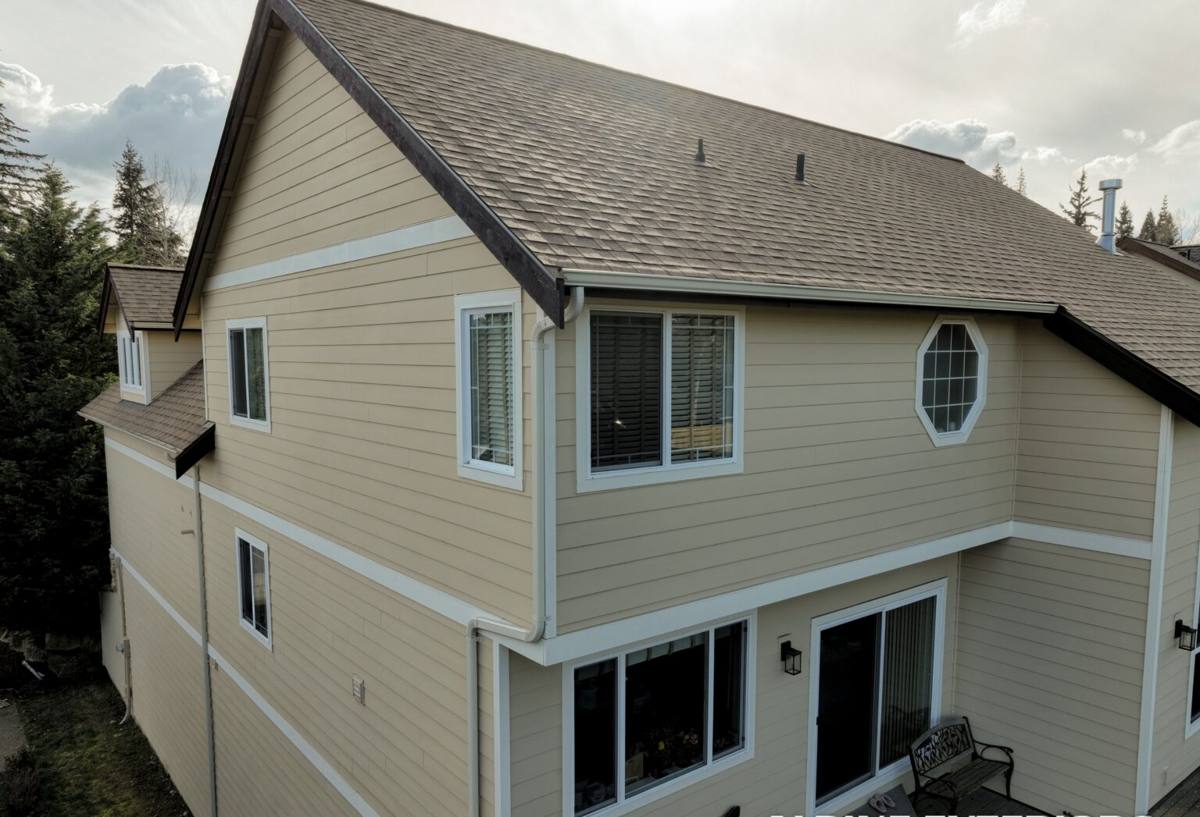
What This Climate Actually Does to Vertical Siding
Whatcom County sits in a spot where several weather patterns stack on top of each other. Air moving in off the Sound carries a fine load of salt that settles on exterior surfaces over time, especially on homes with any wind exposure. Layer on top of that the driving, sideways rain that comes through in fall and winter storms, and you've got moisture getting pushed into joints and laps that a calmer climate would never test. Then there's shade — a lot of homes around the lake sit under mature conifers, and that shade plus the ambient humidity off the water adds up to a long moss and algae season that can run most of the year on north-facing walls.
Why Board & Batten Feels This More Than Lap Siding
Every batten strip is a fastening line, and every fastening line is a place where the substrate underneath gets penetrated. Done right, those penetrations are backed by proper flashing and a drainage plane that lets any water that does get in find its way back out. Done wrong — battens fastened directly through both layers into sheathing without a rainscreen gap, or caulk used as the primary water management strategy instead of flashing — moisture gets trapped exactly where it can't dry, and that's where you start seeing swelling, staining, and eventually rot at the sheathing level, not just the siding.
What a Correct Board & Batten Installation Involves
There's a real difference between siding that looks like board and batten and siding that's built to perform as board and batten in a wet climate. The details that matter aren't visible once the job is done, which is exactly why they get skipped by crews trying to move fast.
- A weather-resistive barrier installed and lapped correctly, with all seams taped
- A drainage gap (rainscreen) behind the panel so water that gets past the outer layer can drain and the wall can dry
- Proper flashing at every horizontal transition — window and door heads, roof-to-wall intersections, and any deck or porch ledger connections
- Battens fastened into framing, not just sheathing, with a fastening pattern that matches the manufacturer's engineering specs for the wind exposure at the lake
- Correct gapping and sealant at panel joints, sized for the material's expansion and contraction
- Base of wall detailing that keeps splash-back and standing moisture away from the bottom course
None of that shows up in a photo of the finished wall. It shows up five, ten, and twenty years later — either as a wall that's still tight and dry, or one that's rotting from the inside while the paint still looks fine.
Why We Install Board & Batten in James Hardie Fiber Cement Only
We get asked fairly often about board and batten in other materials — engineered wood panels, vinyl board-and-batten systems, or primed cedar. We don't install any of them, and it's worth explaining why rather than just saying no.
Engineered wood and primed wood products depend on their paint or primer layer staying intact to keep moisture out of the substrate. In a climate with this much sustained rain and shaded, slow-drying wall sections, any breach in that coating — a nail pop, a hairline crack, a spot the caulk missed — becomes an entry point for water into a substrate that swells and deteriorates once it's wet. Vinyl board and batten sidesteps rot but has its own limits: it can't hold the crisp, deep shadow lines that make the style work visually, it's more vulnerable to impact and UV fading over time, and it isn't rated for the kind of fire resistance we want on homes near forested lots.
James Hardie fiber cement is what we standardized on because it holds up to this specific set of problems. It's non-combustible, which matters for homes with wildland-urban interface exposure around a tree-lined lake. It doesn't swell or rot the way wood-based products can if a detail fails. And it comes with a factory-applied ColorPlus finish that's baked on and warranted against fading and peeling — which matters when you've got salt air and UV both working against a painted surface. We're not saying other products can't be installed correctly by someone; we're saying we've made a professional call about which material gives our board and batten installations the best odds of still looking and performing right in twenty years.
How We Approach a Lake Whatcom Board & Batten Project
1. On-Site Assessment
We look at wall exposure, tree cover, existing moisture damage, and how water currently moves around the home — gutters, downspouts, grading, and roof runoff all affect how a board and batten wall will perform once it's up.
2. Tear-Off and Substrate Check
Old siding comes off and we inspect the sheathing underneath. Around the lake, this step regularly turns up water damage that wasn't visible from outside, especially near windows, decks, and roof-to-wall intersections. Any compromised sheathing gets addressed before anything new goes up — covering over a wet wall just locks the problem in.
3. Weather Barrier and Rainscreen
We install and tape the weather-resistive barrier, then build in a drainage gap behind the panel. This is the single biggest factor in how a board and batten wall handles a wet climate long-term.
4. Flashing at Every Transition
Windows, doors, roof lines, and any wall penetrations get properly flashed before the siding goes on — not caulked after the fact.
5. Panel and Batten Installation
Hardie panels and battens go up per manufacturer fastening specs, with correct joint gapping and sealant. Fastener spacing accounts for the wind exposure typical of open lake-facing walls.
6. Finish and Walkthrough
We check caulking, trim, and paint lines, then walk the job with the homeowner so they know what to expect from the finish over the first year of weather exposure.
Cost Factors for a Board & Batten Project Around the Lake
Board and batten generally costs more per square foot to install than standard lap siding because of the extra material (two layers instead of one continuous plane) and the added labor for correct fastening and flashing at every batten line. Actual pricing depends on the specifics of your home, but these are the factors that move the number most:
| Factor | Why It Affects Cost |
|---|---|
| Wall condition underneath | Rot or moisture damage found during tear-off adds sheathing repair before new siding can go on |
| Home height and roofline complexity | Steep or multi-story walls near the lake often need more scaffolding and safety setup |
| Panel vs. batten ratio and reveal size | Wider battens or tighter spacing mean more material and more fastening lines |
| Trim and detail work | Window and door surrounds, corner boards, and transitions to stone or timber accents add labor |
| Access and tree clearance | Wooded lots common around Lake Whatcom sometimes need branch clearance or careful staging |
| Color and finish | Factory-finished ColorPlus panels cost more upfront than field-painted but remove a recurring maintenance cost |
We'll always give you a real number for your specific home rather than a rule-of-thumb estimate — too much of the cost depends on what we find once the old siding comes off.
Living With Board & Batten in a Moss-Prone Climate
Once it's installed correctly, a Hardie board and batten wall doesn't need much from you — but a few habits go a long way in a climate that stays damp this much of the year:
- Keep gutters clear so roof runoff isn't sheeting down onto siding or pooling at the base of a wall
- Trim back branches and brush that keep a wall in constant shade and slow — it never fully dries
- Rinse north-facing and shaded walls periodically to keep moss and algae from building up on the surface
- Check caulking at panel joints and trim every year or two, since sealant is the one component that does wear over time
- Watch for any staining or soft spots at the base of the wall, which can signal a drainage or flashing issue worth catching early
None of this is heavy maintenance — it's the kind of upkeep any exterior in this climate needs, board and batten or otherwise. The difference is that a correctly installed Hardie wall gives moss and moisture far fewer places to actually cause damage while you keep up with it.
Why It Matters That We Already Work This Area
Board and batten performance comes down to details that are specific to a site — how exposed a wall is to wind off the lake, how much shade it sits under, how the roof sheds water onto it. A crew that's worked homes around Lake Whatcom repeatedly has already seen how those conditions play out over years, not just at installation. That shows up in small decisions: where we add extra flashing attention, how we detail a wall that sits under heavy tree cover, and what fastening pattern makes sense for a lake-facing exposure versus a sheltered one. It also means we're familiar with the permitting and inspection process in Whatcom County, so there are no surprises partway through the job.
If you're weighing board and batten for a home near Lake Whatcom, we're glad to walk the property with you, look at what's there now, and talk through what a correct installation would involve for your specific walls and exposure — no pressure, no obligation. Fill out the form below and we'll set up a time to take a look.