 Sudden Valley Siding
 Fairhaven Sits in a Different Weather Lane Than Our Home Turf
Our crew is based in Sudden Valley, inland along Lake Whatcom, but a good share of our repair calls take us west into Fairhaven, down on Bellingham Bay. It's the same county — Whatcom — and the same wet Pacific Northwest weather machine, but the exposure profile is not the same. Inland at Sudden Valley, siding damage tends to come from tree cover, shade-driven moss, and lake-effect humidity. Out in Fairhaven, closer to open water, homes take on salt-laden air, wind-driven rain that hits siding sideways instead of straight down, and a longer stretch of the year when north-facing and shaded walls simply never fully dry out. That combination is harder on siding, harder on fasteners and trim, and it changes what a "correct" repair actually looks like.
This page is about one thing specifically: siding repair on Fairhaven homes. Not a full re-side, not a general climate primer — the actual work of diagnosing and fixing damaged fiber cement siding on a coastal-influenced Whatcom County home, and doing it in a way that holds up rather than becoming a callback in two years.
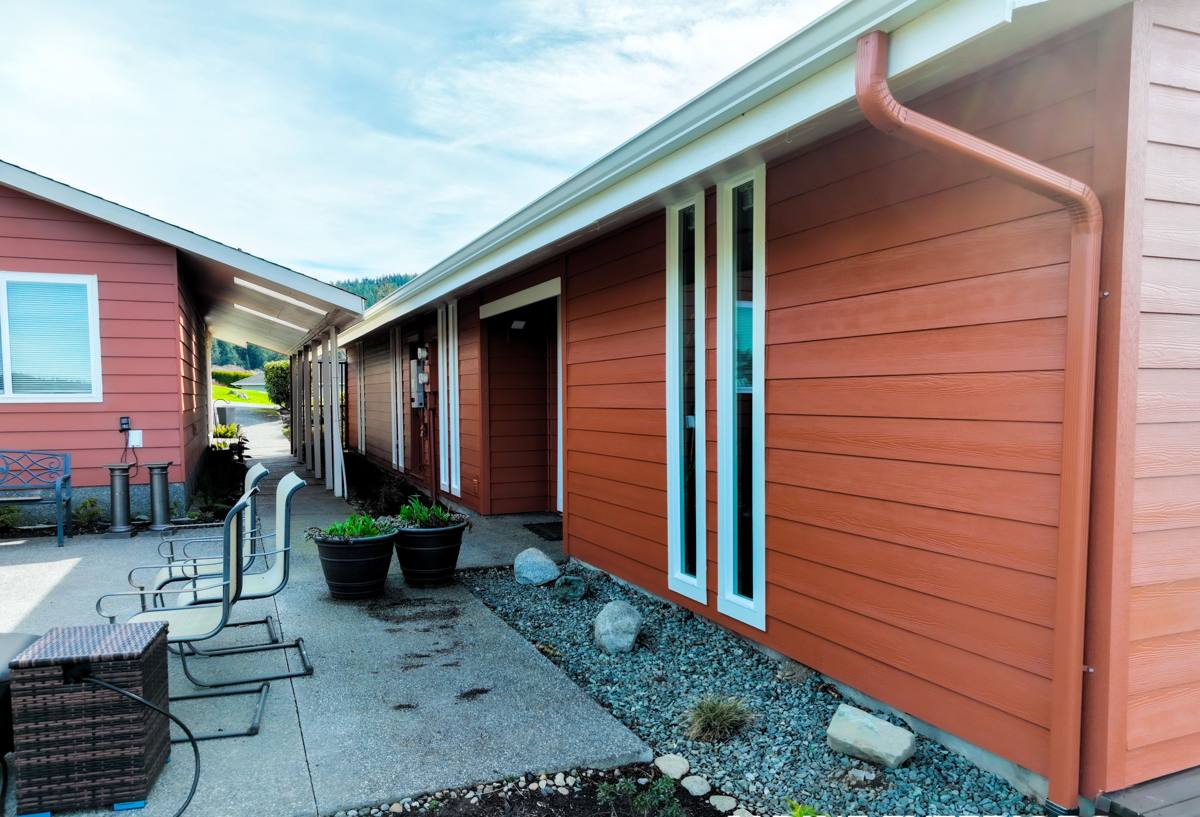
What Salt Air, Driving Rain, and Moss Season Do to Siding
Three separate stressors show up on Fairhaven siding, often at the same time on the same wall:
- Salt air: Airborne salt from the bay accelerates corrosion on exposed fasteners, flashing, and any metal trim. A siding panel can look fine while the nail or screw holding it has already started to fail underneath.
- Driving rain: Wind off the water pushes rain into laps, seams, and butt joints that would stay dry in a calmer inland spot. Any gap in caulking or flashing becomes a water entry point much faster here than it would a few miles inland.
- Moss season: Whatcom County's long wet stretch, roughly fall through spring, keeps shaded and north-facing walls damp for weeks at a time. Moss and algae hold moisture against the siding surface, which is exactly the condition that causes rot at butt joints and bottom edges if the siding isn't sealed and detailed correctly.
None of these are dramatic, one-time events. They're slow, cumulative wear — which is why siding problems in this area tend to get discovered late, after moisture has already reached the sheathing behind the siding, not just the surface.
Signs a Fairhaven Home Needs Siding Repair
Most calls we get start with something small the homeowner noticed and decided to have looked at. Worth checking for:
- Soft or spongy spots when you press on siding, especially near the bottom courses and around windows and doors
- Visible gaps, cracking, or separation at butt joints and corner trim
- Persistent moss or algae staining that comes back quickly after cleaning
- Rust streaking below nail heads or trim fasteners
- Paint or ColorPlus finish that's peeling, bubbling, or flaking in one localized area rather than evenly across the whole wall
- A musty smell or visible staining on interior walls that back up to an exterior wall showing exterior damage
- Warped, bowed, or visibly out-of-plane siding panels
Localized problems like these are usually a repair, not a full re-side — but only if they're caught before the damage spreads into the sheathing and framing behind the siding.
What a Correct Repair Actually Involves
A siding repair that's done right is not just "replace the bad board and caulk the edges." On a coastal-exposed home, cutting that corner is how the same spot fails again in a season or two. Our process on a repair call:
1. Diagnose Before Touching Anything
We remove enough siding around the visibly damaged area to see what's actually happening underneath — house wrap condition, sheathing moisture, flashing at windows and penetrations, fastener corrosion. Surface damage is often a symptom of a smaller problem further back, and repairing only what's visible without checking behind it is how water damage gets sealed in rather than fixed.
2. Address the Water Path, Not Just the Symptom
If the damage traces back to a flashing gap, a failed caulk joint, or a housewrap tear, that gets corrected first. Replacing siding over an unfixed water entry point buys a homeowner a year or two, not a durable fix.
3. Match Material and Finish
Because we install James Hardie fiber cement exclusively, repairs on a Hardie home get matched with the correct Hardie profile, plank width, and, where possible, a ColorPlus factory finish that's a close match to the existing siding. On older installs where the exact ColorPlus color has been discontinued or the existing siding has field paint on it, we'll walk through the honest options — closest factory match, or repainting the repaired section and adjacent field to blend.
4. Detail for the Exposure
On bay-facing and wind-exposed walls, that means correct fastener type and placement, properly lapped and sealed joints, and flashing detailed to shed wind-driven rain rather than just vertical rain. This is where a lot of repair shortcuts show up years later — the patch looks fine on installation day, but was never really built for the wind direction it's exposed to.
5. Clean Up and Verify
We check that the repaired section drains and dries correctly, confirm the surrounding siding wasn't disturbed or damaged during the work, and leave the site clean.
Repair or Replace? How to Think About It
Not every damaged section needs a full re-side, but a full re-side is sometimes the more honest answer than another localized patch. Here's the general framework we use when we're standing in front of a Fairhaven wall:
| Factor | Repair Usually Makes Sense | Replacement Usually Makes Sense |
|---|---|---|
| Extent of damage | Isolated to one or two wall sections | Spread across multiple elevations or the whole home |
| Sheathing condition | Sound once exposed | Soft, rotted, or damaged over a wide area |
| Siding age and material | Newer Hardie install, matchable finish | Old, discontinued material or product we won't warranty a patch into |
| Underlying water intrusion | Single identifiable source, correctable | Multiple failure points suggesting systemic issues |
| Cosmetic uniformity | Patch will blend acceptably | Patch will always visibly mismatch the field |
We'll always tell you plainly which side of that table your home is on. A repair we don't stand behind isn't worth doing.
Why We Only Repair With James Hardie Fiber Cement
We install and repair exclusively with James Hardie products — we don't work in vinyl, LP SmartSide, Cemplank, Allura, or bare cedar or primed spruce. On a repair job specifically, that has real practical consequences worth being upfront about:
- Consistency of material: If your home already has Hardie siding, a Hardie repair matches the panel profile, thickness, and expansion behavior exactly. Mixing in a different fiber cement brand or a different material entirely creates a seam that moves and weathers differently than the original.
- ColorPlus finish: James Hardie's factory-applied ColorPlus finish is baked on and warranted separately from field paint. Where we can match it, a repair holds its color and resists fading the same way the rest of the wall does, instead of becoming the one obviously repainted patch.
- Non-combustible, moisture-resistant substrate: Fiber cement doesn't absorb and swell with water the way wood-based siding products can, which matters directly in a climate where sections of a wall stay damp for weeks at a stretch.
- Climate-engineered product lines: James Hardie's HZ product system is engineered for regional moisture and temperature conditions, which is part of why we don't substitute in a product line that wasn't built for the Pacific Northwest's wet cycle.
We understand other products have their own advantages — vinyl and LP SmartSide are typically less expensive up front, and each has homeowners who are happy with them. Our decision to install and repair only Hardie is a standard we hold, not a claim that other materials can't function. For our crew and the way we warranty our work, fiber cement — specifically Hardie — is what we're willing to put our name behind in this climate.
What Drives the Cost of a Repair
Every repair is different, so we won't quote a number without seeing the wall, but these are the factors that typically move a repair estimate up or down:
| Cost Factor | Why It Matters |
|---|---|
| Accessibility | Second-story or hard-to-reach sections take more setup time (scaffolding, lifts) |
| Hidden damage extent | Sheathing or framing repair adds labor and material beyond the visible siding |
| Color/finish matching | Discontinued ColorPlus colors may require repainting a broader section to blend |
| Number of separate repair areas | Multiple isolated spots cost more in aggregate setup than one contiguous area |
| Trim and flashing scope | Repairs that include window/door flashing correction take more time than a siding-only patch |
How Our Process Works, Start to Finish
- Initial look and estimate: We walk the affected area, take measurements, and give you an honest read on repair versus replacement.
- Written scope: You get a clear description of what's being repaired, what materials are used, and what the work does and doesn't include.
- Scheduling around the weather: Because Fairhaven's wet season runs long, we schedule repair work for windows with a reasonable dry stretch — patching fiber cement and sealing joints properly requires dry material and dry conditions.
- The repair itself: Removal, diagnosis, correction of the underlying issue, and installation of matched Hardie material, done to manufacturer installation specifications.
- Final walkthrough: We review the completed work with you before we consider the job done.
Why a Crew That Already Works Fairhaven and Sudden Valley Matters
Siding repair is detail work, and the details that matter change with the neighborhood. A crew that mostly works dry, inland, low-wind sites can do a technically fine repair that still isn't detailed for wind-driven rain off the bay. Because we regularly work both our home base in Sudden Valley and out toward Fairhaven, we see the difference between the two conditions directly — which fastener corrosion looks like after a few salt-air seasons, which wall orientations hold moss longest, and where a "good enough" repair on an inland home would actually fail on a bay-facing wall. That's not a marketing point, it's just what shows up in the diagnosis when you've done the comparison enough times.
After the Repair: What Keeps It Holding Up
A correctly done repair on Hardie siding is low-maintenance, but "low-maintenance" isn't "no-maintenance," especially in this climate. A short list worth keeping in mind:
- Rinse off moss and algae buildup before it has a chance to hold moisture against the siding for an extended stretch — a soft wash rather than high-pressure spray
- Keep an eye on caulking at trim joints and penetrations; caulk is a maintenance item, not a permanent seal
- Trim back vegetation that's shading a wall and keeping it from drying out between rain events
- Have any new soft spots or staining looked at early rather than waiting — small repairs stay small when they're caught early
If you're seeing damage, staining, or soft spots on a Fairhaven-area home and want a straight answer on whether it's a repair or something bigger, we're happy to come take a look. The estimate is free, there's no pressure attached to it, and you'll get a clear scope either way — just fill out the form below.