 Sudden Valley Siding
 Edgemoor's Climate Is Harder on Siding Than It Looks
Edgemoor sits close enough to the water that homes here deal with a combination most inland Whatcom County neighborhoods don't: salt-laden air, wind-driven rain that hits walls at an angle instead of falling straight down, and a moss season that can run most of the year in shaded or north-facing spots. None of those factors is dramatic on its own. Together, over years, they're what separates a siding job that looks fine at year three from one that's still solid at year twenty.
Salt air accelerates corrosion on fasteners and metal trim, and it degrades certain paint and coating systems faster than manufacturers' standard ratings account for. Driving rain doesn't just wet the surface of your siding — it tests every seam, joint, and piece of flashing behind it, pushing moisture into gaps that would stay dry in a calmer climate. And moss doesn't just grow on roofs. Given organic material to root in — dirt, pollen, and wood fiber trapped in siding texture or lap joints — it holds moisture against the wall surface for weeks at a time.
A siding replacement in Edgemoor has to be planned around all three of these, not just the one that's most visible when you're standing on the ground looking at your house.
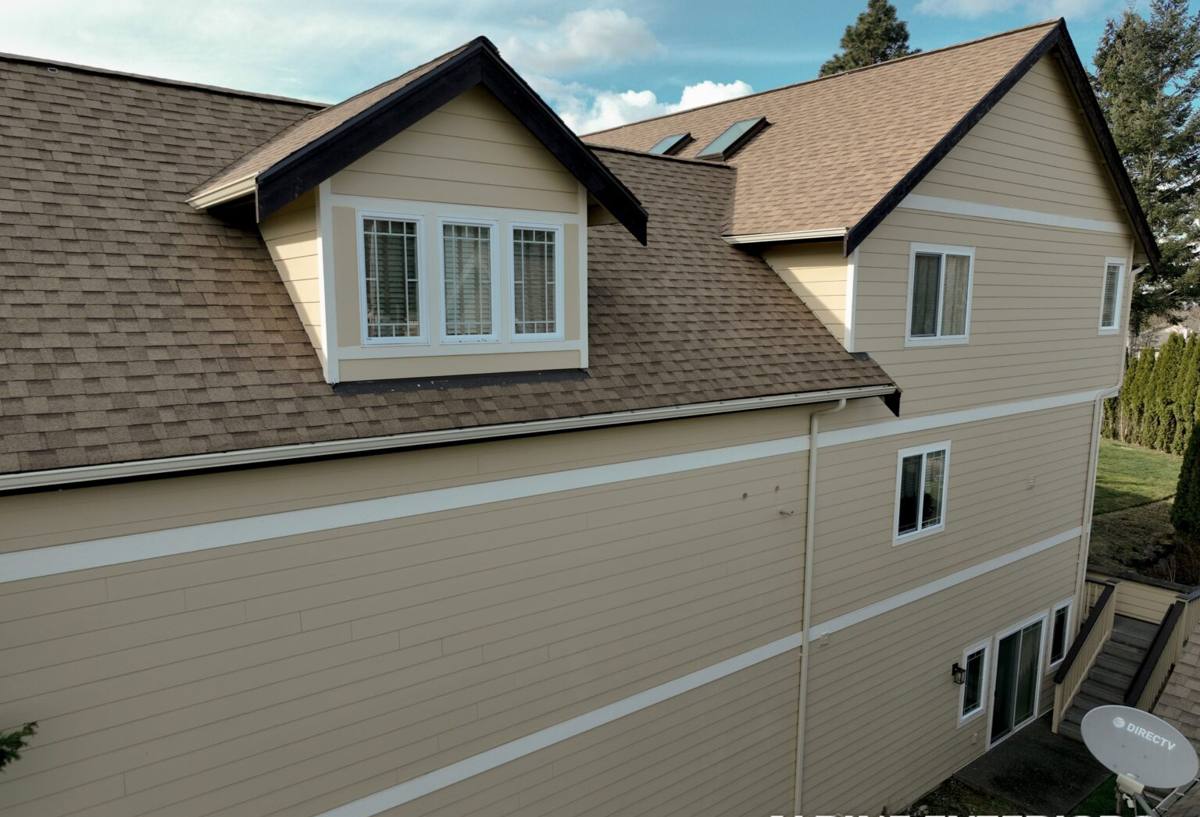
What a Correct Siding Replacement Actually Involves
"Siding replacement" gets used loosely. Some contractors mean tearing everything off down to the studs; others mean an overlay job where new material goes on top of what's already there. For homes in a marine-influenced neighborhood like Edgemoor, we don't recommend overlaying — it traps whatever moisture or rot is already present behind a new, sealed layer, and you won't know it's a problem again until it's a bigger one.
Full Tear-Off, Not a Cover-Up
A proper replacement starts by removing the old siding entirely. That's the only way to actually inspect the sheathing, framing, and existing weather barrier underneath — which, on a home exposed to years of coastal rain, is often where the real story is.
What's Underneath Matters More Than What's On Top
Rotted sheathing, compromised framing, or a failed or missing weather-resistive barrier (WRB) won't be fixed by new siding — they'll just be hidden behind it. Any section of sheathing showing soft spots, staining, or fastener pull-through gets replaced before anything new goes up. This step is where corners get cut on cheap jobs, and it's the single biggest predictor of whether a siding job lasts fifteen years or fifty.
Flashing and Water Management
Around windows, doors, roof-to-wall transitions, and any penetration through the wall, flashing has to be installed and lapped correctly — meaning water always drains outward and downward, never into a seam. In a driving-rain climate, flashing mistakes are the most common cause of hidden rot, and they're invisible from the outside until the damage has already spread.
Fastening and Installation to Spec
Fiber cement siding has a manufacturer-published installation manual covering fastener type, spacing, clearances from grade and roofing, and caulking at joints. Skipping or shortcutting any of it can void the product warranty even if the siding itself is high quality. We install to that spec, every time, because it's the difference between a warranty that actually protects you and one that's void the day you'd need it.
Why We Only Install James Hardie in Edgemoor
We're a James Hardie-only siding contractor. We don't install vinyl, LP SmartSide, Cemplank, Allura, primed spruce, or cedar — not because those products don't have a place in the market, but because after years of installing and standing behind siding in this climate, Hardie fiber cement is what we're willing to put our name on.
Vinyl siding is affordable and low-maintenance in mild climates, but it expands and contracts with temperature swings, can warp or crack under impact, and its factory color fades with UV exposure over time — cosmetic issues that show up faster near the coast where the sun reflects off water. Wood and primed spruce need ongoing paint maintenance to stay sealed against moisture, and in a climate where moss and dampness are a near-constant presence, that maintenance window shrinks. Engineered wood products like LP SmartSide perform well when installed and maintained correctly, but they're wood-based, meaning any breach in the factory coating creates a path for moisture absorption and swelling at cut edges and joints — exactly the failure mode a driving-rain, salt-air environment is built to find.
James Hardie fiber cement is cement, sand, and cellulose fiber — it doesn't absorb moisture the way wood-based products do, and it won't rot. It's also non-combustible, which matters increasingly across Washington as wildfire risk gets factored into insurance underwriting. Hardie's ColorPlus factory finish is baked on under controlled conditions and backed by its own finish warranty, which holds up better against UV and salt exposure than field-applied paint. And Hardie makes climate-engineered HZ product lines specifically formulated for regions like the Pacific Northwest, where moisture exposure is the primary threat rather than extreme heat or cold.
How the Options Compare in This Climate
| Factor | James Hardie Fiber Cement | Vinyl | Wood / Primed Spruce / LP SmartSide |
|---|---|---|---|
| Moisture behavior | Non-absorbent, engineered for wet climates | Doesn't absorb, but seams can trap water behind panels | Absorbs at cut edges and coating breaches; can swell or rot |
| Maintenance | Repaint on your schedule, not out of necessity; no rot risk | Low, but color fades and can't be effectively repainted | Regular repainting/sealing required to prevent moisture entry |
| Salt air resistance | Cement composition unaffected by salt exposure | Plastic can become brittle faster near coast | Accelerated coating breakdown near salt air |
| Fire rating | Non-combustible | Combustible | Combustible |
| Typical lifespan when installed to spec | 30+ years, often longer | 20-30 years | 15-25 years, maintenance-dependent |
Our Process for an Edgemoor Siding Replacement
1. On-Site Assessment
We walk the exterior with you, looking specifically for the failure points this climate creates: moss buildup on north- and shade-facing walls, staining or soft spots that suggest moisture behind the current siding, and areas where flashing or trim is already showing wear.
2. Written Estimate
You get a clear scope of work and pricing before anything is scheduled — no vague verbal quotes, no pressure to sign same-day.
3. Tear-Off and Sheathing Inspection
Old siding comes off, sheathing and framing get inspected, and any necessary repairs are identified and priced separately so you're never surprised by a change order that should have been caught up front.
4. Weather Barrier and Flashing
A new WRB goes on where needed, and flashing is installed or replaced at every window, door, and roofline transition — the details that determine whether the wall stays dry for the next thirty years.
5. Hardie Installation to Manufacturer Spec
Fastening, clearances, and joint treatment follow James Hardie's published installation guidelines, which is what keeps the product warranty intact.
6. Final Walkthrough
We go over the finished work with you before calling the job done.
Cost Factors for Siding Replacement in Edgemoor
Every home is different, but the line items that actually move the price are consistent. We'll give you specific numbers after seeing your home — broadly, expect these factors to matter most:
| Factor | Why It Affects Cost |
|---|---|
| Sheathing/framing condition | Hidden rot found during tear-off requires repair before new siding goes on |
| Home size and wall complexity | More corners, gables, and trim detail means more labor and material |
| Siding profile and Hardie product line | Lap, shingle, and panel styles vary in material and install cost |
| Number of window/door/roof transitions | Each one requires flashing work, which is labor-intensive to do right |
| Access and site conditions | Slopes, tight setbacks, or landscaping can add labor time |
Signs Your Edgemoor Home May Need Siding Replacement Now
- Visible moss or persistent green staining on siding, especially on shaded or north-facing walls
- Soft spots, bubbling, or a spongy feel when you press on the siding
- Paint that's peeling, bubbling, or won't hold on the same wall repeatedly
- Warping, cupping, or visible gaps opening up between siding pieces
- Higher heating or cooling bills without another clear explanation
- Visible daylight, drafts, or moisture at interior walls near exterior siding
- Siding that's original to a home built more than 20-25 years ago and has never been replaced
Why Hiring a Crew That Already Works Edgemoor Matters
A contractor who mainly works dry, inland jobs can install siding correctly by the book and still miss the details that matter most in a marine climate — how much clearance to leave near grade in a neighborhood where rain runoff behaves differently, which walls in a coastal-facing home need extra attention to moss and moisture, or how salt exposure changes fastener choices over time. A crew that already works Whatcom County's coastal neighborhoods has seen what actually fails here, not just what fails in a training manual written for a different climate.
That local experience is also why we standardized on one product instead of offering a menu of options at different price points. We're not trying to match a budget to a product — we're trying to make sure every siding job we put our name on is still doing its job in this climate two decades from now.
Get a Free, No-Pressure Estimate
If your Edgemoor home's siding is showing moss, moisture damage, or just age, we're happy to take a look and give you an honest read on what it needs — whether that's a full replacement or something less. Fill out the form below to schedule a free estimate.