 Sudden Valley Siding
 Why Edgemoor Siding Has to Work Harder Than Siding Inland
Homes around Edgemoor and the broader Sudden Valley area sit inside one of the more punishing exterior environments in Whatcom County. You've got moisture coming from three directions at once: driving rain off the water, damp air that lingers under tree cover, and long stretches of gray, low-sun months where painted or wood-based siding never fully dries out between storms. Add proximity to saltwater air along parts of the corridor and you get a slow, steady corrosive load on fasteners, trim, and any siding product that isn't built to shrug it off.
None of this is dramatic on its own. A house doesn't fail in one storm. It fails in year eight or twelve, when caulk joints that were never detailed right start letting water behind the cladding, or when moss that's been quietly colonizing a north-facing wall finally holds enough moisture to start rot underneath. The siding decision you make now is really a decision about what your walls are doing in year fifteen, not what they look like in month one.
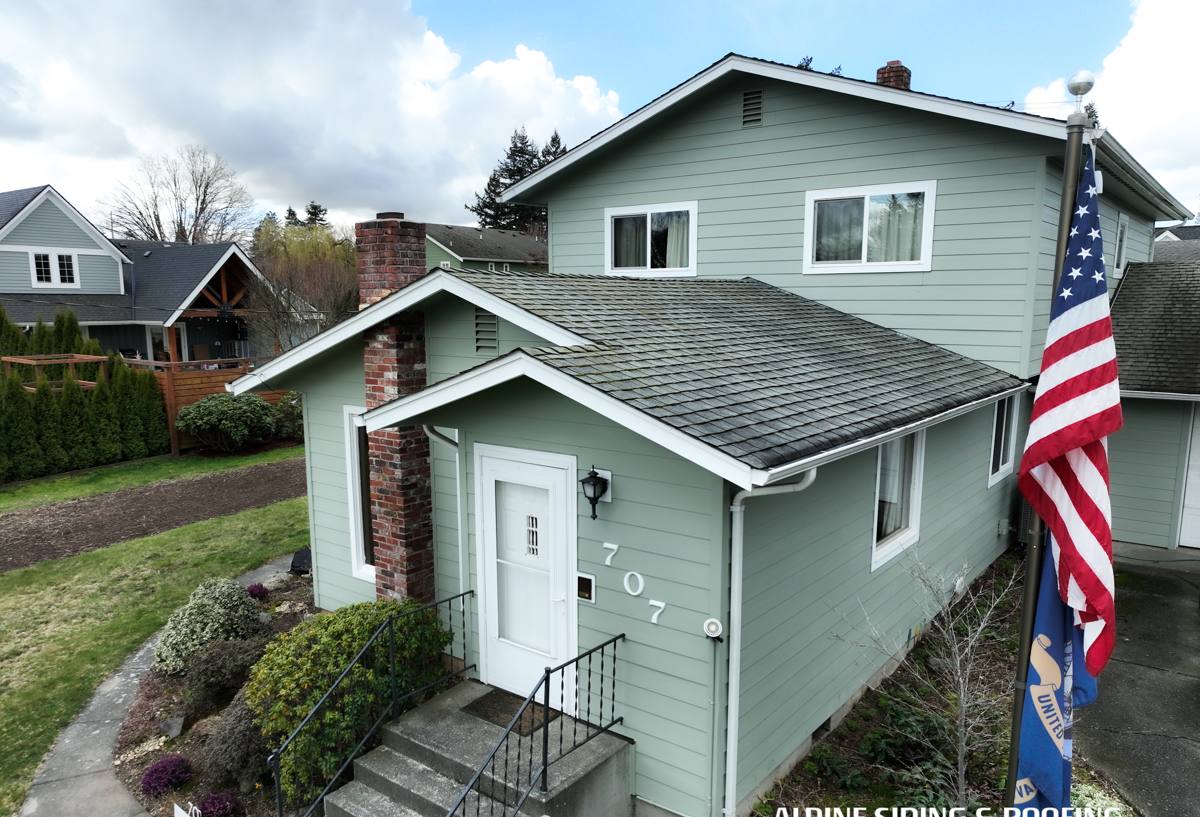
What Local Homes Actually Need From Their Siding
Strip away the marketing and a house in this part of Whatcom County needs a cladding system that does four things well:
- Resists water intrusion at the field of the wall, not just at the seams
- Doesn't swell, cup, or delaminate when it stays damp for days at a time
- Holds a factory finish long enough that repainting isn't a recurring maintenance line item
- Sheds moss and algae growth instead of feeding it
Fiber cement, specifically James Hardie's engineered lines, checks all four boxes when it's installed to spec. It's a cement, sand, and cellulose fiber composite — it doesn't absorb and hold water the way wood-based products can, it's dimensionally stable across our wet-to-dry swings, and the ColorPlus factory finish is baked on under controlled conditions rather than field-applied, which matters enormously in a climate that rarely gives a painter three dry days in a row.
Why We Only Install James Hardie
We get asked why we don't offer LP SmartSide, vinyl, or one of the other fiber cement brands on the market. The honest answer is that we standardized on Hardie because it's the product we're willing to warranty and stand behind on homes in exactly this climate. LP SmartSide is a wood-strand product — treated and engineered, but still wood at its core, which means it's more sensitive to sustained moisture exposure than a cement-based board. Vinyl is inexpensive and low-maintenance in dry climates, but it can warp under temperature swings and its seams are a long-term weak point against driving rain. Other fiber cement brands exist and some are reasonable products, but we've built our installation crews, flashing details, and warranty process around one system, and we'd rather be excellent at installing Hardie correctly than mediocre across four different product lines.
What Correct Installation Actually Involves
Fiber cement siding fails almost exclusively at the details, not the material itself. The board is durable; the installation is where water gets a foothold if it's rushed.
Weather Barrier and Drainage Plane
Every wall gets a water-resistive barrier installed and lapped correctly before a single board goes up, with a drainage gap behind the siding so any moisture that does get past the cladding has somewhere to go besides your sheathing. This step matters more here than almost anywhere else in the state, given how many wet days in a row this area sees between fall and spring.
Flashing at Every Penetration
Windows, doors, hose bibs, light fixtures, deck ledgers — every penetration through the siding plane is a potential entry point. Correct flashing, not just caulk, is what actually keeps water out over a 30-year timeline. Caulk is a backup, not a strategy.
Clearances and Gaps
Hardie's own installation instructions specify minimum clearances from grade, roof lines, decks, and other siding-to-trim gaps. These aren't suggestions — they're the difference between a wall that dries out after rain and one that stays damp against the framing.
Fastening
Corrosion-resistant fasteners, driven to the correct depth (not overdriven, which cracks the board's edge and creates a moisture entry point), into solid framing. This is a detail that's invisible once the job is done and painted, but it's one of the most common places corners get cut on a rushed install.
Field Cuts and Joints
Butt joints get sealed and, where possible, backed with flashing tape rather than caulk alone. Cut edges get sealed before installation, since the factory finish doesn't extend into a fresh cut.
James Hardie vs. Other Common Siding Choices
| Product | Moisture Behavior | Finish Durability | Typical Maintenance |
|---|---|---|---|
| James Hardie fiber cement | Cement-based, doesn't swell or rot; engineered HZ formulations for wet climates | Factory-applied ColorPlus finish, long warranty on color and finish | Occasional wash; repaint cycle far longer than field-painted products |
| LP SmartSide (wood strand) | Treated but wood-based; more sensitive to prolonged moisture exposure | Factory or field finish depending on install | Watch cut edges and joints closely |
| Vinyl siding | Doesn't rot but can warp with heat/cold cycling; seams are weak points | Color molded in, but fades over time; can't be repainted easily | Low, but limited repair options if damaged |
| Cedar / primed wood | Attractive but requires ongoing sealing to resist rot in a wet climate | Field-applied finish needs recoating on a regular cycle | Highest — repainting, caulking, moss treatment |
Moss, Algae, and the Long Gray Season
Anyone who's owned a house in this region for more than a couple of winters knows the drill: north-facing walls, anything under tree cover, and low-sun exposures grow moss and algae faster than they can be scrubbed off by hand. This isn't just cosmetic. Sustained organic growth holds moisture against the wall surface, and on products with a field-applied or lower-grade finish, that moisture cycle is exactly what accelerates paint failure and, eventually, substrate damage underneath.
Hardie's factory finish is formulated to resist mildew growth on the surface far better than a standard field-applied paint job, and because the board itself is cement-based rather than organic, it doesn't feed rot even where moss does take hold. That doesn't mean moss won't grow on it in the shaded, damp pockets that exist around Sudden Valley — it means that when it does, you're dealing with a cleaning problem instead of a structural one.
Our Process on an Edgemoor Job
- Walk and assessment — we look at existing siding, trim, flashing, and any visible moisture damage before quoting anything, including known problem areas like north walls and grade-level clearances.
- Tear-off and sheathing check — once old siding comes off, we inspect the sheathing underneath. Any soft or water-damaged sections get flagged and addressed before new siding goes up, not covered over.
- Weather barrier and flashing — house wrap, flashing tape, and drainage details go in per manufacturer spec, adapted to this area's rain and wind exposure.
- Hardie installation — boards, fasteners, and trim installed to Hardie's published fastening and clearance requirements.
- Caulking and touch-up — factory-matched caulk at joints, touch-up paint at cut edges and fastener heads.
- Final walkthrough — we go over the finished job with you before calling it done, not after.
Cost Factors for an Edgemoor Fiber Cement Project
| Factor | Why It Matters |
|---|---|
| Home size and wall complexity | More corners, gables, and dormers mean more cutting, flashing, and labor time |
| Condition of existing sheathing | Hidden rot found during tear-off adds repair scope before new siding can go on |
| Siding profile and trim selection | Lap width, shingle-style panels, and trim detail level all affect material and labor cost |
| Access and site conditions | Sloped lots, tree cover, and limited staging area are common around Sudden Valley and can affect crew efficiency |
| Color and finish selection | ColorPlus factory finishes vs. field painting change both cost and long-term maintenance |
We won't give you a number without seeing the house — anyone who quotes a full re-side over the phone is guessing. What we can tell you is that the line items above are the real drivers, and a contractor who explains them clearly before you sign anything is doing you a favor.
Why It Matters That We Already Work This Area
A crew that's re-sided homes in and around Sudden Valley and Edgemoor knows which walls take the worst weather exposure, which older homes in the area tend to have moisture issues hiding behind their original siding, and how the local moss and algae season actually behaves through the year — not from a general climate chart, but from having pulled siding off these houses and seen what was underneath. That local pattern-recognition is worth more than it sounds like on paper. It's the difference between a crew that flags a rot pocket during tear-off because they've seen it before in this neighborhood, and one that's guessing.
Questions Worth Asking Any Contractor Before You Hire
- Are you a factory-certified James Hardie installer, and can you explain your flashing details specifically?
- What happens if you find water damage or rot once the old siding comes off?
- What's covered under the manufacturer's warranty versus your own workmanship warranty?
- Do you use Hardie's specified fasteners and clearances, or generic hardware?
- Can you show me examples of similar homes you've sided in this area?
Ready for a Straight Answer on Your Siding?
If your Edgemoor or Sudden Valley home has siding that's showing its age — cracking, holding moisture, growing moss faster than it used to, or just due for a real look — we're happy to come take a look and give you an honest read on what's going on and what it would take to fix it right. There's no pressure and no obligation. Use the form below to request a free estimate.