 Sudden Valley Siding
 Why Siding Wears Out Faster Here Than It Does Elsewhere
Homes in Cordata and around Sudden Valley sit in one of the more punishing exterior environments in Whatcom County, even if it doesn't look that way on a dry afternoon. You've got moist air drifting in off Bellingham Bay, driving rain that comes sideways off the water more often than most homeowners realize, and a tree canopy — especially around Sudden Valley's forested lots near Lake Whatcom — that keeps north- and west-facing walls shaded and damp for weeks at a stretch. Add a moss season that can run from October into May in a typical year, and you have exterior siding that's under near-constant moisture pressure for more than half the calendar.
None of that is unusual for the Pacific Northwest. What's unusual is how much it varies block to block. A home tucked against a tree line in Sudden Valley deals with different stress than a more open lot in Cordata closer to I-5 — less direct salt exposure, more shade-driven moisture and moss. Siding that's rated for "Pacific Northwest conditions" in a brochure doesn't account for that kind of micro-climate difference. Correct product selection and installation detail do.
Signs Your Siding Is Telling You It's Time
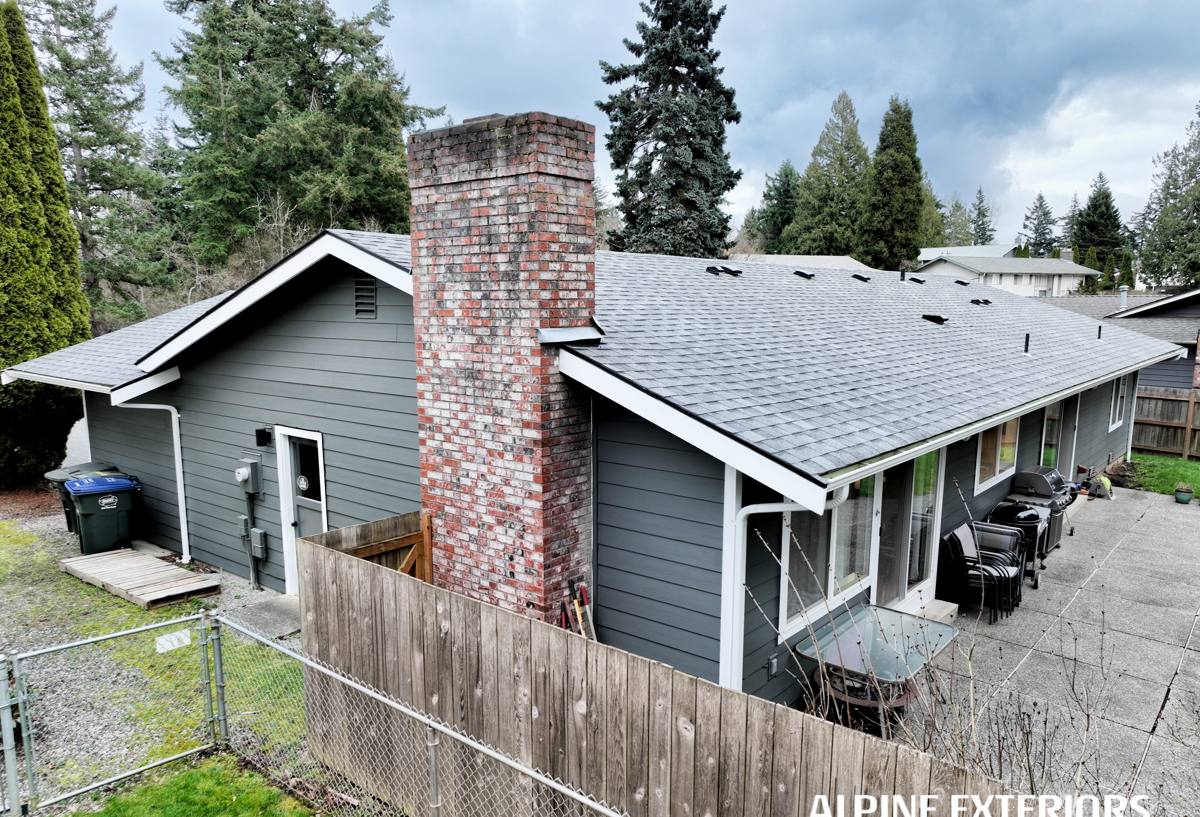
Most siding failure in this area doesn't show up as one dramatic problem — it shows up as a pattern of small ones that add up. If you're seeing more than one or two of these, it's worth having someone look at it before it becomes a rot repair instead of a siding replacement:
- Moss or algae staining that comes back within a season or two of being cleaned off
- Paint that's peeling, bubbling, or chalking faster than the repaint interval you were told to expect
- Soft or spongy spots when you press on siding near the bottom courses, corners, or under windows
- Visible cupping, warping, or gaps opening up between boards or panels
- Rising heating bills that don't match any other change to the house
- Siding that's swollen or delaminating at butt joints and seams
- Caulk lines that keep failing no matter how often they're redone
Any wood-based or wood-composite siding — cedar, primed spruce, LP SmartSide — is more prone to these symptoms here than in drier parts of the state, simply because the wood fiber in the product needs moisture and time to break down, and Whatcom County supplies both in abundance.
What a Correct Siding Replacement Actually Involves
Siding replacement is not a cosmetic swap. If the tear-off and reinstall aren't done right, the new siding will fail on the same schedule as the old, just with a fresh coat of paint hiding it longer. A correct job includes:
Full Tear-Off and Sheathing Inspection
Old siding comes off down to the sheathing, and the sheathing gets inspected — not glanced at. In homes with a history of moss, moisture staining, or prior water intrusion, we expect to find some soft or compromised sheathing, especially around window and door openings and at the base of walls. That gets repaired before anything new goes up. Covering rotten sheathing with new siding just moves the problem behind a fresh surface.
A Proper Weather-Resistive Barrier
A correctly lapped, sealed water-resistive barrier (WRB) behind the siding is what actually keeps wind-driven rain out of the wall assembly — the siding itself is the first line of defense, not the only one. Given how often this area sees driving rain off the bay, gaps or shortcuts here are where future rot starts.
Flashing at Every Penetration
Windows, doors, hose bibs, light fixtures, and vents all need proper flashing and integration with the WRB. This is the single most common place we find corners cut on prior installs — flashing that's missing, reversed, or just caulked over instead of properly lapped.
Correct Fastening and Clearances
Fiber cement siding has specific fastener spacing, nailing zones, and minimum clearances from grade, roofing, and decks that manufacturers publish for a reason — get them wrong and you void the warranty and invite moisture right back in at the bottom edge, which is exactly where we see the most damage on older homes in this area.
Comparing Siding Materials for This Climate
| Material | Moisture/Moss Resistance | Salt Air Durability | Maintenance | Typical Warranty |
|---|---|---|---|---|
| James Hardie fiber cement | Very high — non-organic, won't swell or rot | Engineered HZ product lines for coastal/marine exposure | Low — factory finish, occasional wash | Long transferable material warranty, factory finish warranty separate |
| Vinyl siding | Doesn't rot, but traps moisture behind it and can warp/crack in temperature swings | Can fade and become brittle over time | Low, but repairs are visible (color mismatch) | Prorated, often weaker at seams/corners |
| LP SmartSide / engineered wood | Wood-strand core, vulnerable at cut edges and joints if not sealed perfectly | Moderate — sensitive to sustained moisture exposure | Moderate — repaint cycle, edge sealing | Warranty often conditioned on strict installation/maintenance compliance |
| Cedar / primed wood siding | Low without diligent upkeep — organic material feeds moss and rot | Low — salt air accelerates weathering | High — regular refinishing, caulking, moss treatment | No manufacturer warranty on the material itself |
This is exactly why we don't install vinyl, LP SmartSide, primed spruce, or cedar. Each has real strengths — vinyl's low cost, wood's traditional look, LP's workability — but in a climate that keeps siding wet for most of the year, those trade-offs consistently show up as callbacks, repaint cycles, or rot repairs within a decade or two. We standardized on James Hardie fiber cement because it's non-combustible, doesn't feed moss or mildew the way wood-based products do, and comes with a factory-applied ColorPlus finish engineered to hold color and resist the moisture cycling this area puts siding through.
Why We Install Only James Hardie
Hardie's HZ5 product line is specifically formulated for climates like ours — wet winters, freeze-thaw cycling, and sustained humidity — rather than a generic national spec. Fiber cement doesn't absorb water the way wood or wood-composite products can, which means it doesn't swell, cup, or provide the organic surface moss and algae need to establish themselves the way cedar or primed wood does. The factory finish also removes the weakest link in most siding failures we see locally: field-applied paint that was never going to hold up to this many wet-dry cycles a year.
None of that means Hardie is maintenance-free or bulletproof — no siding is. It means the failure points shift from "the material itself breaking down" to "installation quality," which is exactly the variable a good contractor controls. That's the whole reason correct tear-off, flashing, and fastening matter as much as the product choice.
HardiePlank vs. HardiePanel
Most homes in Cordata and Sudden Valley are good candidates for HardiePlank lap siding, which gives the traditional horizontal-board look most buyers expect in this market. Homes with more modern or craftsman detailing sometimes use HardiePanel for vertical sections, board-and-batten accents, or gable ends. The right choice depends on the home's existing style and trim detailing, not a one-size answer — we'll walk you through it during the estimate rather than defaulting to whatever's fastest to install.
Our Process
- On-site assessment — we look at current siding condition, sheathing risk areas, moisture history, and sun/shade exposure specific to your lot
- Product and profile selection — matching HardiePlank, HardiePanel, or trim details to the home's style and your budget
- Written scope and estimate — clear on what's included: tear-off, sheathing repair allowance, WRB, flashing, siding, trim, and cleanup
- Tear-off and sheathing repair — done before a single piece of new siding goes up
- WRB, flashing, and siding installation — to manufacturer spec, not shortcuts, so the warranty stays intact
- Final walkthrough — we go over the finished work with you directly before calling the job done
Why Local Experience Matters Here
A crew that already works Cordata and Sudden Valley knows what to expect before the tear-off starts — which wall orientations are more likely to have hidden sheathing damage, how much moss buildup is normal versus a red flag, and how Whatcom County's permitting and inspection process actually runs. That familiarity shows up in fewer surprises mid-project and a more accurate estimate up front, instead of change orders once the old siding is off the wall.
It also matters for something less obvious: local crews see how their own past installs hold up over years, in this exact climate, on homes like yours. That feedback loop is what keeps installation standards honest — you can't fake how HardiePlank looks on a Sudden Valley home after five wet winters.
What Affects the Cost
| Factor | Why It Matters |
|---|---|
| Sheathing condition | Hidden rot found during tear-off adds repair scope — more likely on shaded, moss-prone walls |
| Home size and wall complexity | More corners, dormers, and trim detail mean more labor and cut waste |
| Siding profile and accents | Board-and-batten, shingle-style accents, or trim upgrades add cost over a straightforward lap job |
| Access | Steep lots, forested lots with limited staging room (common around Sudden Valley), and multi-story walls affect labor time |
| Color and finish | ColorPlus factory finishes vary slightly in cost by line, but eliminate a future repaint that field-painted siding will eventually need |
We won't quote a number without seeing the house — anyone who does hasn't accounted for what's actually behind your current siding. What we can tell you honestly is that the sheathing repair line item is the one homeowners are most often surprised by, and it's also the one that matters most for how long the new siding lasts.
Get a Straightforward Estimate
If your siding is showing moss, soft spots, paint failure, or you're just planning ahead for a home in Cordata or Sudden Valley, we're glad to come take a look. The estimate is free, there's no pressure, and we'll tell you plainly what we find — including if a repair makes more sense than full replacement right now. Fill out the form below to get started.