 Sudden Valley Siding
 Roof Repair Built for Bellingham's Weather
Bellingham roofs work harder than roofs almost anywhere else in the state. Between the marine air rolling in off Bellingham Bay, the long stretch of drizzle that runs from October through May, and the deep shade a lot of Whatcom County lots have from mature fir and cedar cover, a roof here is under near-constant moisture load for most of the year. That combination is exactly what drives the repair calls we see most often in this area: moss colonies working into shingle mat, soft or stained decking under valleys and skylights, and flashing that's finally given out after years of expansion and contraction in the damp-to-dry cycle.
None of that means Bellingham roofs are doomed — it means they need repair work that actually accounts for the climate instead of a generic patch job. That's the difference between a repair that buys you two years and one that buys you ten.
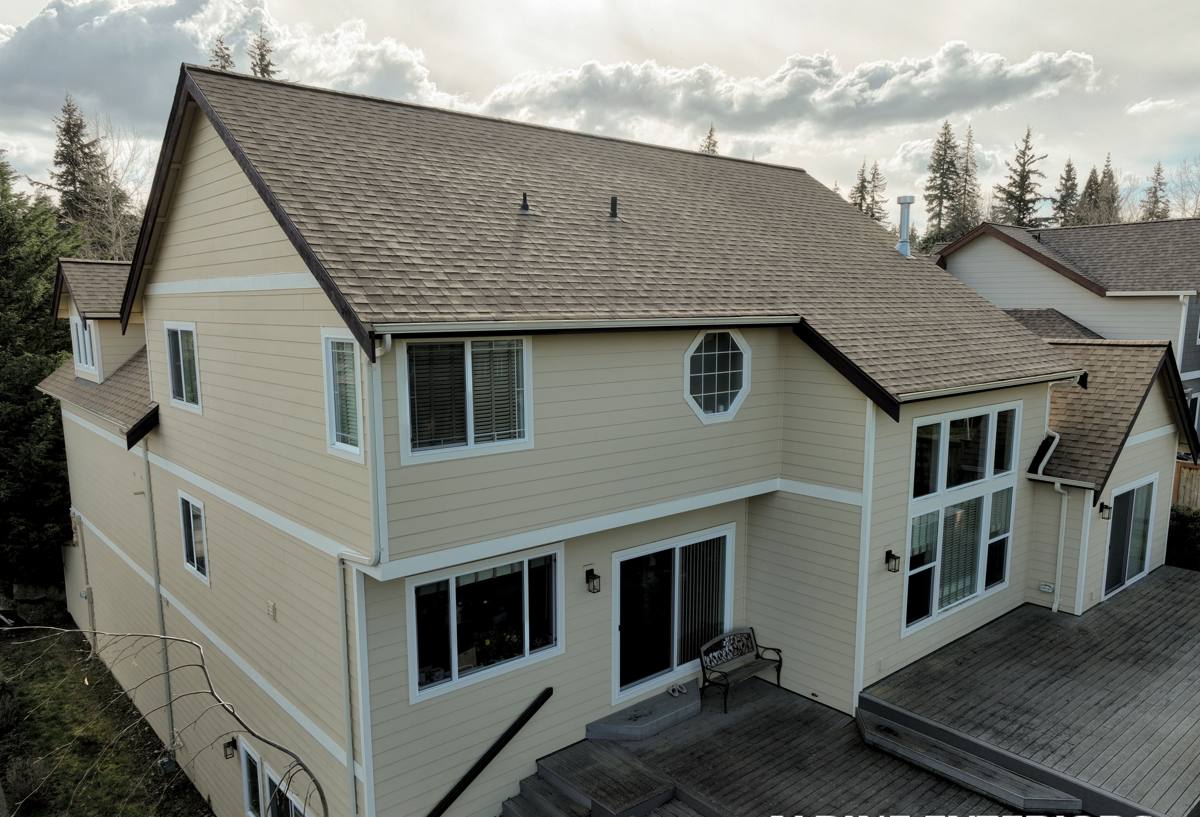
What Bellingham's Climate Actually Does to a Roof
Moss and Organic Growth
Whatcom County's moss season isn't a seasonal nuisance — it's close to year-round on north-facing slopes and anywhere a roof sits under tree cover. Moss doesn't just sit on top of shingles; it roots into the granule layer, lifts shingle edges, and holds a film of moisture against the roofing material long after a storm has passed. Over a few seasons, that trapped moisture accelerates granule loss and can work its way under shingle tabs, especially at butt joints and around fasteners.
Driving Rain and Wind-Driven Moisture
Storms coming off the Sound and the Strait don't always fall straight down — wind-driven rain gets pushed sideways under shingle edges, around chimney flashing, and into any gap in ridge or hip caps. A roof that would shed vertical rainfall just fine can still leak in a sideways storm if the underlayment and flashing details aren't tight.
Salt Air and Metal Fatigue
Proximity to saltwater accelerates corrosion on exposed metal — flashing, fasteners, vent boots, gutter hardware. Galvanized components that would last decades further inland can start showing rust streaks and pinholing sooner here. It's a slow process, but it's steady, and it's one of the reasons flashing failure shows up as a repair need even on roofs that are otherwise in decent shape.
Temperature Swings and Material Movement
Whatcom County doesn't get brutal heat, but it does get repeated wet-to-dry and cool-to-mild cycling. That steady expansion and contraction is hard on sealants, pipe boot collars, and caulked transitions — the small stuff that quietly fails years before the shingles themselves wear out.
Signs a Bellingham Roof Needs Repair
- Visible moss mats, especially on north-facing or shaded slopes
- Dark streaking or algae staining across shingle courses
- Granules collecting in gutters or at downspout outlets
- Curling, cupping, or lifted shingle edges
- Rust staining around vent pipes, flashing, or exposed fasteners
- Water stains on interior ceilings, especially near chimneys, skylights, or valleys
- Soft or spongy decking felt underfoot in the attic near roof penetrations
- Sagging or discoloration in soffits and fascia below roof edges
- Daylight visible through the roof deck from inside the attic
Any one of these on its own might not mean a full roof replacement — but it does mean the roof is telling you something, and in this climate, small problems don't stay small for long.
What a Correct Repair Actually Involves
A lot of roof "repairs" in wet climates amount to caulking over a symptom instead of fixing the cause. We approach it differently:
1. Find the Real Source
Water in a Bellingham attic doesn't always show up directly below where it's entering — it can travel along rafters or sheathing before dripping. We trace stains and moisture back to the actual entry point rather than patching where the stain happens to appear.
2. Address Moss at the Root, Not Just the Surface
Scraping visible moss off the surface without treating the roof leaves the roots and spores behind, and it comes right back within a season. A proper moss repair removes the growth, treats the affected area, and looks at whether the underlying shingles have already lost enough granule protection to need replacement in that section.
3. Rebuild Flashing Properly, Not Just Reseal It
Caulk is a short-term fix, not a repair. Where flashing has failed — around chimneys, skylights, dormers, or roof-to-wall transitions — the right fix is re-forming or replacing the metal and properly integrating it with the underlayment, so water sheds over it instead of relying on a bead of sealant to hold it back.
4. Check the Decking Underneath
Any repair near a known leak point should include a check of the roof deck itself. If sheathing has softened from sustained moisture exposure, patching the shingles over it without addressing the deck just hides the problem until it reappears — usually worse.
5. Match Materials and Technique to What's Already There
A patch that doesn't match the surrounding shingles' age, exposure, and fastening pattern can actually create a new weak point. We match repair materials and installation method to the existing roof so the fix blends into the system instead of standing apart from it.
Our Repair Process
- Inspection. We get on the roof (weather permitting) and in the attic, looking at decking, insulation, and ventilation, not just the shingle surface.
- Diagnosis and explanation. We tell you what's actually failing and why — in plain terms, with photos where useful — before recommending a scope of work.
- Written estimate. A clear scope and cost range, so you know what you're approving before any work starts.
- Repair. Moss removal and treatment, flashing rebuild, decking repair, and shingle replacement in the affected area — done to blend with the surrounding roof.
- Cleanup and walk-through. Debris cleared, gutters checked, and a final look together so you can see what was done.
Repair vs. Replacement: How We Help You Decide
| Factor | Repair Usually Makes Sense | Replacement Worth Considering |
|---|---|---|
| Roof age | Under roughly 15-20 years, isolated issue | Nearing or past expected material lifespan |
| Extent of damage | Localized — one valley, one flashing point, one slope | Multiple areas showing granule loss, curling, or leaks |
| Decking condition | Solid, no soft spots found | Soft, stained, or spongy in more than one location |
| Moss/algae history | First significant occurrence, treatable | Recurring heavily despite past cleaning and treatment |
| Interior damage | None or minor, recently discovered | Ongoing staining, insulation damage, or mold concerns |
We won't push a full replacement when a targeted repair will genuinely hold up — and we won't recommend patching a roof that's clearly at the end of its useful life. Our estimate reflects what the roof actually needs, not what's easiest to sell.
Why Local Experience in Bellingham Matters
A crew that works Whatcom County regularly knows which slopes in this area tend to hold moss longest, how far wind-driven rain typically pushes under flashing on the roof pitches common here, and what decking condition to expect on homes of different ages around Bellingham. That's not something you get from a crew passing through once. It shows up in faster, more accurate diagnosis, and in repairs that account for next season's weather instead of just today's leak.
It also matters for timing. Roof repair work in this region has a real weather window, and a local crew can plan around it — getting moss treatment done before growth accelerates in the wet months, and getting flashing and decking repairs finished before the heaviest rain sets in.
Simple Maintenance That Extends a Bellingham Roof's Life
- Keep gutters and downspouts clear so water isn't backing up under the roof edge
- Trim overhanging branches to cut down on shade and debris that feed moss growth
- Have moss treated before it establishes heavily, not after it's visibly thick
- Check attic ventilation — poor airflow traps moisture against the underside of the deck
- Have flashing and pipe boots inspected every few years, since sealant and rubber components degrade faster in this climate than shingles do
None of this replaces a professional inspection, but staying ahead of these basics is the single biggest thing a homeowner can do to keep small issues from becoming repair calls.
Get a Straight Answer About Your Roof
If you're seeing moss, staining, or a slow leak on a Bellingham roof, it's worth having someone look before it gets ahead of you. We offer free, no-pressure estimates — we'll tell you honestly whether you're looking at a repair or something more, with no obligation either way. Fill out the form below to get started.