 Sudden Valley Siding
 Siding Installation in Barkley: What the Climate Demands
Barkley sits within the Sudden Valley area of Whatcom County, and any siding installation here has to be judged against a specific set of conditions, not a generic Pacific Northwest weather profile. Salt air moving in off the water accelerates corrosion on exposed fasteners and hardware and keeps painted or coated surfaces damp longer than they'd stay in a drier climate. Driving rain, pushed sideways by wind rather than falling straight down, forces water into laps, seams, and fastener points that a calmer climate would never test. And a moss season that runs long through fall, winter, and much of spring keeps shaded walls and north-facing exposures wet for extended stretches, which is exactly the condition moss, mildew, and rot need to take hold.
None of that shows up as a dramatic failure on any single day. It's cumulative — small amounts of moisture intrusion, UV exposure, and freeze-thaw cycling that compound year after year. A siding installation that's correct on day one but not detailed for this specific combination of salt, wind-driven rain, and sustained dampness will show its age faster than homeowners expect, regardless of which product went up on the wall.
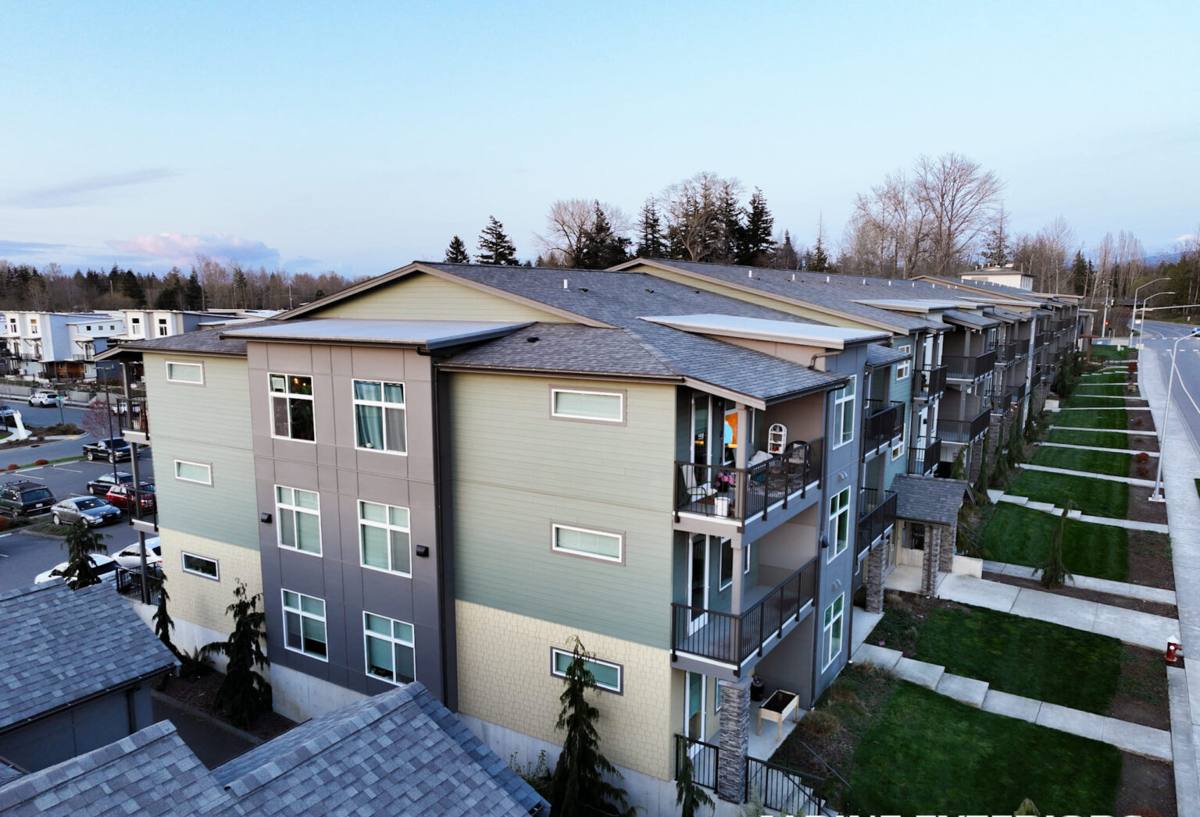
What a Correct Installation Actually Involves
Underneath the Siding
Before any siding panel goes up, the wall needs a properly lapped and sealed weather-resistive barrier, with seams taped and penetrations flashed so that any water that does get past the cladding has a way out instead of a place to sit. This layer does more of the real work than most homeowners realize — the siding sheds the bulk of the water, but the barrier underneath is what protects the sheathing and framing if any of it gets past the first line of defense.
Flashing and Clearances
Every window, door, and penetration needs flashing detailed to direct water out and away from the wall assembly, not just tucked behind the siding and hoped for. Clearance above grade, roofing, decks, and hardscape matters just as much — siding installed too close to the ground or a horizontal surface stays wet longer and starts to fail from the bottom up, well before the rest of the wall shows any problem.
Fastening and Fit
Fastener type, length, and spacing have to match the manufacturer's specification for the product and the wall assembly behind it. Under-fastened or incorrectly spaced siding can work loose over years of wind exposure; over-driven fasteners crack the material at the fastening point and create a spot for water to enter. Getting this right the first time is a matter of following the spec exactly, not eyeballing it.
Why We Install Only James Hardie Fiber Cement
We don't install vinyl siding, LP SmartSide, primed spruce, cedar, or other fiber cement brands. That's a professional standard, not a limitation on what we're able to install. In a climate like Barkley's, the materials that tend to struggle share a common weakness: they either absorb moisture directly, rely on a field-applied or factory coating to keep water out indefinitely, or expand and contract enough with humidity and temperature swings that seams and joints gradually work themselves open. None of those failure modes are dramatic in year one. They show up in year eight or twelve, usually as caulking, repainting, or panel replacement that falls back on the homeowner.
James Hardie fiber cement is engineered specifically against that kind of exposure. It's non-combustible, it doesn't swell, rot, or feed moss the way wood-based siding can, and its ColorPlus factory finish is baked on under controlled conditions and warrantied against the fading and chalking that constant moisture and UV cycling cause over time. Hardie also builds climate-specific HZ formulations rather than a single national product, which matters in a region that sees this much sustained dampness. Combined with a strong transferable warranty and installation carried out to the manufacturer's actual specifications, it's the system we're willing to put our name behind for a full Whatcom County year, not just an install-day photo.
That's not a claim that every other product is worthless — vinyl, engineered wood, and primed wood all have legitimate uses in the right climate and price range. It's that in a salt-air, high-rain, long-moss environment, the maintenance burden and moisture risk on those materials tends to land back on the homeowner sooner than a fiber cement system does, and we'd rather install the product that holds up than the one that's cheaper up front and more expensive over time.
Our Installation Process for Barkley Homes
- On-site assessment. We walk the exterior, check the existing siding and sheathing for hidden moisture damage, and look at how each wall's orientation and shade exposure affects its risk profile.
- Tear-off and inspection. Old siding comes off down to the sheathing, which gets inspected for rot, soft spots, or prior water damage before anything new goes up. Any compromised sheathing gets repaired or replaced — covering it over is how small problems turn into structural ones.
- Weather barrier and flashing. A new weather-resistive barrier goes on, lapped correctly and sealed at seams, with flashing detailed at every window, door, and penetration.
- Hardie installation to spec. Panels or planks go up with the fastener pattern, spacing, and clearances James Hardie specifies for this climate zone — not a generic national default.
- Trim, caulking, and finish work. Trim gets fitted and sealed at the joints that see the most wind-driven rain, and touch-up is matched to the ColorPlus finish so repairs and cut edges blend in rather than standing out.
- Final walkthrough. We go over the finished work with the homeowner, point out anything worth knowing for ongoing maintenance, and answer questions before we consider the job done.
What Drives Cost on a Barkley Siding Project
Every siding installation is priced around a handful of factors specific to the home and the job, not a flat per-square-foot number that applies everywhere. The table below covers the main variables that move the estimate up or down.
| Cost Factor | Why It Matters |
|---|---|
| Home size and wall complexity | More square footage and more corners, gables, and dormers mean more material and more labor-intensive cutting and fitting |
| Condition of existing sheathing | Hidden rot or water damage found during tear-off adds repair work that can't be scoped until the old siding is off |
| Siding profile | Lap siding, shingle-style panels, and board-and-batten each carry different material and labor costs |
| Trim and accent work | Detailed trim packages and accent siding sections take more time to fit and finish correctly |
| Site access | Difficult access, slopes, or limited staging area can add time to material handling and setup |
| Color and finish | Factory ColorPlus finishes come pre-selected from Hardie's palette, which affects material cost versus field-painted options |
We walk every one of these factors with the homeowner during the estimate, so the number reflects the actual home rather than a rough average.
Signs Your Barkley Home May Need New Siding
Some warning signs are obvious; others take a closer look, especially on walls that don't get much direct attention. Worth checking for before problems get expensive:
- Visible moss, algae, or persistent green staining on shaded or north-facing walls
- Soft spots, bubbling, or a spongy feel when you press on the siding
- Cracked, warped, or separating boards, especially near the ground or at seams
- Paint that's peeling, chalking, or failing faster than it used to
- Gaps or failing caulk around windows, doors, and trim joints
- Rising energy bills that can't be explained by anything else, which can point to a compromised weather barrier
- Rot or discoloration at the bottom courses of siding, near grade or hardscape
Any one of these on its own isn't necessarily an emergency, but a home showing several of them at once is usually past the point where a patch or touch-up is the right answer.
Living With Fiber Cement in Barkley's Climate
James Hardie siding is low-maintenance compared to wood-based alternatives, but "low-maintenance" doesn't mean "no maintenance," especially in a climate that stays damp as much of the year as this one does. Keep gutters and downspouts clear so water isn't sheeting down walls it shouldn't be. Rinse off accumulated moss or algae on shaded walls before it has years to establish itself, rather than waiting until it's visibly heavy. Check caulking at trim joints and penetrations periodically, since even a good caulk job has a service life and needs to be renewed before it fails, not after. None of this is difficult work, but staying ahead of it is what lets a correctly installed Hardie exterior go a long time between the kind of repainting and repair cycles that wood-based siding demands on a much shorter clock.
Why Hire a Crew That Already Works in Sudden Valley
A siding installer who's worked walls throughout the Barkley and Sudden Valley area already knows which orientations take the worst of the wind-driven rain, which walls stay shaded and damp long after a sunny day elsewhere, and how the local moss season actually behaves compared to a textbook Pacific Northwest description. That's not something you can substitute with a generic installation manual. It shows up in the small decisions — where to add an extra flashing detail, which walls warrant closer attention to ventilation, how aggressively to plan for moss exposure on a shaded elevation — that separate a siding job that looks right on install day from one that's still performing correctly a decade later.
It also means fewer surprises during the estimate. A crew that's opened up walls in this area before has a realistic sense of what's likely hiding behind older siding in Whatcom County's moisture, and can price and plan for that honestly instead of guessing.
Ready to Talk About Your Barkley Home?
If your siding is showing its age, or you're planning ahead rather than waiting for a problem to force the decision, we're happy to take a look and walk you through what we'd recommend and why. There's no pressure and no cost to get an honest assessment — just fill out the form below to schedule a free estimate.