 Sudden Valley Siding
 Why Bellingham Roofs Take a Different Kind of Beating
Roofs in Bellingham and the surrounding Sudden Valley area don't fail the way roofs do in drier parts of the country. The damage here is cumulative and sneaky. Salt-laden air moving in off Bellingham Bay and the Strait of Georgia corrodes exposed metal fasteners, flashing, and vent stacks faster than inland climates ever see. Add in the driving, wind-pushed rain that comes through during fall and winter storm systems, and water finds its way into gaps that would stay dry in a calmer climate. Then there's moss — with Whatcom County's long wet season and heavy tree cover, moss and algae get a real foothold on north-facing slopes and shaded roof sections for much of the year, not just a few weeks.
None of that means Bellingham roofs are doomed. It means storm damage repair here has to account for three things a generic repair often misses: corrosion-resistant materials, water-shedding detail work at every penetration, and a plan for moss that doesn't just scrape it off and walk away.
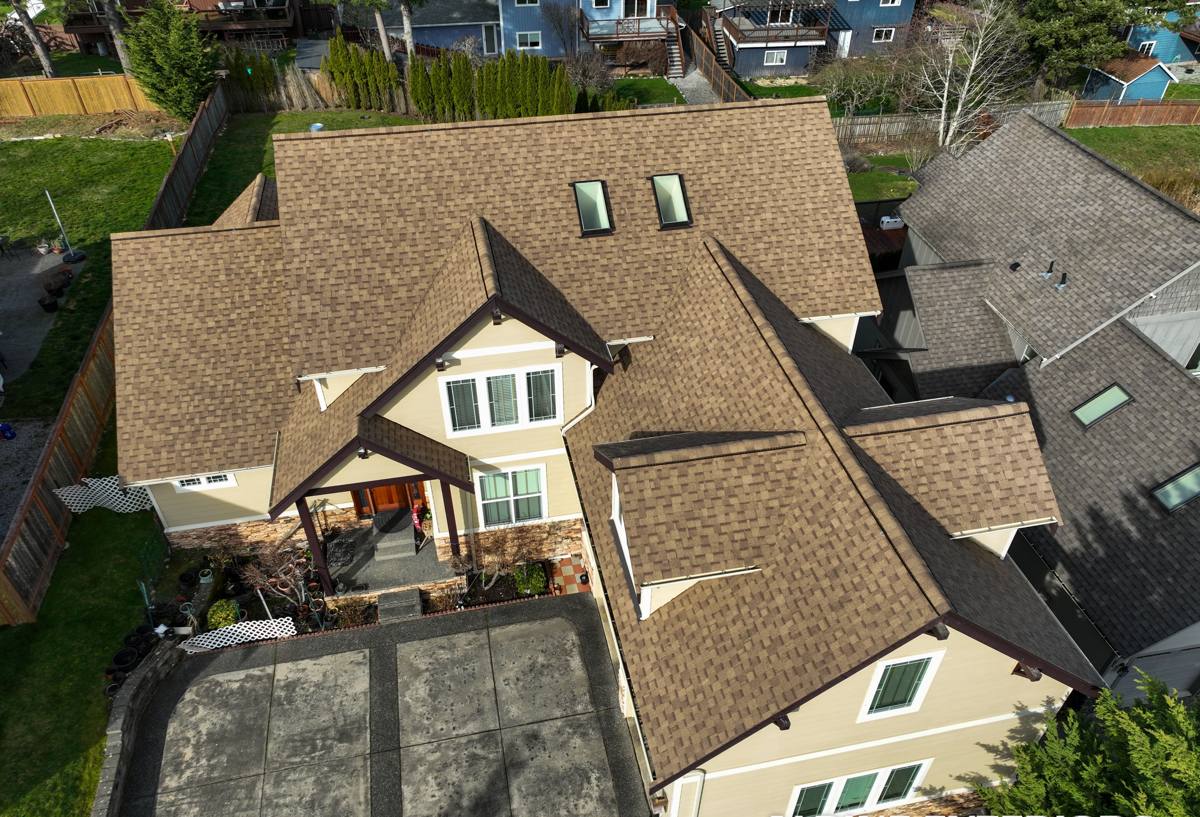
What Actually Counts as Storm Damage on a Local Roof
Homeowners often think "storm damage" means a dramatic hole or missing section. In practice, most of what we get called out for after a windstorm or heavy rain event is quieter than that.
Common Storm-Related Problems We See
- Shingles lifted or creased at the tab by sustained wind, even if they didn't blow off
- Flashing around chimneys, skylights, and roof-to-wall transitions pulled loose or bent
- Wind-driven rain forced sideways under shingle edges and ridge caps
- Limb or branch strikes from the conifers common throughout the region, cracking shingles or denting metal roofing
- Granule loss from wind abrasion, showing up as bare, shiny patches
- Clogged or overflowing gutters backing water up under the roof edge during heavy rain
Because moss holds moisture against the roof surface, storm damage and moss damage often show up together. A shingle edge that's already been lifted slightly by moss growth is far more vulnerable to wind getting underneath it during the next system that rolls through.
How We Inspect a Roof After a Storm
A proper storm inspection isn't a walk-around from the driveway. We get on the roof (weather permitting) and go section by section, and we also check the parts of the house most homeowners never think to look at.
Exterior Check
We look at every slope for lifted, cracked, or missing shingles; check flashing at chimneys, valleys, and sidewalls; inspect ridge caps and vents; and note any moss or debris buildup that's trapping water against the surface.
Interior and Attic Check
Storm damage often shows up inside the house before it's obvious on the roof. We check the attic for water staining, damp insulation, or daylight coming through at the decking, and we look at interior ceilings near exterior walls and chimneys for staining that points to a slow leak rather than a sudden one.
Documentation
If the damage is likely to involve an insurance claim, we photograph and describe findings in a way that's useful to an adjuster — not just "damaged," but where, how, and what it will take to correct.
What a Correct Repair Actually Involves
A lot of "storm damage repairs" in this region are done fast and shallow — a few shingles swapped, a bead of sealant, done. That approach tends to fail again in the next big blow, especially with the wind-driven rain typical of Whatcom County winters. A repair that actually holds up includes a few non-negotiables.
Matching and Compatible Materials
New shingles should match the existing roof's weight, profile, and as close to the color as the sun-faded original allows. Mismatched granule types and colors age differently, which shows and can also affect how well the patch sheds water at the seams.
Flashing Done Right, Not Just Caulked
Bent or corroded flashing gets replaced, not just re-sealed. Caulk is a short-term patch, not a repair, on flashing that's already failed once — especially in salt air, which accelerates corrosion on lower-grade metal.
Sheathing Inspection
Before new shingles go down, we check the decking underneath for soft spots or water staining. Shingling over damaged sheathing just hides a problem that will resurface, usually as a sag or a leak somewhere else on the same slope.
Moss and Debris Addressed, Not Just Covered
If moss contributed to the original failure, we clear it and address the conditions that let it grow back quickly (shade, debris buildup, poor drainage) rather than just repairing over it.
Repair or Replace? How We Help You Decide
Not every storm-damaged roof needs full replacement, and not every roof is worth repairing again. The honest answer depends on the roof's age, how widespread the damage is, and what condition the rest of the roofing system is in.
| Factor | Points Toward Repair | Points Toward Replacement |
|---|---|---|
| Roof age | Under 12-15 years, otherwise sound | Nearing or past typical shingle lifespan |
| Extent of damage | Isolated to one slope or small area | Multiple slopes, widespread granule loss |
| Sheathing condition | Solid, no rot found during inspection | Soft spots or water damage found underneath |
| Moss/algae history | Minor, manageable with cleaning | Long-term growth has degraded shingles broadly |
| Prior repairs | Roof is otherwise well-maintained | Multiple past patches, recurring leaks |
We'll always tell you plainly which side of that table your roof falls on, and why — including when a repair is genuinely the right, lower-cost call.
Storm Damage and Insurance Claims
Many storm repairs in this area do get filed as insurance claims, since wind and impact damage is often covered even when general wear isn't. A few things are worth knowing going in:
- Coverage typically hinges on a specific storm event, not gradual deterioration — documentation of the damage and its likely cause matters
- An adjuster's estimate and a contractor's estimate can differ, especially if the adjuster wasn't able to get eyes on every affected area
- Getting an independent inspection before or alongside the adjuster's visit gives you a second, unbiased set of findings
- You are entitled to choose your own contractor for the repair — you're not required to use anyone the insurance company suggests
We're happy to provide a written inspection report you can hand to your insurance company, whether or not you end up hiring us for the repair.
Our Process, Start to Finish
- Initial contact and scheduling — we get basic details about the storm event and visible damage, and get out to look in person.
- On-site inspection — full exterior and, where relevant, attic/interior check as described above.
- Written estimate — a clear breakdown of what's damaged, what needs to happen, and cost, with repair vs. replacement laid out honestly.
- Scheduling around weather — we work with the reality of a wet climate and plan repairs for windows where the roof can be properly dried in and sealed.
- The repair itself — materials matched, flashing replaced where needed, sheathing checked, moss addressed.
- Final walkthrough — we go over what was done and answer questions before we consider the job finished.
Why Local Experience in the Sudden Valley and Bellingham Area Matters
A crew that already works this part of Whatcom County knows things a roofer passing through doesn't. We know which slopes in this region tend to hold moss longest because of shade and tree cover near Lake Whatcom. We know how far wind-driven rain can push under a poorly sealed ridge cap during a real winter system off the Sound, not just a light shower. And we know the difference between a roof that needs a real repair and one where a quick patch is being oversold as a full fix.
That local knowledge also means fewer surprises during the job — we're used to working around this area's wet-season scheduling realities, and we're not guessing at what materials hold up here versus what looks fine on paper.
Keeping a Repaired Roof in Good Shape
A storm repair is only as good as the maintenance that follows it, especially in a climate that gives moss and moisture a year-round opportunity. A simple homeowner routine goes a long way between storms.
- Clear gutters and downspouts before the fall rains start, and again mid-winter if trees are nearby
- Look up at the roofline periodically for new moss growth, especially on shaded, north-facing slopes
- After any significant windstorm, do a visual check from the ground for obviously lifted or missing shingles
- Check attic insulation for dampness once a year, ideally after the wettest stretch of winter
- Don't wait on small leaks — a stain the size of a coin now is cheaper to fix than sheathing repair later
- Have a professional inspection every few years even without an obvious storm event, since slow damage doesn't always announce itself
If a recent storm has you wondering about the condition of your roof, we're glad to take a look. A free, no-pressure estimate is the easiest way to find out exactly what's going on and what it would take to fix it — just fill out the form below.