 Sudden Valley Siding
 Why Composite Decking Fits Alger Homes
Decks in this part of Whatcom County take a beating that decks in drier climates never see. Homes around Alger sit under tree cover, close to water, and inside a weather pattern that delivers long stretches of driving rain followed by damp, shaded stretches where nothing dries out fast. Add the salt air that drifts inland off the Sound and Bellingham Bay, and you've got a combination that's hard on any exterior surface — but it's especially hard on wood decking.
Composite decking was built for exactly this kind of exposure. It doesn't absorb water the way wood fibers do, it doesn't need annual staining or sealing, and it resists the slow rot that eventually takes down even well-maintained cedar or pressure-treated lumber. That doesn't mean composite is maintenance-free or foolproof — it still has to be installed correctly for this climate, with the right framing, fasteners, and drainage details. A composite deck installed the same way you'd install one in Arizona will not perform the same way here.
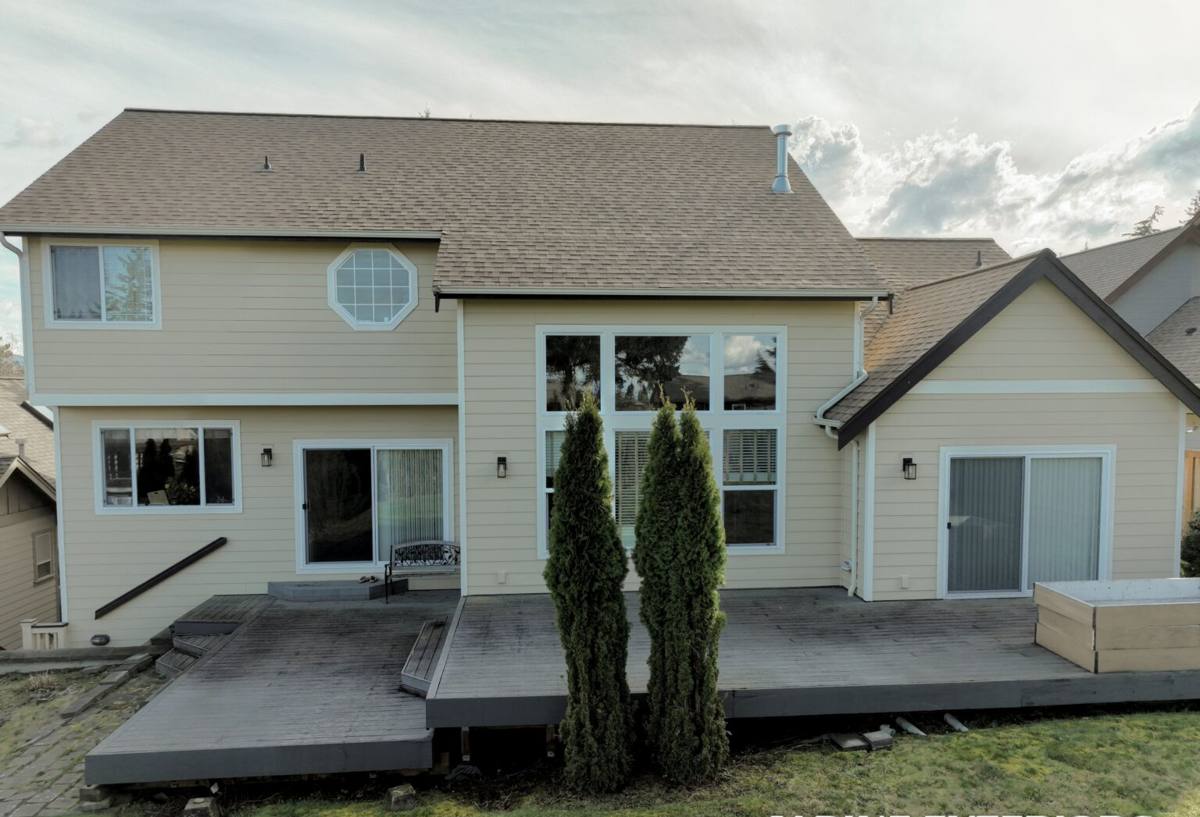
What Alger's Climate Actually Does to a Deck
Moisture That Never Fully Leaves
Whatcom County doesn't get occasional heavy rain — it gets sustained rain over months, followed by fog and dew that keep surfaces damp even on dry days. Framing lumber underneath a deck can stay wet for weeks at a time if it isn't ventilated and flashed properly. Composite boards handle surface moisture well, but the substructure underneath them is still almost always real lumber, and that lumber needs the same protection it would need under any deck.
Moss and Algae Growth
Anywhere shaded and damp long enough grows moss — roofs, walkways, and deck surfaces included. Composite decking is far less hospitable to moss than wood because it doesn't have the porous grain moss needs to root into, but it isn't immune, especially in board grooves, in permanently shaded corners, or where debris is allowed to sit and hold moisture against the surface.
Salt Air and Metal Fasteners
The salt air common to this stretch of coastal Washington accelerates corrosion on anything ferrous. Standard fasteners, joist hangers, and hidden fastener clips that aren't rated for coastal exposure will rust, stain the decking around them, and eventually weaken. This is one of the most common shortcuts we see on decks that were installed by crews unfamiliar with this region.
What a Correct Composite Deck Installation Involves
Composite boards themselves are fairly forgiving to install. What separates a deck that lasts twenty-plus years from one that has problems in five is almost entirely in the parts you don't see once the project is finished.
- Framing condition: joists and beams inspected and replaced where soft, undersized, or previously water-damaged — not just decked over
- Joist protection tape: applied to the tops of joists so fastener penetrations don't become entry points for moisture into the wood
- Coastal-rated fasteners and hardware: stainless or otherwise corrosion-resistant hidden fastener systems, hangers, and screws suited to salt-air exposure
- Proper board spacing: gaps sized to allow the boards to expand and contract with temperature and moisture swings without buckling or pinching
- Ledger board flashing: a correctly flashed and sealed connection where the deck attaches to the house, so water is directed away from the structure instead of behind it
- Under-deck ventilation: airflow beneath the deck so framing can dry between rain events instead of staying saturated all season
- Drainage and slope: a slight pitch away from the house so water sheets off rather than pooling on the surface or against the foundation
Skip any one of these and the composite boards on top can look fine for years while the structure underneath quietly deteriorates — which is a worse outcome than a wood deck showing visible wear, because the problem stays hidden until it's serious.
Composite vs. Other Decking Materials
| Material | Moisture Behavior in This Climate | Maintenance | Typical Lifespan Here |
|---|---|---|---|
| Composite (capped) | Resists water absorption, minimal swelling | Occasional washing | 25-30+ years |
| Composite (uncapped) | More prone to surface moisture absorption and staining over time | Periodic cleaning, more care around debris | 15-20 years |
| Cedar | Absorbs moisture, prone to graying, splitting, and moss in shaded areas | Annual cleaning and refinishing | 10-15 years with upkeep |
| Pressure-treated pine | Absorbs moisture, warps and checks over time | Regular sealing recommended | 10-15 years with upkeep |
| PVC decking | Fully moisture resistant, no wood content | Low | 25-30+ years |
Capped composite is our standard recommendation for most Alger homes: it holds up to this region's moisture and shade without the upkeep cycle that wood decking demands. PVC decking is a reasonable alternative for homeowners who want zero wood content in the deck surface at all, though it comes with its own tradeoffs in feel and flex underfoot that we're happy to walk through in person.
What Drives the Cost of a Composite Deck
| Factor | Why It Matters | Relative Cost Impact |
|---|---|---|
| Framing condition | Rotted or undersized joists/beams must be replaced, not decked over | Low to High |
| Board tier | Uncapped vs. fully capped composite affects material cost and longevity | Medium |
| Deck size and shape | Cuts, angles, and picture-frame borders add labor | Medium to High |
| Railing system | Composite or metal railing vs. simple wood rail | Medium |
| Height and stairs | Elevated decks need more structural work and stair framing | Medium to High |
| Access to the site | Tight lots or limited equipment access add time | Low to Medium |
We give honest ranges once we've actually looked at the existing structure — framing condition is the single biggest swing factor, and it's not something we can accurately estimate from a phone call or a photo.
How We Handle a Composite Decking Project
- On-site assessment: we inspect the existing deck or the build site, including framing, ledger connection, and drainage, before quoting anything
- Honest scope: we tell you plainly what needs to be replaced structurally versus what can be reused, and why
- Tear-off (if replacing): old decking and any compromised framing removed and hauled off
- Framing and flashing repair: joists, beams, ledger flashing, and hardware brought up to a standard that fits this climate, not a generic spec sheet
- Composite installation: boards, hidden fasteners, and railing installed with proper spacing and coastal-rated hardware
- Final walkthrough: we go over the finished deck with you, including basic care, before we consider the job done
Living With and Caring for a Composite Deck Here
Composite decking is genuinely lower-maintenance than wood, but "low-maintenance" in a Whatcom County shade pocket still means doing a few things on a schedule. Neglect these and you'll get moss and organic staining even on a well-installed composite deck.
- Sweep leaves, needles, and debris off the deck regularly, especially in fall and through the wet season — trapped organic matter is what feeds moss and algae
- Wash the surface a couple of times a year with a soft-bristle brush and a mild deck cleaner rather than a pressure washer on high, which can damage the board surface
- Keep planters, mats, and furniture legs from sitting in one spot for months at a time so moisture and debris don't collect underneath them
- Check that gutters and downspouts near the deck are directing water away rather than dumping onto or under it
- Have the under-deck area checked periodically for framing moisture, especially on decks over ten years old
Signs an Existing Deck Needs Attention
- Soft, spongy, or bouncy spots underfoot
- Boards that have visibly warped, cupped, or separated at the fasteners
- Rust staining bleeding through around screws or hardware
- Persistent moss or dark staining that comes back quickly after cleaning
- Gaps or movement where the deck meets the house at the ledger board
- Visible rot or discoloration on the framing when you look underneath
Any one of these is worth a look before it becomes a safety issue rather than a cosmetic one.
Why Local Experience Matters for This Job
Composite decking installation isn't complicated in the abstract, but doing it right in a climate with sustained rain, shaded moss growth, and salt-air corrosion takes judgment that comes from working on decks in this specific area, not just decks in general. A crew that already works around Alger and the wider Sudden Valley area knows which fastener grades hold up, how much slope and ventilation this region's rainfall actually requires, and where moss tends to establish itself on a deck surface long before it becomes obvious. That's the difference between a deck that still looks and performs like new in fifteen years and one that needs framing repairs long before the composite boards themselves would have failed.
If you're planning a new composite deck or replacing an aging one in Alger, we're glad to take a look and give you a straightforward, no-pressure estimate — just fill out the form below.