 Sudden Valley Siding
 Siding Repair Built for Lake Whatcom's Weather
Lake Whatcom sits in a pocket of Whatcom County that gets more of everything the Pacific Northwest throws at a house: more rain funneling off the hillsides, more humidity holding in the tree cover, and more moss than almost anywhere else in Sudden Valley. Homes here don't fail because the siding was cheap or the crew was lazy — they fail because water found a gap, sat there through a wet winter, and nobody caught it until the damage was already behind the wall. Siding repair in this area isn't just patchwork. It's diagnosing why the failure happened in the first place and making sure the fix doesn't repeat the same mistake.
We work on homes around Lake Whatcom regularly, and the patterns repeat: north-facing walls that never fully dry out, siding near mature evergreens that stays shaded and damp for days after a storm, and trim details where the original installer didn't leave enough clearance for water to shed. A repair that ignores those conditions is a repair that comes back in two or three years.
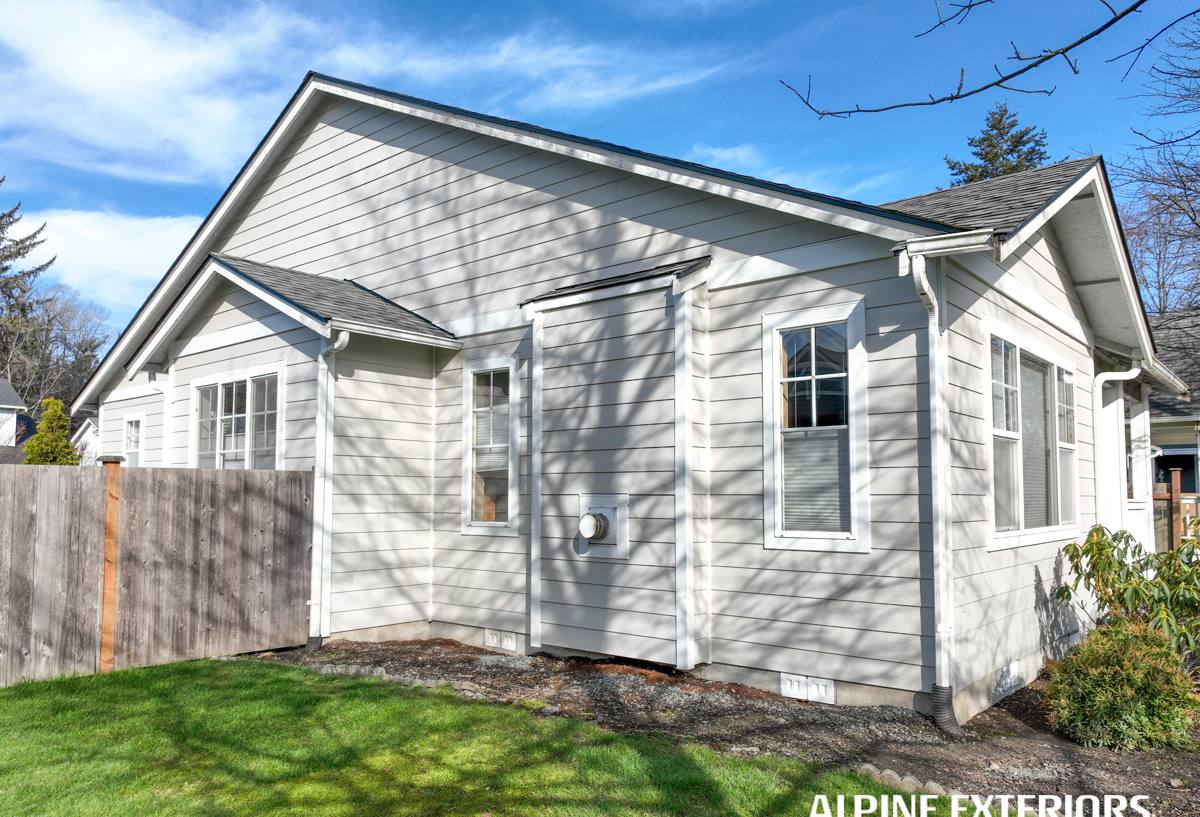
Why Lake Whatcom Homes Take a Different Kind of Beating
Moisture That Doesn't Let Up
Lake-adjacent air holds more moisture longer than homes further from the water. Combined with driving rain off the lake during winter storms, siding here gets wet more often and dries more slowly than siding on a typical inland lot. Any material or installation detail that's marginal on moisture tolerance shows its weakness here first.
A Long Moss Season
Shade from the surrounding tree cover, combined with consistent dampness, gives moss a long window to establish itself — on roofs, on decks, and on siding, especially in corners and behind gutters where debris collects. Moss holds moisture directly against the surface it's growing on, which is exactly the wrong thing to have happening to a wall for months at a time.
Wind-Driven Rain and Storm Exposure
Winter storms push rain sideways, not straight down, which means the usual weak points — butt joints, caulk lines, flashing above windows and doors — take on water they weren't necessarily designed to shed under everyday conditions. Repeated exposure like this is what turns a small installation gap into a real moisture problem over a few seasons.
What Siding Repair Actually Involves
A proper repair starts with figuring out what's actually wrong, not just what's visible. Cracked or buckled boards are the obvious symptom, but the real question is what let water or movement get to that point. That means checking the flashing above the damaged area, looking at how the boards were fastened, and, where there's any doubt, opening up the area enough to see the water-resistive barrier and sheathing behind it.
Common Repair Scenarios We See Around Lake Whatcom
- Moss-driven surface breakdown — moss and algae holding moisture against panels or lap siding, softening paint film and, on older or non-fiber-cement products, the substrate underneath.
- Cracked or split boards — usually from moisture cycling (swelling and shrinking) in a material not engineered for it, or from impact damage that went unrepaired.
- Failed caulking and trim joints — gaps that opened up as the house settled or the original caulk aged out, letting wind-driven rain behind the siding.
- Rot at the bottom courses — the classic failure point where siding sits too close to grade, decking, or landscaping and never gets a chance to dry.
- Flashing gaps above windows and doors — often invisible until you pull a board, and one of the most common sources of hidden water damage in this area.
What a Correct Repair Includes
- Diagnose the actual water path — not just replace what's visibly damaged.
- Check the sheathing and water-resistive barrier behind the damaged section for hidden rot before closing anything back up.
- Correct the underlying detail (flashing, clearance, fastening) so the same failure doesn't repeat.
- Match materials and finish so the repair blends rather than becoming its own future weak point.
- Re-seal and re-caulk to current standards, not just however the original joint was done.
Repair vs. Replacement: How We Make the Call
Not every damaged section needs a full re-side, and we're not going to tell a homeowner they need one if a targeted repair genuinely solves the problem. But there's a point where patching keeps costing money without fixing anything, and it's worth being honest about where that line is.
| Situation | Repair Usually Makes Sense | Replacement Usually Makes Sense |
|---|---|---|
| Damage extent | Isolated to one wall or a few boards | Spread across multiple elevations |
| Underlying sheathing | Dry, sound wood behind the damaged area | Soft, rotted, or repeatedly wet sheathing |
| Siding age and material | Newer material, or Hardie board with isolated impact damage | Original material at or past its realistic service life |
| Root cause | A fixable detail (flashing, caulk, clearance) | A systemic issue (no water-resistive barrier, widespread gaps) |
| Moss/moisture pattern | Surface-level, cleaned and treated | Recurring across the house year after year |
If we open a wall for a repair and find that the damage goes well beyond what's visible from the outside, we'll tell you that plainly, with photos and an honest explanation — not push straight into a bigger sale.
Why We Only Repair and Replace With James Hardie
When a repair involves patching in new material, what we use matters. We install James Hardie fiber cement exclusively — we don't carry vinyl, LP SmartSide, Cemplank, Allura, primed spruce, or cedar. That's a deliberate standard, not a matter of what happened to be on the truck.
In a climate like Lake Whatcom's, the differences show up fast. Wood-based products, even engineered ones, absorb and release moisture with the seasons, and in a spot this consistently damp, that cycle is relentless. Vinyl doesn't rot, but it flexes and gaps with temperature swings and doesn't hold paint if a homeowner ever wants to change the color. Hardie's fiber cement is engineered specifically for wet, moss-prone climates like this one — it's non-combustible, it doesn't feed moss and algae the way wood-based products can, and its ColorPlus factory finish holds color and resists the fading and chalking that comes from years of gray-sky exposure. Hardie's HZ5 product line in particular is built for regions with heavy moisture and freeze-thaw cycling, which describes this part of Whatcom County well.
Patching a repair with mismatched material is one of the fastest ways to create a future problem — different expansion rates, different moisture behavior, different finish life. Using Hardie for repairs on a Hardie home is straightforward. On homes with older or different siding, we'll be upfront about what a clean, lasting repair with matching material actually requires, and where it makes more sense to plan for a phased or full transition to Hardie over time.
Our Process for Lake Whatcom Siding Repair
- On-site inspection — we look at the damaged area and the conditions around it: grade, drainage, shade, gutter overflow, and how water actually moves across that wall.
- Honest diagnosis — we tell you what we think caused the damage, not just what we plan to replace.
- Written scope and cost — a clear explanation of what's included, what materials we're using, and why.
- Correct the cause, not just the symptom — flashing, clearance, and sealing details get fixed as part of the repair, not left as-is.
- Clean finish — matched material and color where possible, sealed to current standards.
Moss and Moisture Prevention After the Repair
A repair is only worth doing if it holds up. A few habits make a real difference for homes on the lake:
- Keep gutters clear so overflow isn't running straight down the siding.
- Trim back branches and brush that keep a wall in constant shade and dampness.
- Rinse visible moss and algae buildup before it has a chance to spread or hold moisture against the surface.
- Check caulk lines around windows, doors, and trim once a year — small gaps are cheap to reseal and expensive to ignore.
- Watch the bottom courses near grade, decks, and planting beds, where splash-back and poor drainage cause the most repeat damage.
Working With a Crew That Knows Lake Whatcom
Siding repair done by someone unfamiliar with this specific microclimate tends to treat every home the same way. A crew that's actually worked around Lake Whatcom knows which walls take the worst of the wind-driven rain, how long moss season really runs here, and where the original builders in this area tended to cut corners on flashing and clearance. That local knowledge is the difference between a repair that's cosmetic and one that actually solves the problem for good.
If you've got damaged, cracked, or moss-covered siding on a Lake Whatcom home, we're happy to take a look and give you a straight answer — no pressure, no upsell, just what we'd actually recommend if it were our own house. Reach out for a free estimate using the form below.