 Sudden Valley Siding
 Why Roofs Age Faster Near Fairhaven and Bellingham Bay
Fairhaven sits close to the water, and that location is a mixed blessing for a roof. The same salt-laced air that makes the neighborhood feel coastal also accelerates corrosion on fasteners, flashing, and metal roof edges. Add in driving rain that comes off the bay sideways during winter storms, and you've got water finding its way under shingles, around chimneys, and into valleys that a roof twenty miles inland would never have to deal with. Then there's shade. Mature tree cover, marine humidity, and long stretches of overcast days from fall through spring create a moss season that can run six months or longer here in Whatcom County. Moss isn't just cosmetic — it holds moisture against the roofing material, lifts shingle edges, and works its way under flashing over time.
None of this means Fairhaven homes need exotic roofing. It means the details — underlayment choice, flashing quality, ventilation, and fastener selection — matter more here than they do in a drier, more sheltered part of the county. A roof replacement done to a generic spec, without accounting for these local conditions, tends to show problems again within five to eight years instead of lasting out its expected lifespan.
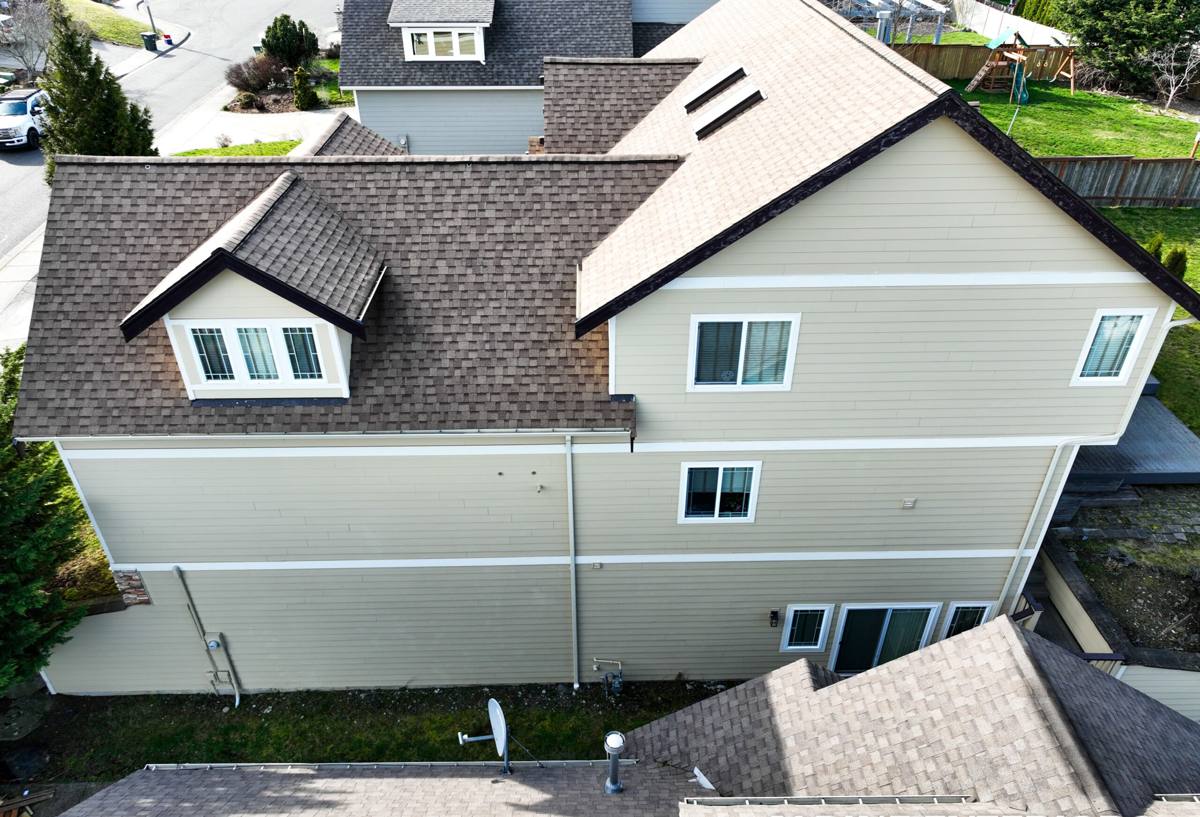
Warning Signs It's Time to Replace, Not Repair
Not every roof problem in Fairhaven calls for a full replacement. But there's a point where patching becomes a losing game — you're spending money to delay the inevitable instead of fixing it. Here's what tends to tip a roof from "repairable" into "replace" territory:
- Granule loss heavy enough that you're finding grit in the gutters every time it rains
- Shingles that are curling, cupping, or cracking across multiple slopes, not just one weathered section
- Moss growth that keeps coming back within a season or two of cleaning, especially on north-facing slopes
- Soft or spongy decking felt underfoot in the attic, or daylight visible through the roof boards
- Rusted or failing flashing around chimneys, skylights, and roof-to-wall junctions
- Interior water stains that reappear after repairs, meaning the water is finding a new path in
- A roof at or past 20–25 years old (asphalt) or showing widespread wear rather than one localized issue
If you're only seeing one or two of these, a targeted repair may still make sense. If you're seeing several at once, that's usually the roof telling you it's done as a system, not just in one spot.
Roofing Materials That Hold Up to Salt Air, Rain, and Moss
Every roofing material has trade-offs, and the right choice depends on your home's exposure, your budget, and how much upkeep you're willing to do. We'll walk through the honest pros and cons for a Fairhaven property rather than push one product for everyone.
| Material | Moss/moisture behavior | Salt air durability | Typical lifespan | Maintenance |
|---|---|---|---|---|
| Architectural asphalt shingle | Good with algae-resistant granules; needs clean valleys | Solid with quality fasteners and flashing | 25–30 years | Low to moderate |
| Synthetic/composite shingle | Very good; resists moisture absorption | Strong; won't corrode | 30–40 years | Low |
| Standing seam metal | Excellent; moss struggles to grip smooth panels | Depends on coating; needs a coastal-rated finish | 40–50+ years | Low |
| Cedar shake | Poor without diligent upkeep; holds moisture | Moderate; salt speeds weathering | 20–30 years with maintenance | High |
For a lot of Fairhaven homes, algae-resistant architectural asphalt or a synthetic shingle strikes the best balance of cost, appearance, and moss resistance. Metal is worth serious consideration on homes with heavy shade or steep, hard-to-maintain slopes, since it gives moss the least to hold onto. We don't push cedar shake as a default choice in this climate — not because it's a bad-looking product, but because keeping it performing well this close to the water takes a level of ongoing maintenance most homeowners don't want to sign up for. That's an honest trade-off conversation we'll have with you, not a knock on the material itself.
What a Correct Roof Replacement Actually Includes
A roof replacement is more than stripping old shingles and nailing down new ones. Done right, especially in a wet coastal climate, it involves several layers that each do a specific job:
Tear-off and deck inspection
We remove the old roofing down to the deck so we can actually see what's underneath — soft spots, rot, or old water damage that a re-roof over existing layers would just seal in. Any damaged sheathing gets replaced before anything new goes down.
Ice-and-water shield and underlayment
Eaves, valleys, and any low-slope transitions get a self-adhering waterproof membrane, not just felt paper. Given how much wind-driven rain Fairhaven sees, this is one of the details that separates a roof that holds up for decades from one that starts leaking at the first hard storm.
Flashing
Chimneys, skylights, sidewalls, and roof valleys all need properly formed, corrosion-resistant flashing — this is one of the most common failure points on older roofs in salt-air areas, and it's worth getting right the first time rather than patching it repeatedly.
Ventilation
Balanced intake and exhaust ventilation keeps the attic dry and temperature-regulated, which protects the deck from the inside and helps the shingles themselves last their full rated life.
Final materials and fasteners
Corrosion-resistant fasteners and flashing metals matter more here than in a drier inland climate — cheaper hardware corrodes and weakens well before the shingles themselves wear out.
Ventilation and Moisture Control: The Part Homeowners Don't See
This deserves its own explanation because it's the part that gets skipped most often on rushed jobs, and it's invisible until it fails. A roof deck that can't breathe traps moisture from both directions — humid air rising from inside the house, and damp marine air sitting on the roof surface for months during moss season. Over time that trapped moisture leads to sheathing rot, mold, and shingles that fail from underneath, well before their surface wear would suggest it. Proper ventilation, sized correctly for your attic and roof shape, is one of the cheapest parts of the job relative to how much it protects everything else you've paid for. It's also easy for an estimate to leave out, since it doesn't show up in a walk-around inspection of the roof surface — it only shows up years later, in the form of a callback.
Our Roof Replacement Process
- On-site inspection and estimate. We walk the roof and attic, check the deck, flashing, and ventilation, and give you a written, itemized quote — no surprise add-ons once work starts.
- Material selection. We go through the options above based on your home's exposure, budget, and how much maintenance you want to take on long-term.
- Scheduling around the weather. Whatcom County's rain patterns mean timing matters; we plan tear-off in windows that minimize the roof sitting open to the elements.
- Tear-off and deck repair. Old roofing comes off, decking is inspected, and any compromised sections are replaced.
- Underlayment, flashing, and ventilation installed. The layers that don't show but do the real work of keeping water out.
- New roofing installed to manufacturer spec. Correct nailing patterns and exposure are what keep warranties valid and roofs performing as designed.
- Cleanup and walkthrough. Site is cleared of debris and nails, and we walk you through the finished roof and any warranty paperwork.
Cost Factors for a Fairhaven Roof Replacement
Every roof is different, so we won't quote a number without seeing yours, but these are the main factors that move the price up or down:
| Factor | Why it matters |
|---|---|
| Roof size and number of slopes | More squares and complexity mean more material and labor |
| Pitch and access | Steep or hard-to-access roofs take longer and require more safety setup |
| Deck condition | Rotted or soft sheathing found during tear-off adds material and labor |
| Material choice | Asphalt, synthetic, and metal carry different material and install costs |
| Flashing and ventilation scope | Older homes often need more flashing replacement and ventilation upgrades |
| Layers being removed | Tearing off multiple existing layers adds disposal and labor time |
As a broad range, a full asphalt shingle replacement on an average Fairhaven-area home typically runs from the mid-teens to the low thirties, in thousands of dollars, with metal roofing running higher. The only way to get an accurate number is a look at the actual roof, which is what the estimate is for.
Why Hire a Crew That Already Works This Area
A roofing crew that mostly works inland or in drier parts of Washington isn't necessarily going to default to coastal-grade flashing, algae-resistant materials, or the ventilation approach that a Fairhaven roof needs. Those aren't upgrades — they're the baseline for a roof that's going to face salt air, driving rain, and a long moss season every single year. Working this part of Whatcom County regularly also means knowing how local permitting works, what the wind exposure actually looks like street to street near the bay, and which failure points show up again and again on homes with this kind of coastal weather history. That familiarity shows up less in any one dramatic decision and more in a dozen small ones — the underlayment brand, the flashing detail at a tricky valley, the ventilation math — that add up to a roof that's still doing its job in twenty-five years instead of ten.
If your roof is showing its age or you just want an honest assessment of where it stands, we're happy to take a look. Reach out for a free, no-pressure estimate using the form below.