 Sudden Valley Siding
 Metal Roofing Built for Edgemoor's Coastal Exposure
Edgemoor sits close enough to Bellingham Bay that salt-laden air is a real factor in how long a roof lasts, not a theoretical one. Add in the driving rain that comes off the water during fall and winter storms, plus the deep shade thrown by mature conifers on many wooded lots, and you've got a roofing environment that's tougher on materials than most inland parts of Whatcom County. We install metal roofing on Edgemoor homes with that specific combination in mind — not a generic install pulled from a manufacturer brochure.
A metal roof done right for this neighborhood has to manage three things at once: resist corrosion from airborne salt, shed heavy wind-driven rain without backing up at seams and penetrations, and stay ahead of the moss and algae growth that thrives in shaded, damp conditions for much of the year. Get any one of those wrong and you're looking at premature fading, rust streaking, or leaks well before the roof should be showing its age.
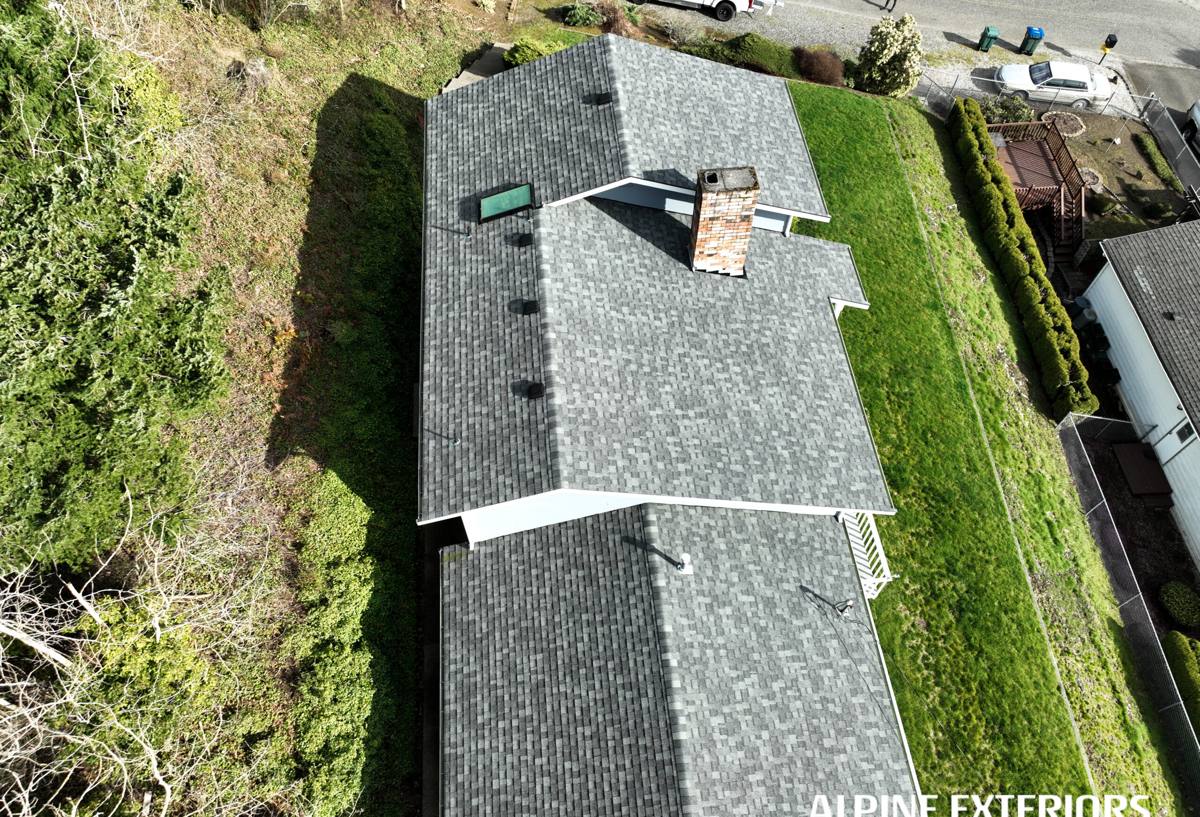
What Salt Air and Driving Rain Actually Do to a Roof
Salt air doesn't ruin a roof overnight — it works slowly, at fastener heads, cut edges, and any spot where the protective coating on a metal panel gets scratched or worn thin. Over years, untreated or poorly coated steel will show rust bleed at those weak points first, usually around screws, flashing seams, and panel ends. Aluminum and properly coated steel resist this far better, which is part of why material selection matters more here than it would twenty miles inland.
Driving rain adds a second layer of stress. When wind pushes rain sideways instead of letting it fall straight down, water finds its way under poorly lapped panels, around undersized flashing, and through fastener penetrations that weren't sealed correctly. A roof that would perform fine in calm conditions can leak in Edgemoor's wind-driven storms if the laps, flashing details, and fastener spacing weren't built for that kind of weather in the first place.
Where Problems Usually Start
- Fastener heads with worn or missing washers, letting water track down the screw shaft
- Undersized or poorly lapped valley and ridge flashing
- Panel end cuts left unsealed or unpainted, exposing bare metal to salt air
- Low-slope transitions and dormers where wind-driven rain collects instead of shedding
- Shaded north- and west-facing slopes where moss gets a foothold and holds moisture against the panel
Choosing the Right Metal Roofing System for This Neighborhood
Not every metal roofing product is a good fit for a coastal, tree-shaded lot. We steer Edgemoor homeowners toward systems that hold up to salt exposure and heavy rain without high maintenance demands, and we're upfront about the trade-offs of each option rather than pushing whatever's easiest to install.
| System | Best For | Trade-Offs |
|---|---|---|
| Standing seam steel or aluminum | Full roofs, especially on homes with rain exposure and visible rooflines | Higher upfront cost; requires experienced installers for clean seams and flashing |
| Exposed-fastener metal panels | Secondary structures, additions, budget-conscious projects | Fasteners need periodic inspection and re-sealing over the roof's life |
| Stone-coated steel | Homeowners wanting a shake or tile look with metal's durability | More installation steps; heavier than bare panel systems |
For most Edgemoor homes we recommend standing seam over exposed-fastener panels, specifically because it has far fewer penetration points for wind-driven rain to exploit, and no exposed fastener heads for salt air to work on over time. It costs more to install, but it's the system that best matches what this location actually demands from a roof.
Coatings and Fastener Hardware Matter as Much as the Panel
Two roofs using the same panel gauge can perform very differently based on coating quality and fastener hardware. We use coatings rated for coastal exposure and stainless or coated fasteners rather than standard hardware, because the difference shows up years down the line as rust streaking or premature fading — problems that are expensive to fix after the fact but cheap to avoid at install time.
What a Correct Metal Roof Installation Actually Involves
A metal roof is only as good as the details underneath it. The panels get the attention, but the underlayment, flashing, and ventilation are what determine whether the roof performs for its full service life or starts giving trouble in year five.
The Details We Don't Skip
- Synthetic or self-adhering underlayment rated for high-wind, wind-driven rain conditions, not the cheapest roll available
- Properly sized and lapped flashing at every valley, wall transition, and roof penetration
- Fastener spacing and torque set to the manufacturer's coastal or high-wind specification, not a generic default
- Ridge and eave ventilation sized correctly so trapped moisture isn't cooking the underside of the panels
- Panel end caps and closures installed to keep pests and wind-driven rain out of open panel ribs
Skipping any of these to save a day of labor is where most metal roof problems in this area actually originate — not from the panels themselves failing, but from what's underneath or around them being under-built for the conditions.
Moss, Algae, and the Shade Factor
Edgemoor's tree cover is part of what makes the neighborhood attractive, but shaded roof sections stay damp longer after every rain, and that's exactly what moss and algae need to establish. Metal roofing resists moss far better than composition shingle or wood, since there's no porous surface for spores to root into, but it isn't immune — moss can still build up in valleys, at panel laps, and anywhere debris collects and holds moisture against the metal.
The fix isn't chemical treatments or aggressive pressure washing, which can strip coatings and void warranties. It's keeping valleys and laps clear of needles and leaf litter, and making sure the roof design doesn't create flat, slow-draining sections where debris naturally piles up. We factor tree exposure into the panel layout and flashing design on shaded Edgemoor lots specifically to reduce how much maintenance the roof needs down the road.
Our Process for Edgemoor Metal Roofing Projects
- On-site assessment. We look at roof slope, tree exposure, wind exposure relative to the bay, and the condition of the existing roof deck before recommending a system.
- System and material selection. Based on that assessment, we recommend a panel type, coating, and fastener package suited to the specific lot — not a one-size answer for every job.
- Deck and structure check. We confirm the roof deck is sound before panels go on; metal roofing only performs as well as what it's fastened to.
- Underlayment and flashing installation. This is where most of the long-term performance gets built in, and it's the step we spend the most time getting right.
- Panel installation. Panels go on to manufacturer spec for fastener spacing, seam engagement, and end treatment.
- Final walkthrough. We review the completed roof with the homeowner, including what maintenance — if any — the system will need going forward.
Why a Crew That Already Works This Area Matters
A crew that's worked Edgemoor's lots before already knows what standard-issue installers often learn the hard way: how narrow driveways and mature trees limit staging and material delivery, how permitting works through Whatcom County and the City of Bellingham depending on exactly where a property sits, and which flashing and coating specs actually hold up against this location's combination of salt air and rain rather than just looking good on a spec sheet. That local track record shows up in fewer surprises mid-project and a roof detailed for the conditions it will actually face, not generic conditions.
It also matters for accountability. A crew with an ongoing presence in the neighborhood has a reputation to protect with the homeowners who live here, which is a different incentive than a crew passing through on a one-off job.
Cost Factors for Edgemoor Metal Roofing Projects
Metal roofing costs more upfront than composition shingle, but the gap narrows over the life of the roof given how much less maintenance and how many fewer replacement cycles a good metal system needs. Exact pricing depends on the project, but the main cost drivers are consistent across jobs:
| Factor | Why It Affects Cost |
|---|---|
| Panel system chosen | Standing seam runs higher than exposed-fastener panels due to labor and material |
| Roof complexity | Valleys, dormers, and multiple roof planes add flashing work and labor time |
| Tear-off vs. overlay | Removing an old roof adds cost but is often necessary to check deck condition |
| Coating and fastener grade | Coastal-rated coatings and hardware cost more but reduce long-term maintenance |
| Access and staging | Tree cover, slope, and driveway width can affect equipment and labor time |
We provide a project-specific estimate after seeing the roof in person rather than quoting off square footage alone, since the factors above can shift a price meaningfully from one Edgemoor lot to the next.
A Quick Checklist Before You Commit to Metal Roofing
- Confirm the contractor is specifying coastal-rated coatings and fasteners, not standard-grade hardware
- Ask what underlayment is being used and whether it's rated for wind-driven rain
- Get flashing details in writing for valleys, walls, and any roof penetrations
- Ask how the design handles shaded, moss-prone sections of the roof
- Check that ventilation is being addressed, not just the panel installation itself
- Get a written warranty that covers both material and workmanship, and understand what voids it
If you're weighing metal roofing for a home in Edgemoor, we're happy to take a look and walk through what your specific roof needs given its exposure, shade, and layout. Reach out for a free, no-pressure estimate using the form below.