 Sudden Valley Siding
 Lake Whatcom Siding Has to Work Harder Than Siding Anywhere Else in the County
Homes around Lake Whatcom sit in one of the more demanding microclimates in Whatcom County. Between the tree cover, the lake-effect humidity, and long stretches where a wall never sees direct sun, siding here is under near-constant moisture load for months at a time. Add in the driving rain that comes off the Sound-influenced weather systems that move through this part of Washington, and you've got a combination that punishes any siding product with a weak point — a butt joint that isn't sealed right, a face that swells when it gets wet, or a finish that can't shed water fast enough between storms.
We install James Hardie fiber cement siding exclusively, and Lake Whatcom is exactly the kind of neighborhood that explains why. This page covers what the local climate actually does to siding here, what a correct James Hardie installation involves on a Lake Whatcom lot, and how our process works from estimate to finished job.
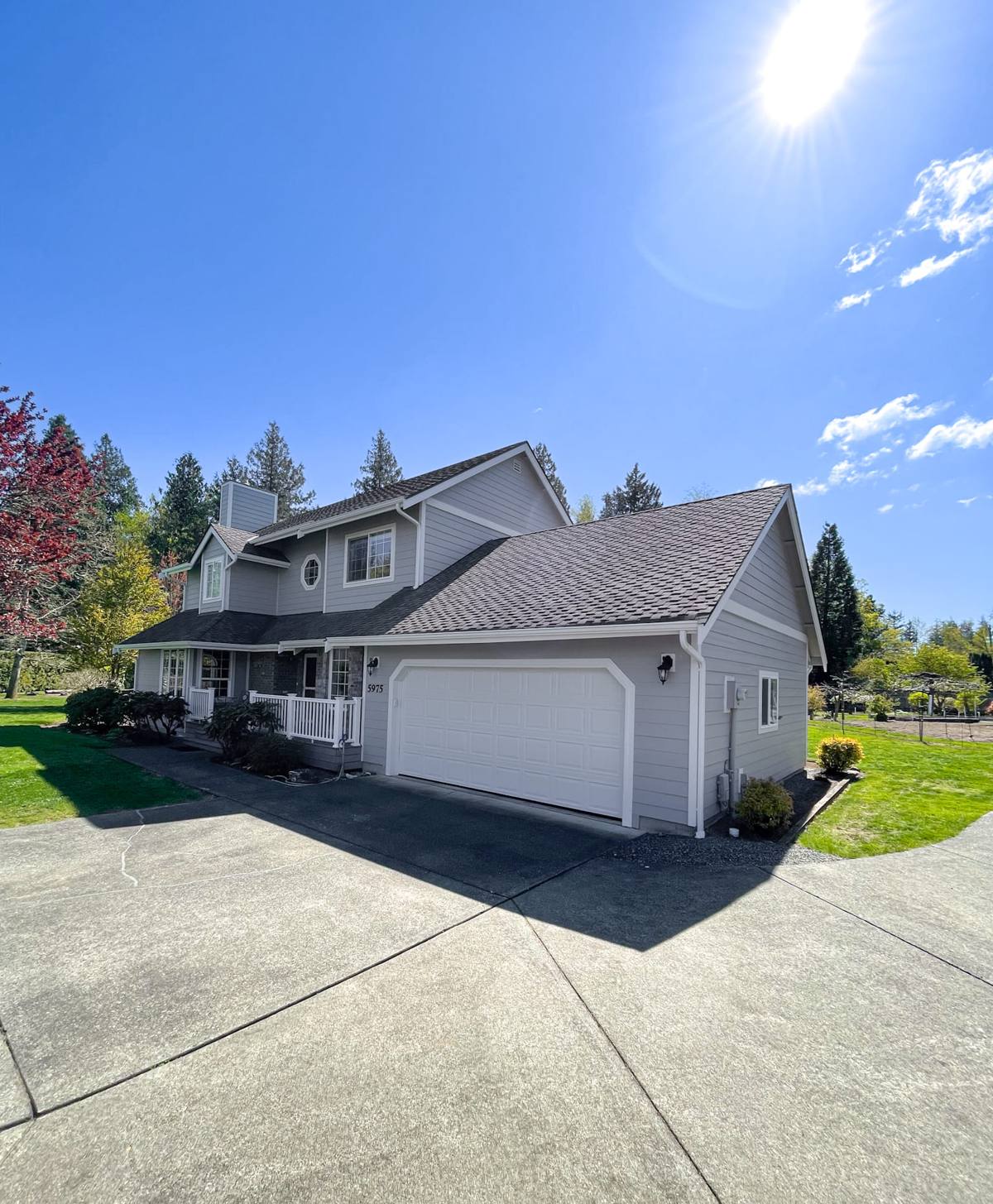
What Shade, Moss, and Driving Rain Do to a Home's Exterior
The moss problem
North- and east-facing walls around Lake Whatcom — especially on wooded lots — can stay damp for weeks during the wet season. That's the environment moss and algae need to establish. On wood-based siding products, moss holds moisture directly against the substrate, and once it's rooted into a seam or a soft spot, it accelerates rot from the outside in. Fiber cement doesn't give moss the same foothold, and it doesn't break down when moss is pressure-washed off, which matters because most homeowners here end up cleaning their siding at least once a year regardless of what it's made of.
Driving rain and wind-driven water
Rain in this part of Whatcom County rarely falls straight down. Wind pushes it sideways into wall assemblies, which means the water-resistive barrier behind the siding, the flashing details, and the siding's own joints all have to work together. A siding product that swells, cups, or loses its seal at the joints under repeated wetting-and-drying cycles will eventually let water past — no matter how well it looked on installation day.
The freeze-thaw shoulder seasons
Whatcom County doesn't get brutal winters, but Lake Whatcom's elevation and tree cover mean shaded siding stays wet longer into cooler weather, and there are enough freeze-thaw cycles each winter to stress any material that's already saturated. Siding that absorbs water is siding that's vulnerable during those cold snaps.
Why We Only Install James Hardie Here
We don't install LP SmartSide, vinyl, Cemplank, Allura, primed spruce, or cedar — not because those products don't have a place in the market, but because we've made a professional call that James Hardie's fiber cement is the product that holds up best to the specific conditions homes around Lake Whatcom face year-round. A few of the reasons that call matters here specifically:
- Non-combustible core. Fiber cement doesn't feed a fire the way wood-based products can — worth noting for wooded lots near Lake Whatcom where defensible space and building material both factor into wildfire risk during dry summer stretches.
- Moisture-stable substrate. Hardie's fiber cement doesn't swell, delaminate, or wick water the way engineered wood products can when they're under prolonged damp shade.
- Factory-applied ColorPlus finish. A finish baked on and cured at the factory holds color and resists cracking far longer under UV and moisture cycling than a field-applied paint job, which matters when a home is going to sit under filtered light and damp air for most of the year.
- Climate-engineered product lines. Hardie builds regional formulations specifically for wet, temperate climates like ours — this isn't a one-size-fits-all product.
We're upfront that this is our standard, not a claim that every alternative product fails outright. Vinyl is inexpensive and low-maintenance in mild climates; cedar has real curb appeal for the right buyer willing to keep up with it. But given what Lake Whatcom's shade and moisture load do to a wall over ten, twenty, thirty years, we don't think those trade-offs make sense for homes here, and we'd rather turn down work than install something we don't believe will perform.
The HZ5 Line: Built for This Kind of Climate
James Hardie makes climate-specific formulations under its HZ (HardieZone) system. Western Washington, including the Lake Whatcom area, falls into the HZ5 zone, engineered for regions with sustained moisture exposure and moderate freeze-thaw activity. Practically, that means the plank composition and moisture-management engineering are matched to exactly the conditions described above — not a generic national blend.
Popular Hardie product lines we install around Sudden Valley and Lake Whatcom include:
| Product | Best fit for | Notes |
|---|---|---|
| HardiePlank lap siding | Most single-family homes | Available in smooth or cedar-textured finish; the most common choice on the lake |
| HardiePanel vertical siding | Accent walls, gables, modern/cabin-style homes | Common on Lake Whatcom's more contemporary builds and A-frame-style cabins |
| HardieShingle | Homes wanting a shingle-style look without the moisture upkeep of real cedar shingle | Good option for homeowners drawn to a rustic aesthetic near the lake |
| HardieTrim | Fascia, corner boards, window trim | Pairs with any of the above for a consistent, sealed system |
What a Correct Installation Actually Involves
Fiber cement performs the way it's rated to perform only when it's installed to Hardie's published specifications. On a shaded, moisture-heavy lot like most properties around Lake Whatcom, the details below aren't optional extras — they're the difference between siding that lasts decades and siding that fails early despite being the "right" product.
- Correct starter strip and clearance from grade, decks, and roof lines so water has somewhere to go
- Proper water-resistive barrier and flashing at every window, door, and penetration before the first plank goes up
- Manufacturer-specified fastener pattern and fastener type — under- or over-driven nails are one of the most common causes of early failure
- Correct joint treatment and gapping so panels can move without opening a moisture path
- Field-cut edges sealed per Hardie spec, since raw cut edges are the most vulnerable point on any fiber cement job
- Ventilation and rainscreen detailing appropriate for a shaded, damp lot
- Caulking and sealant only where Hardie's install guide calls for it — over-caulking traps moisture instead of shedding it
How Our Process Works
1. Walk the property
We look at sun exposure, tree cover, existing moss or moisture damage, and how water currently moves around the home — all of which shapes the install plan on a lake lot more than it would on an open, sunny site.
2. Assess what's underneath
Before any new siding goes up, we check the sheathing and water-resistive barrier for hidden rot or moisture damage, which is common on older Lake Whatcom homes that have spent years under wood-based siding in a damp, shaded setting.
3. Written estimate, honest product fit
You get a clear scope and price before any work starts, and we'll tell you plainly if a home needs more than a straight siding swap — extra flashing work, sheathing repair, or added ventilation.
4. Installation to spec
Every job follows Hardie's published installation requirements — not shortcuts, not "close enough." That's what keeps the manufacturer's warranty intact and keeps the siding performing in this climate.
5. Final walkthrough
We go over the finished job with you before we consider it done.
What Drives Cost on a Lake Whatcom Job
| Factor | Why it matters here |
|---|---|
| Home size and wall complexity | More corners, gables, and dormers mean more cutting, flashing, and trim detail |
| Condition of existing sheathing | Moisture-damaged sheathing under old siding is common on shaded, older lake homes and adds repair cost |
| Product line and finish | Lap, panel, and shingle profiles price differently; textured finishes and premium ColorPlus tones cost more than base options |
| Site access | Sloped, wooded, or lakefront lots around Sudden Valley can limit staging and equipment access |
| Tear-off and disposal | Removing old wood or vinyl siding, especially if it's moisture-damaged, adds labor and haul-away cost |
We don't publish blanket per-square-foot pricing because these factors swing the total meaningfully from one lake property to the next — which is exactly why we walk every site in person before quoting.
Signs Your Current Siding Is Already Losing the Fight
- Moss or dark streaking that keeps coming back within months of cleaning
- Soft, spongy spots when you press on siding near ground level or under eaves
- Peeling or bubbling paint, especially on shaded walls
- Visible warping, cupping, or gaps opening up at panel seams
- Musty smell or moisture staining on interior walls that back up to exterior siding
None of these are emergencies the day you notice them, but on a shaded Lake Whatcom lot they tend to progress faster than homeowners expect, because the wall never fully dries out between rain events.
Why It Matters That We Already Work This Neighborhood
Sudden Valley and the Lake Whatcom shoreline aren't a generic subdivision — lot grading, tree cover, HOA expectations, and typical home styles here differ from a standard Bellingham or Whatcom County flatland property. A crew that's already worked this area knows what to check for before it becomes a surprise: where moisture tends to collect on a shaded gable, how much clearance a lakefront lot actually needs at grade, and what kind of access challenges to plan for on a sloped, wooded driveway. That familiarity shows up in fewer change orders and a install that accounts for this specific site instead of a generic one.
If your Lake Whatcom home's siding is showing moss, soft spots, or peeling finish — or you're planning ahead for a replacement — we're happy to walk the property and give you a straightforward, no-pressure estimate. Use the form below to get started.