 Sudden Valley Siding
 Roofing Built for Life on Lake Whatcom
Homes around Lake Whatcom don't sit in a mild, dry climate, and their roofs shouldn't be treated like they do. Between the marine air pushing inland off Bellingham Bay and the Sound, the driving rain that comes sideways off the lake in a winter storm, and a moss season that can run eight months of the year under the fir and cedar canopy, an asphalt shingle roof here works harder than the same roof would thirty miles inland. A correct installation accounts for all of that from day one — not as an upsell, but as the baseline for a roof that actually makes it to the end of its warranty period.
This page is about one job in one place: asphalt shingle roofing for homes in and around Lake Whatcom, including Sudden Valley's gated community on the lake's south shore. It's not a generic roofing overview. It's what we've learned installing and repairing shingle roofs on this specific lake, under this specific tree cover, in this specific weather.
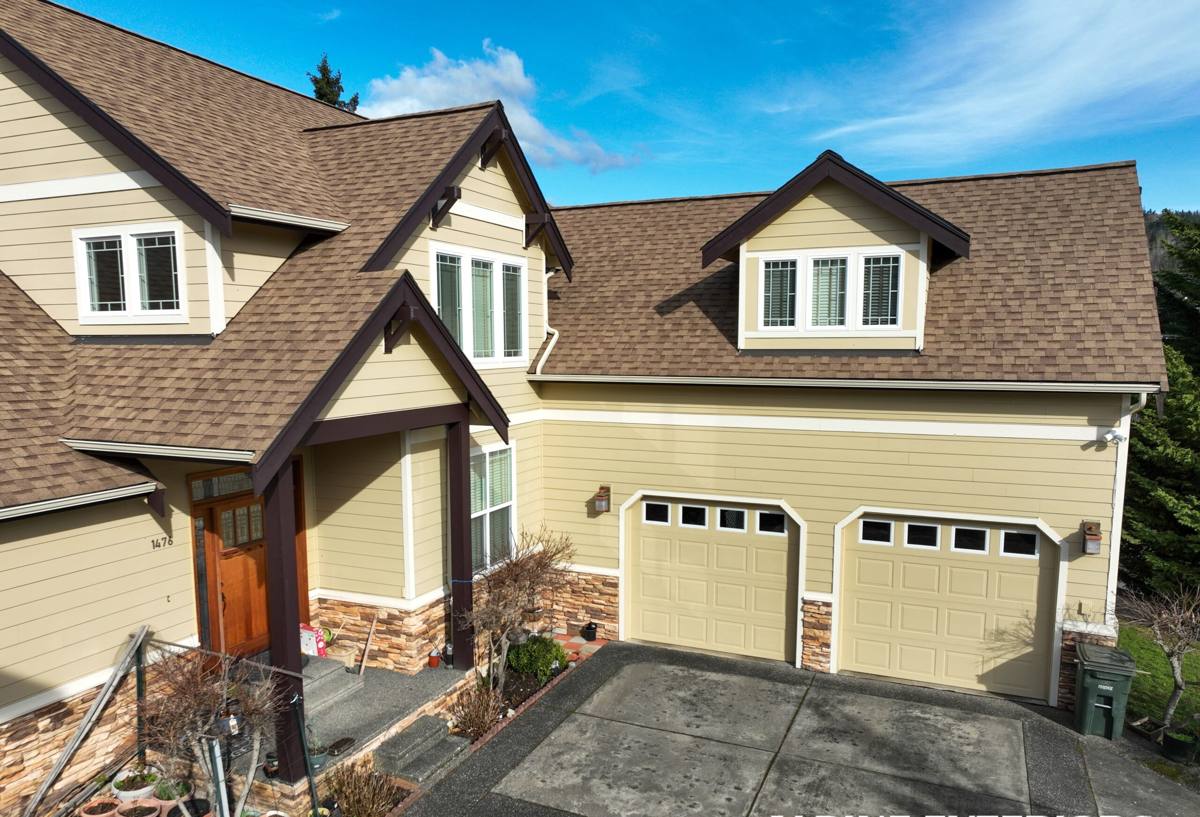
What This Climate Actually Does to a Shingle Roof
Whatcom County's marine climate is generally mild, but "mild" doesn't mean easy on a roof. A few things are specific to lakeside and heavily wooded lots like the ones around Lake Whatcom:
Moss and algae on shaded slopes
North-facing roof planes under mature fir and cedar stay damp for days after a storm because the sun never fully dries them out. That constant moisture is exactly what moss needs to get a foothold in the shingle mat, and it's what feeds the black algae streaking that shows up on almost every older roof in this area. Once moss roots into the shingle surface, it lifts tabs and holds water against the deck — that's a slow leak waiting to happen, not just a cosmetic issue.
Wind funneling down the lake corridor
Lake Whatcom sits in a valley, and wind tends to funnel along its length during winter storms rather than hitting a home evenly from one direction. Roofs with inconsistent or under-driven nailing patterns are the ones that lose shingles first — usually along the same ridge line or eave edge, storm after storm, because that's where the wind load concentrates.
Driving rain and wind-driven moisture at edges
Rain here rarely falls straight down for long. When it's driven sideways by lake wind, it finds its way under shingles at eaves, into valleys, and around any flashing that was installed loose or under-lapped. Standard installation practices that are "good enough" in a calmer climate leave gaps here.
Tree litter and clogged drainage
Needles, cones, and leaf debris collect in valleys and behind chimneys on tree-covered lots, holding moisture against the shingle surface and blocking water from draining off cleanly. Left alone, this accelerates granule loss and rot at the deck long before the shingles themselves are actually worn out.
Choosing the Right Asphalt Shingle for This Property
Not every asphalt shingle is a good fit for a shaded, wet, wind-exposed lake lot. The biggest factor isn't looks — it's how the shingle resists algae and how well it's rated to stay locked down in wind.
| Shingle Type | Algae Resistance | Wind Rating | Typical Lifespan Here | Best Fit |
|---|---|---|---|---|
| Standard 3-tab | None or minimal | Lower | 12–18 years under heavy tree cover | Budget-driven projects, sun-exposed roof planes |
| Architectural / laminate | Algae-resistant (AR) granules standard on most lines | Higher, rated for gusts common on this lake | 20–28 years with proper ventilation | Most Lake Whatcom homes — the standard we recommend |
| Premium / designer laminate | Enhanced AR granule blend | Highest of the three | 25–30+ years | Steep-slope, highly visible roofs; longer warranty coverage |
For most homes on shaded lots around the lake, we steer clients toward a mid-to-upper architectural laminate with algae-resistant granules — copper or zinc compounds baked into the granule coating that slow algae growth on the north and east-facing planes that stay damp longest. It's a modest cost difference over a plain 3-tab, and on a lot with real shade, it's the difference between a clean roof at year fifteen and one that's already streaked black.
Signs Your Roof Needs Replacing, Not Just Patching
A lot of the shingle roofs we look at around Lake Whatcom are structurally fine but showing the early signs of this climate catching up with them. Some of these are fixable with a repair; others mean it's time to plan a replacement before a winter storm makes the decision for you.
- Moss visibly rooted into the shingle mat, not just sitting on the surface
- Heavy granule loss showing up as dark grit in gutters and downspouts after rain
- Shingle edges curling, cupping, or turning brittle when touched
- Cracked or missing shingles after a windstorm, especially along one ridge or eave
- Soft or spongy spots when walking the roof, a sign the deck underneath is wet
- Daylight or damp insulation visible from inside the attic
- Recurring leaks around chimneys, skylights, or valleys during driving rain specifically
- The roof is 18+ years old and has never had algae or moss treated
If you're only seeing one or two of these, a targeted repair and a moss treatment plan may be enough. If you're seeing several at once, patching is usually money spent delaying a replacement rather than avoiding one.
What a Correct Installation Involves Here
Tear-off and deck inspection
We remove existing shingles down to the deck rather than layering over old roofing — layering traps moisture and hides deck rot, which is common on lake-adjacent homes where shaded planes stay damp for extended stretches. Any soft, delaminated, or water-stained decking gets replaced before anything new goes down.
Ice-and-water shield at eaves and valleys
Given how much of this area's rain arrives wind-driven rather than falling straight, we run self-adhered ice-and-water barrier along eaves, in all valleys, and around every roof penetration — well beyond the minimum code requirement in spots where wind-driven water backup is a known risk on lake lots.
Synthetic underlayment, not felt alone
A synthetic underlayment handles the extended exposure to damp conditions during a multi-day install far better than old-style felt, which can absorb moisture and wrinkle under Whatcom County's wet stretches.
Proper attic and roof ventilation
Heavy tree cover keeps roof decks cooler and damper than an open, sun-exposed roof, which makes balanced ridge-and-soffit ventilation more important here, not less. Under-ventilated roofs on shaded lake lots trap moisture in the attic, which shortens shingle life from underneath — a failure mode that has nothing to do with the shingle itself.
Nailing pattern and wind performance
We nail to the manufacturer's high-wind specification — six nails per shingle in the exposure zones that see the worst of the lake's funneled wind — rather than the minimum four-nail pattern that's common on lower-cost installs. It's the single biggest factor in whether a roof loses shingles in a winter windstorm.
Flashing at every penetration
Chimneys, skylights, and sidewalls get step flashing and counter-flashing installed correctly and lapped for this area's driving rain, not just caulked over — caulk fails, properly lapped metal doesn't.
Cost Factors for Lake Whatcom and Sudden Valley Roofs
Every roof is priced on its own specifics, but the factors that move the number most on this lake are fairly consistent:
| Factor | Why It Matters Here |
|---|---|
| Roof pitch and complexity | Steeper lake-view roofs and multiple valleys take longer and need more careful flashing work |
| Tree cover and access | Mature trees close to the roofline mean more careful staging and sometimes limbing before work starts |
| Number of existing layers | Full tear-off of multiple layers takes longer and often reveals deck repairs |
| Deck condition | Moisture-damaged sheathing under moss-affected areas is common and adds material cost |
| Ventilation upgrades | Older homes often need added ridge or soffit venting to meet current performance standards |
| Shingle tier selected | Standard 3-tab to premium designer laminate covers a wide range per square |
| Site access | Private roads, gated entry, and steep driveways common around Sudden Valley affect staging and dumpster placement |
Broadly, a straightforward asphalt shingle replacement on a moderate-pitch home here runs in the low-to-mid five figures, with steeper, larger, or more complex roofs running higher. We give an exact number only after walking the roof — anything quoted without seeing the deck and access conditions is a guess.
Why Local Experience on This Lake Matters
Sudden Valley and the neighborhoods around Lake Whatcom have their own logistics that a crew unfamiliar with the area will hit for the first time on your job. Private, gated roads mean coordinating delivery and dumpster drop-off in advance. Steep driveways and tree-lined lots change how a crew stages material and sets up fall protection. And the microclimate itself — which slopes stay damp longest, which side of a roof takes the worst of the wind funneling down the lake — is something you learn by working roofs on this specific body of water, not by reading a spec sheet.
We also pull permits and handle inspections the way Whatcom County requires, which matters more on a lake property where drainage and runoff considerations sometimes come up during permitting. A crew that's already done this paperwork for this jurisdiction moves the project along instead of hitting delays partway through.
Our Process, Start to Finish
1. On-site inspection
We walk the roof and the attic, check the deck where we can access it, and look specifically for moss rooting, granule loss patterns, and flashing condition — the things that actually determine repair versus replacement here.
2. Written proposal
You get a clear scope: shingle tier, underlayment, ventilation plan, flashing detail, and a firm price — no vague allowances that turn into surprises mid-job.
3. Installation
Tear-off, deck repair as needed, ice-and-water shield, underlayment, shingles nailed to the high-wind pattern, and flashing at every penetration, in that order, on a schedule we commit to before we start.
4. Cleanup and walkthrough
Magnetic sweep for nails, debris hauled off, and a final walkthrough with you before we consider the job done — including warranty paperwork registered with the manufacturer.
If your roof is showing moss, granule loss, or wind damage, or you're just planning ahead for a home near Lake Whatcom, we're glad to walk it with you. The estimate is free, there's no pressure to sign anything on the spot, and you'll get a straight answer about whether you need a repair or a full replacement — just fill out the form below.