 Sudden Valley Siding
 What This Climate Does to Siding in the Columbia Area
Homes in the Columbia area of Sudden Valley take a combination of punishment that a lot of siding products simply weren't built to handle long-term. Whatcom County sits close enough to the Salish Sea and Bellingham Bay that salt-carrying air reaches well inland, especially when winter storms push wind up through the valley and across the Lake Whatcom basin. Layer on top of that the region's driving rain — rain that comes in sideways during fall and winter fronts instead of falling straight down — and a moss season that can run eight or nine months on shaded, north-facing walls, and you've got three different stresses attacking the same wall assembly at once.
Salt Air and Fastener Corrosion
Salt-laden air accelerates corrosion on anything metal: nail heads, flashing, trim fasteners, and the housewrap staples underneath the siding itself. Once a fastener starts to rust, it stains the face of the siding, loses grip, and eventually creates a small gap where water gets in. This is slow damage — it doesn't show up in year one — which is exactly why the fastener spec and material matter more here than in a drier inland climate.
Wind-Driven Rain at Laps and Seams
Straight-down rain is easy to manage. Wind-driven rain finds every shortcut: undersized laps, missed caulking, butt joints that weren't backed properly, and window and door trim where the flashing sequence was rushed. Over a few wet seasons, water that gets behind the cladding does more damage than water that hits the face of it, because it's hidden and it stays wet longer.
A Moss Season That Doesn't Really End
On shaded walls and anywhere siding sits close to trees, moss and algae take hold and stay green for most of the year in this part of Whatcom County. Moss holds moisture against the surface, which is a bigger problem for wood-based products than for fiber cement, but it still affects how a wall needs to be detailed — ventilation gaps, ground clearance, and gutter performance all matter more when a wall almost never fully dries out.
Why James Hardie Is the Product We Put on Columbia Homes
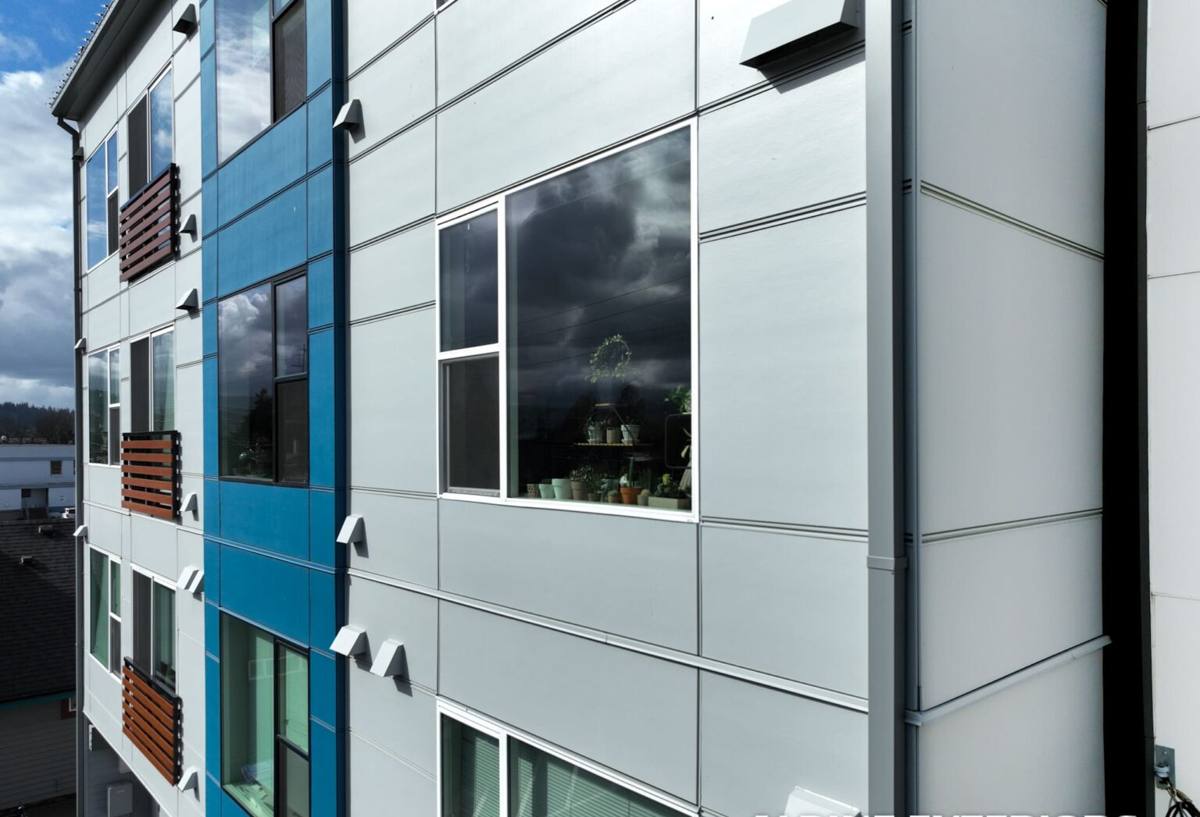
We install James Hardie fiber cement siding exclusively, and the reasons are specific to this climate, not just a brand preference. Fiber cement is made from cement, sand, and cellulose fiber — it doesn't have the wood content that gives moisture and moss something to feed on, and it doesn't swell or delaminate the way wood-based or wood-adjacent products can when they stay wet for months at a time. Hardie's HZ5 engineered product line is built for wetter, more variable climates like ours, with a formulation and finish designed to hold up to repeated wet-dry cycling rather than a handful of dry-climate stress tests.
The factory-applied ColorPlus finish is also a real advantage here. It's baked on under controlled conditions, so it resists fading and moisture penetration better than a field-applied paint job ever will, and touch-up paint is formulated to match. That matters in a climate where a poorly sealed field cut or a scratched edge is an invitation for water to start working into the substrate.
What a Correct Installation Involves in This Climate
Weather-Resistive Barrier and Flashing
Everything starts under the siding, not on top of it. A correctly lapped weather-resistive barrier, properly integrated window and door flashing, and correctly flashed penetrations (vents, hose bibs, light fixtures) are what actually keep wind-driven rain out of the wall assembly. Hardie siding is only as good as what's behind it — this is the step that gets shortcut on rushed jobs and the one that causes the most expensive repairs down the road.
Fastening, Gaps, and Clearances
Hardie's install specs call for specific fastener types, spacing, and clearances — minimum gaps from grade, roof lines, and decks, plus proper gapping at butt joints to allow for expansion. In a coastal-influenced climate, using the corrosion-resistant fasteners the manufacturer specifies (rather than whatever's cheaper on the truck) is the difference between siding that still looks right in fifteen years and siding that's streaking and failing at the joints in five.
Field Cuts, Caulking, and Touch-Up
Every cut edge exposes raw fiber cement that needs to be sealed and painted to match. Caulking has to be a quality, paintable, exterior-grade sealant at trim joints and penetrations — not a thin bead meant to look finished on install day. Rushed field work here is invisible for the first year or two and then becomes the first place moisture gets in.
Matching the Right Hardie Product to Your Home
Not every wall on a Columbia-area home should get the same profile. Here's how the main Hardie product lines typically get used on homes in this area:
| Product | Best Use | Why It Fits This Climate |
|---|---|---|
| HardiePlank Lap Siding | Primary wall cladding | Widest color/texture range, proven lap detailing for wind-driven rain |
| HardieShingle | Accent gables, dormers | Traditional look without the moisture issues of real wood shingle |
| HardiePanel | Vertical accents, porch ceilings | Clean modern lines, holds up well under roof overhangs |
| HardieTrim | Corners, window/door trim, fascia | Matches expansion behavior of the field siding, resists rot at high-exposure edges |
What We Usually Find When the Old Siding Comes Off
On tear-offs in this part of Whatcom County, the same handful of problems show up repeatedly: rot at the bottom courses where siding sat too close to grade or a deck, a weather barrier that was missing, torn, or improperly lapped, and moisture-darkened sheathing behind north-facing walls that stayed shaded and damp for years. None of this is visible from the street, which is exactly why a proper tear-off and inspection matters more than a quick re-side over existing material — covering up a wet wall assembly with new siding doesn't fix the underlying problem, it just hides it for a while longer.
Our Process for a Columbia-Area Job
- On-site inspection of existing siding, trim, and visible moisture or rot indicators
- Tear-off to the sheathing so the wall assembly can actually be inspected and repaired
- Repair or replace any damaged sheathing and framing before anything new goes up
- Install a correctly lapped weather-resistive barrier and properly flashed openings
- Install James Hardie siding, trim, and accessories to manufacturer spec — fasteners, gaps, clearances
- Seal, caulk, and touch up all field cuts and joints with matched ColorPlus touch-up product
- Final walk-through and cleanup, including jobsite debris and nail/fastener sweep
What Drives Cost on a Job Like This
| Cost Factor | Why It Matters |
|---|---|
| Home size and wall complexity | More corners, gables, and dormers mean more cutting, trim, and labor time |
| Condition behind the old siding | Rot or sheathing repair found during tear-off adds material and labor |
| Product mix | Lap siding alone costs less than a mix of lap, shingle accents, and panel details |
| Trim and accessory scope | Corner boards, fascia, and window trim replacement add to the total |
| Site access | Steep lots, limited driveway access, or dense landscaping can slow staging and setup |
We give straightforward, itemized estimates rather than a single lump number, so you can see what you're actually paying for and where the money is going.
Keeping Hardie Siding Performing Once It's Up
James Hardie siding is genuinely low-maintenance compared to wood or wood-based products, but "low-maintenance" isn't "no-maintenance" in this climate. A periodic soft wash to keep moss and algae from building up on shaded walls, checking that gutters and downspouts are actually moving water away from the siding, and an annual look at caulking around trim and penetrations will keep the wall assembly performing the way it's designed to for decades. None of this is heavy work — it's the kind of thing that takes an afternoon once a year and prevents small issues from becoming expensive ones.
Why It Matters to Hire a Crew That Already Works This Neighborhood
A crew that's already worked in Sudden Valley knows what this specific stretch of Whatcom County does to a wall — how much wind exposure a given lot typically gets, how long walls stay shaded through the moss season, and what the existing housing stock in this area was built with originally. That familiarity shows up in small decisions during the job: where to add extra flashing attention, which walls need closer inspection during tear-off, and how to sequence work around the wetter months so the wall assembly isn't left open longer than it needs to be. If your neighborhood or community has its own exterior design guidelines, a local crew is also more likely to already know the general expectations before the estimate walk-through even starts.
If you're weighing a siding replacement for a Columbia-area home, we're happy to walk the property, point out what we actually see, and put together a straightforward, no-pressure estimate — no obligation, just a clear picture of what a correct job would involve for your home specifically.