 Sudden Valley Siding
 Siding Installation in Geneva: Built for What This Spot Actually Gets
Geneva sits inside the Sudden Valley community in Whatcom County, close enough to the water that homes here take on a different kind of weather load than siding farther inland. Salt-laden air off the lake and the broader Puget Sound region, driving rain that comes in sideways during winter storms, and a moss season that can stretch for months all put steady pressure on whatever material is covering a home's exterior walls. Siding installation in this pocket of Whatcom County isn't a cosmetic upgrade — it's the first line of defense between that weather and the framing, sheathing, and insulation behind it.
We install siding in Geneva and throughout Sudden Valley on a regular basis, which means we're not guessing at how a wall assembly holds up here — we see it. Northwest exposures that never fully dry out between rain events, roof-to-wall transitions that take the brunt of wind-driven water, and shaded elevations where moss and algae get a head start every fall. A correct installation accounts for all of that before the first piece of siding ever goes up.
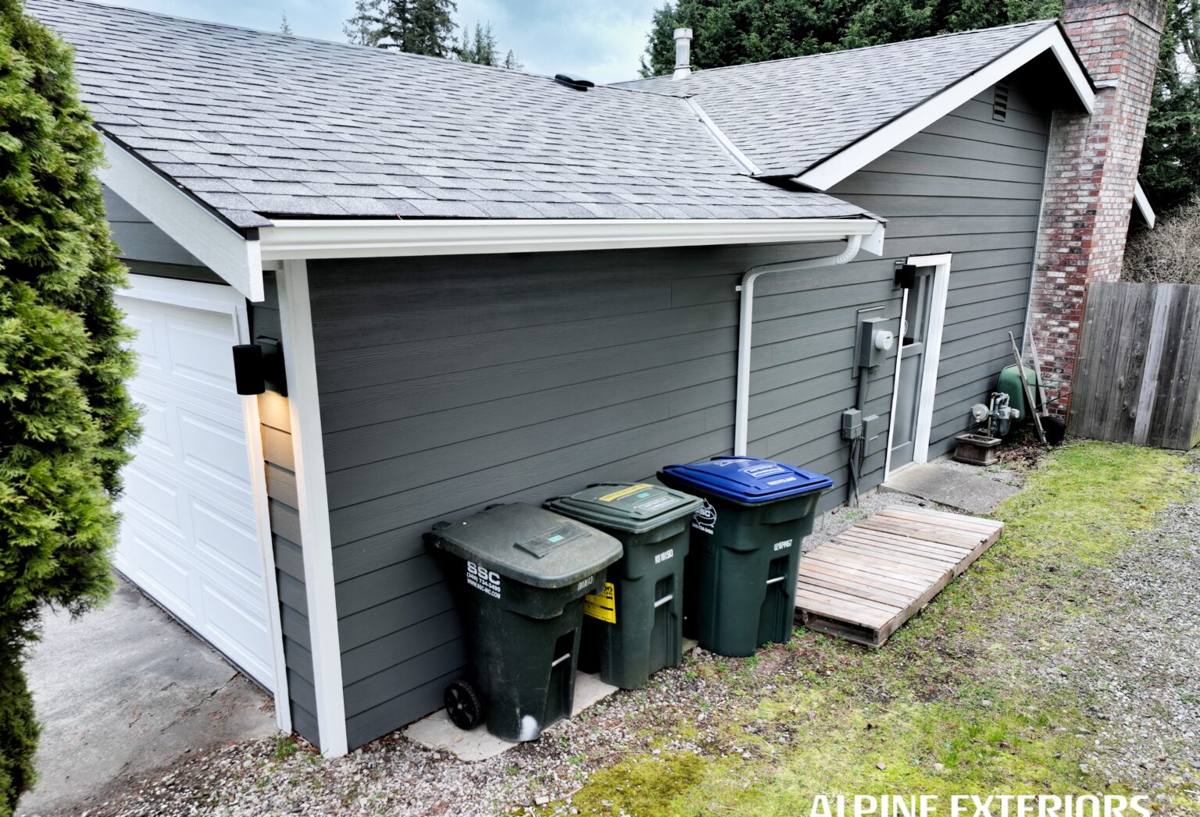
Why Geneva's Microclimate Puts Extra Demands on Siding
Three conditions define what siding has to survive here, and they compound each other rather than acting alone.
Salt Air
Proximity to the water means airborne salt settles on exterior surfaces over time. On untreated or poorly finished materials, that accelerates surface breakdown, corrodes exposed fasteners, and speeds up finish failure. It's a slow process, but it's constant, and it doesn't take a break in the winter.
Driving Rain
Whatcom County storms don't always fall straight down. Wind-driven rain gets pushed sideways into wall assemblies, which puts real stress on every joint, seam, and penetration in the siding system. If flashing details, house wrap laps, and butt joints aren't handled correctly, this is exactly the condition that finds the weak point — sometimes not for a year or two, by which point water has already been working behind the cladding.
Moss Season
Shaded, moisture-retentive spots in Sudden Valley — tree-lined lots, north-facing walls, areas that stay damp longer after a storm — are prime territory for moss and algae growth on siding surfaces. Beyond the appearance issue, sustained moss growth holds moisture against the material, which is a problem for anything that isn't dimensionally stable and properly finished.
None of these three conditions is unusual for the Pacific Northwest on its own. What makes Geneva specifically demanding is that homes here often deal with all three at once, on the same elevation, in the same season.
What a Correct Siding Installation Actually Involves
Siding installation is often talked about like it's just fastening boards to a wall. In a climate like this, that's the part of the job that matters least. The details that actually determine whether a house stays dry for the next twenty years happen before and around the siding itself.
- Inspection and repair of the sheathing underneath — siding installed over damaged or soft sheathing fails from the inside out, no matter how good the material is
- A continuous, correctly lapped water-resistive barrier (house wrap) with every seam taped and every penetration sealed
- Properly integrated flashing at windows, doors, roof lines, and any wall penetration — this is where driving rain gets stopped or gets in
- Rainscreen or drainage gap detailing where appropriate, so any moisture that does get behind the cladding has somewhere to go
- Correct fastener type, spacing, and depth for the specific product being installed — under- or over-driven fasteners are a common cause of early failure
- Proper clearances at grade, decks, and roof lines so the siding never sits in standing water or constant shade-moisture
- A factory-applied, climate-engineered finish on the siding itself, not a field-applied coating that has to be maintained on a schedule
Skip or shortcut any one of these steps and the siding on the surface can look fine for a while even as moisture problems build up behind it. This is exactly why we standardized on one product system rather than installing whatever a homeowner happens to ask for.
Why We Install James Hardie Fiber Cement — and Nothing Else
We install James Hardie fiber cement siding exclusively. We don't install vinyl, LP SmartSide, cedar, primed spruce, or other fiber cement brands. That's a deliberate standard, not a limitation on what we're capable of installing.
Hardie's fiber cement is non-combustible, which matters in Whatcom County's wildfire-conscious building climate as much as it does anywhere else. It's engineered in climate-specific HZ formulations that account for regional moisture exposure rather than being a one-size-fits-all product. The ColorPlus factory finish is baked on under controlled conditions rather than applied on-site, which means the color and protective coating are far more consistent and durable than field-applied paint — a real advantage against salt air and sustained damp conditions. And it carries a strong transferable warranty backed by a manufacturer with decades of fiber cement manufacturing behind it.
Vinyl siding is inexpensive and low-maintenance in mild climates, but it can become brittle in cold snaps, expands and contracts more than fiber cement, and doesn't offer the same fire performance. Cedar and primed spruce are wood products — they look great initially, but they demand an ongoing maintenance and refinishing schedule to hold up against exactly the moisture conditions Geneva sees most of the year, and they're a fuel source, not a fire-resistant material. LP SmartSide is an engineered wood product with its own maintenance and moisture-sensitivity considerations at cut edges and joints. Every one of these is a legitimate product that other contractors install well. We simply made a call, based on what we see on homes in this climate, that fiber cement installed correctly is the material we're willing to put our name behind.
Material Comparison for a Salt Air, High-Rain Climate
| Factor | James Hardie Fiber Cement | Vinyl | Cedar / Primed Wood |
|---|---|---|---|
| Moisture resistance | Engineered for wet climates; dimensionally stable | Doesn't absorb moisture, but seams and expansion gaps can let water in behind it | Absorbs moisture; prone to rot without diligent maintenance |
| Salt air exposure | Factory finish holds up well; fasteners can be specified for corrosion resistance | Generally tolerant, but can become brittle over time | Finish breaks down faster; more frequent refinishing needed |
| Fire performance | Non-combustible | Combustible; can melt or deform | Combustible |
| Maintenance | Occasional washing; no repainting on ColorPlus finish | Low, but repairs require matching discontinued colors/profiles | Regular painting/staining and moisture monitoring |
| Typical lifespan (installed to spec) | Multiple decades | Multiple decades, shorter in impact/heat scenarios | Shorter without consistent upkeep |
Our Installation Process in Geneva
The steps don't change from house to house, but how we apply them does — a shaded, moss-prone north wall in Sudden Valley gets treated differently than a sun-exposed south elevation, even on the same home.
- On-site assessment. We walk the exterior, check existing siding condition, look at drainage, grade, roof-to-wall details, and any areas already showing moisture or moss buildup.
- Removal and substrate inspection. Old siding comes off and we inspect the sheathing and framing underneath before anything new goes up. Any soft or damaged material gets addressed, not covered over.
- Weather barrier and flashing. A continuous water-resistive barrier goes on with correct lapping, and flashing is integrated at every window, door, and penetration.
- Hardie installation to manufacturer spec. Correct fastener schedule, joint treatment, and clearances — installed the way the product is engineered to perform, not just the way that's fastest.
- Final detailing and walkthrough. Trim, caulking where appropriate, and a walkthrough so the homeowner knows what to expect and how to care for the finished siding.
Signs Siding in Geneva Needs Attention
- Persistent moss or algae staining that returns quickly after cleaning
- Soft spots, bubbling, or visible warping, especially on shaded or north-facing walls
- Cracked, peeling, or chalking paint on wood siding that keeps recurring
- Gaps opening up at seams, corners, or trim after a hard winter
- Musty smell or discoloration on interior walls that back onto exterior siding
- Visible fastener corrosion or staining running down from nail heads
Any one of these is worth a look. Several at once usually means moisture has already been getting behind the cladding for a while.
What Working With a Crew That Already Knows Geneva Gets You
Sudden Valley isn't a generic Whatcom County neighborhood — the tree cover, the lake proximity, and the mix of sun and shade exposures across different lots mean the same siding job can call for different detailing from one street to the next. A crew that already works this area isn't learning that on your house. We know which elevations typically need extra attention to drainage and moss resistance, how driving rain tends to behave against these homes in a winter storm, and what correct flashing and clearance details look like in practice here — not just on paper.
That local familiarity, paired with installing a single product system to manufacturer spec every time, is what keeps siding performing the way it's supposed to for the long haul, instead of looking fine for a couple of years and then starting to show problems.
Get a Free Estimate for Your Geneva Home
If your siding is showing wear, or you're planning ahead for a replacement, we're happy to take a look and give you an honest read on what your home needs. There's no pressure and no obligation — just a straightforward assessment from a crew that installs James Hardie fiber cement siding and works this part of Whatcom County regularly. Fill out the form below to request your free estimate.