 Sudden Valley Siding
 South Hill's Siding Environment: Salt Air, Driving Rain, and a Long Moss Season
Homes in the South Hill area of Sudden Valley sit inside one of Whatcom County's tougher climates for exterior building materials. The combination of driving rain off the water, salt-tinged marine air that moves through the county, and heavy tree cover keeps siding damp for long stretches of the year. That dampness doesn't just sit on the surface — it works into seams, laps, and any gap in the original installation, and it feeds moss and algae growth that most homeowners in this area are already familiar with on roofs, decks, and fences.
Siding here isn't decorative trim. It's the first line of defense against a climate that rarely gives a house a long dry season to recover. Whatever goes on a South Hill home needs to handle constant moisture cycling, resist the organic growth that moisture invites, and hold its finish against salt-laden air without chalking, fading, or trapping water behind the surface.
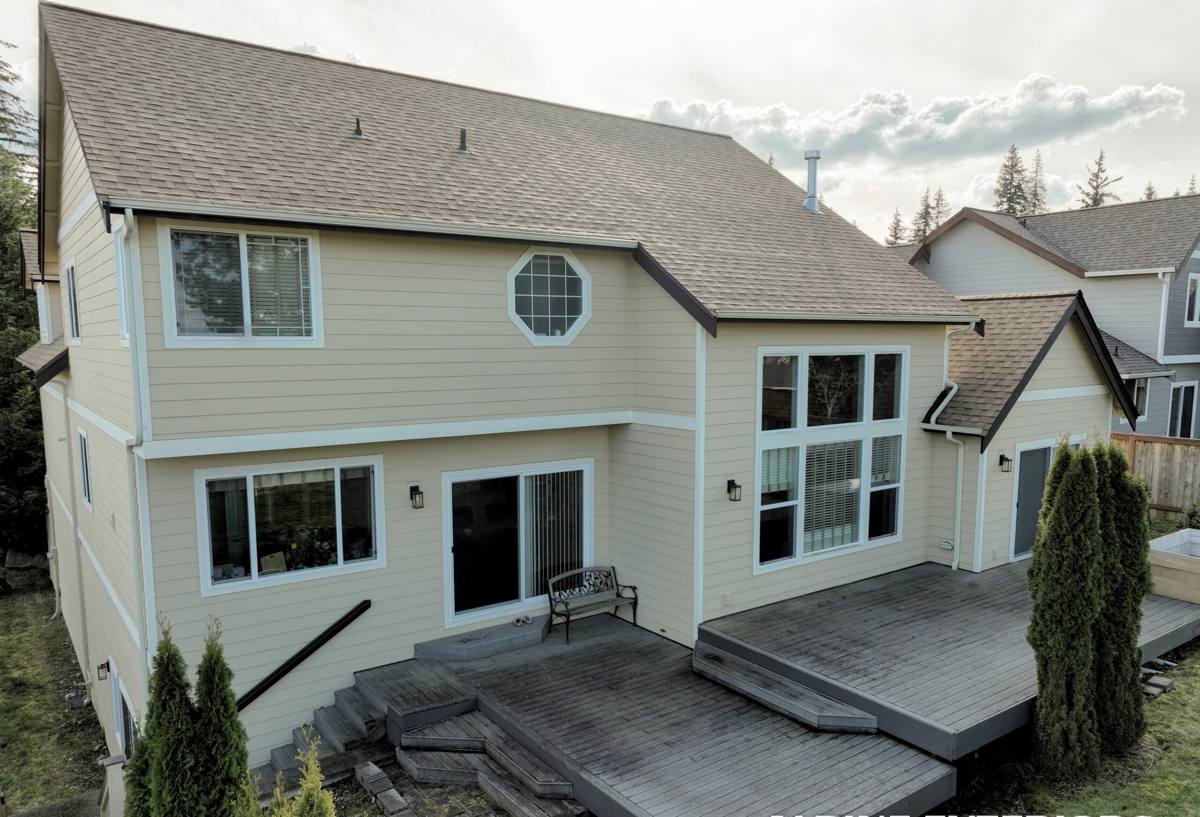
What Correct Fiber Cement Performance Looks Like in This Climate
Not all siding materials respond to this environment the same way, and not all fiber cement installations are equal either. For a South Hill home, "correct" performance means a few specific things:
- Dimensional stability — the siding shouldn't swell, cup, or warp as it cycles between saturated and dry conditions week to week.
- Moss and algae resistance — a factory finish that doesn't give organic growth an easy surface to grab onto, especially on shaded north and east walls.
- Moisture management behind the cladding — proper flashing and a drainage plane so water that reaches the wall assembly can get back out.
- Finish durability — a coating that holds color and sheds moisture without recoating every few years.
This is the standard we hold every South Hill siding job to, and it's the reason we don't treat siding replacement as a one-size-fits-all product swap.
Why We Only Install James Hardie Fiber Cement
We've made a deliberate decision as a company: we install James Hardie fiber cement siding, and nothing else. We don't install vinyl, LP SmartSide, cedar, primed spruce, or other fiber cement brands like Cemplank or Allura. That's not a marketing line — it's a standard we hold because of what this climate does to a house over years, not months.
James Hardie engineers its HZ product lines by climate zone, and the HZ5 formulation used in the Pacific Northwest is built specifically for regions with sustained moisture exposure. The ColorPlus factory finish is baked on under controlled conditions rather than field-applied, which matters in a county where a painter rarely gets a long dry stretch to work with. The material itself is non-combustible, which matters more every year as wildfire smoke and dry-season fire risk become a bigger part of Pacific Northwest summers. And Hardie backs the product with a transferable warranty structure that holds up if the home changes hands, which most alternative products don't match.
None of this means other products are without merit — vinyl is inexpensive and low-maintenance in the right setting, engineered wood has genuine fans, and cedar has real curb appeal. But we've seen enough of what South Hill's moisture cycle does to seams, finishes, and substrates over time that we no longer install anything else. If a homeowner wants one of those alternatives, we'll say so honestly rather than install something we don't stand behind.
What We Tell Homeowners Who Ask About Alternatives
Vinyl siding can crack in cold snaps and often shows moss growth in its overlapping channels faster than a smooth fiber cement surface. Engineered wood products use a wood-based substrate that is more sensitive to sustained moisture exposure at cut edges and butt joints — exactly the kind of exposure this climate creates. Cedar and primed spruce require ongoing maintenance — restaining, recaulking, repainting — that most homeowners underestimate until they're several years in. Fiber cement from a manufacturer that engineers specifically for this climate zone removes most of that maintenance burden.
What a Correct Fiber Cement Installation Involves
The material is only half the equation. A significant share of the siding failures we get called out to inspect trace back to installation shortcuts, not the product itself. On every South Hill project, correct installation means:
Flashing and Drainage Plane
Every window, door, and penetration gets proper head flashing and a continuous water-resistive barrier behind the siding. Given how much rain this area sees, a drainage plane that lets incidental moisture escape the wall assembly is not optional — it's the difference between a house that sheds water and one that slowly rots from the inside out.
Fastening and Clearances
Hardie specifies fastener spacing, nailing patterns, and minimum clearances from grade, roof lines, and decks for a reason. Panels installed too tight to a roofline or too close to grade trap moisture and void the manufacturer's warranty — a detail we see missed on older installs around the county.
Caulking and Trim Work
Butt joints, corners, and trim intersections are where most siding failures start. We follow Hardie's caulking and joint treatment specifications exactly, using compatible sealants rather than whatever's on hand.
Finish Integrity
Because ColorPlus is a factory finish, field-cut edges need proper edge sealing. Skipping this step is a common shortcut that leads to moisture wicking into cut ends over time — and it's invisible until it isn't.
Our Process for a South Hill Siding Replacement
- On-site assessment. We walk the home, check the existing siding and sheathing condition, and look specifically for moisture damage that's common in this microclimate — soft spots near grade, staining under windows, and moss buildup on shaded walls.
- Tear-off and substrate check. Once the old siding is off, we inspect the sheathing itself. Any rot or moisture damage gets addressed before a single new panel goes up — covering a compromised substrate with new siding just hides the problem.
- Weather barrier and flashing installation. This is the step that determines whether the new siding will actually perform in this climate, and we don't rush it.
- Hardie installation to spec. Fastening, clearances, joint treatment, and trim all follow James Hardie's published specifications for the HZ5 zone.
- Final walkthrough. We review the finished work with the homeowner and confirm every detail — caulking, trim, touch-up — before calling the job done.
Fiber Cement vs. Other Siding Options in This Climate
| Material | Moisture & Moss Resistance | Salt-Air / UV Durability | Ongoing Maintenance | Fire Rating |
|---|---|---|---|---|
| James Hardie Fiber Cement (HZ5) | High — engineered for wet climates | High — factory ColorPlus finish | Low | Non-combustible |
| Vinyl Siding | Moderate — moss collects in overlaps | Moderate — can fade and become brittle | Low, but limited repair options | Combustible |
| Engineered Wood (e.g. LP SmartSide) | Moderate — sensitive at cut edges/joints | Moderate | Moderate | Combustible |
| Cedar / Primed Spruce | Lower without diligent upkeep | Lower — finish breaks down faster | High — regular refinishing needed | Combustible |
This table reflects general material behavior, not a specific test result — every installation's real-world performance still depends heavily on workmanship, detailing, and how well the wall assembly manages moisture behind the cladding.
Cost Factors for a South Hill Siding Project
We don't publish blanket pricing because every South Hill home is different, but the factors that actually move the number are consistent:
| Factor | Why It Matters |
|---|---|
| Tear-off scope | Removing multiple layers of old siding costs more than a single-layer tear-off |
| Sheathing/moisture repair | Rot found during tear-off has to be repaired before new siding goes on |
| Home size and stories | Multi-story homes require more staging, scaffolding, and labor time |
| Siding profile chosen | Lap width, shingle-style panels, and trim details vary in material and labor cost |
| Trim and architectural detail | Homes with more corners, dormers, and trim take longer to detail correctly |
| Site access | Trees, slopes, and tight lot lines common around Sudden Valley can add setup time |
Signs Your South Hill Home May Need New Siding Now
- Visible moss or algae growth that returns quickly after cleaning
- Soft or spongy spots when you press on the siding, especially near the bottom courses
- Peeling, bubbling, or chalking paint that keeps recurring
- Warped, cupped, or separating boards
- Gaps opening up at trim, corners, or window frames
- Rising heating bills that suggest the wall assembly is no longer performing as insulation and moisture barrier
- Visible staining or discoloration running down from seams or fasteners
Any one of these on its own isn't necessarily an emergency, but a home with several of them is usually past the point where cleaning or spot repair solves the problem.
Why Hiring a Crew That Already Works South Hill Matters
A siding crew that only shows up in this neighborhood occasionally doesn't have the same read on how this specific microclimate behaves. We've worked enough homes in and around Sudden Valley to know which walls take the worst of the driving rain, where moss tends to establish first, and how long the shaded, tree-covered lots here stay damp compared to more open parts of the county. That knowledge shapes real decisions on a job — where extra flashing attention matters most, which install windows avoid trapping moisture behind fresh caulk, and what substrate condition to expect once the old siding comes off.
It also means we're not guessing at what holds up here and what doesn't. We've seen which installations from years back are still performing and which ones failed early, and that's exactly what led us to standardize on James Hardie fiber cement rather than offer a menu of products and let the climate sort out the winner.
If your South Hill home's siding is showing its age — or you just want an honest read on whether it's holding up the way it should — we're glad to come take a look. The estimate is free, there's no pressure, and you'll get a straight answer about what your home actually needs.