 Sudden Valley Siding
 Sehome's Siding Problem: Salt Air, Driving Rain, and a Moss Season That Never Really Ends
Homes in and around Sehome sit inside the same weather pattern that shapes siding decisions across Whatcom County: onshore air off Bellingham Bay, wind-driven rain that hits walls sideways instead of straight down, and a wet season that stretches from October well into May. Add tree cover and shaded north walls, and you get months at a time where siding simply does not fully dry out. That combination is hard on most exterior products, but it is especially hard on anything that depends on paint film or a factory seal to keep water out rather than shedding it by design.
We see the same failure patterns on Sehome-area homes over and over: caulk joints that opened up after a few freeze-thaw cycles, bottom courses that stayed damp against the foundation and started to swell, and green-black moss film building up on north- and west-facing walls where sun never quite reaches. None of that is unusual for this climate. It's just what happens when siding isn't matched to it, or wasn't installed with this specific weather in mind.
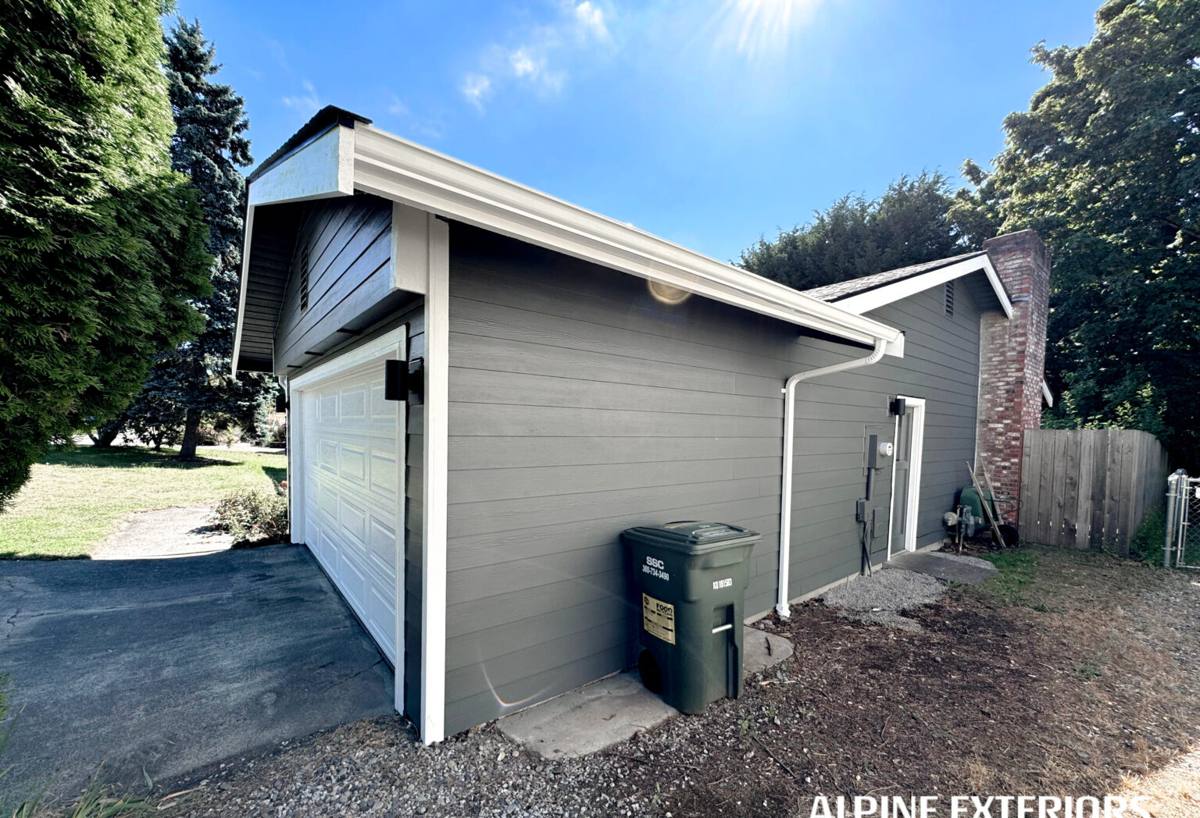
Why Fiber Cement Is the Right Call for This Climate
Fiber cement siding is cement, sand, and cellulose fiber pressed and cured into a dense board. It doesn't absorb bulk water the way wood-based products do, it doesn't rot, and it isn't a food source for the moss and algae that thrive in this area's damp, shaded microclimates. That matters more here than in drier parts of the state, where a siding product's weak points can go years without being tested.
We install James Hardie fiber cement exclusively — no LP SmartSide, no vinyl, no Cemplank or Allura, no primed spruce or cedar. That's a deliberate standard, not a sourcing convenience. Every one of those alternatives asks a homeowner to accept a trade-off: an engineered wood core that's sensitive to sustained moisture, a vinyl panel that moves with temperature swings and can't take a fully sealed joint, or a natural wood product that needs a maintenance schedule most people underestimate until the siding is already failing. Hardie's fiber cement removes those trade-offs for a climate like this one, which is why it's the only product we put our name behind.
What Fiber Cement Doesn't Solve on Its Own
It's worth being straight about this: fiber cement is a durable material, not a magic fix. It still needs correct flashing, proper clearances, and a finish system that can handle UV and salt-laden moisture over decades. A poorly installed Hardie job in Sehome's climate can still trap water behind it or open up at the joints. The material buys a much wider margin for error than wood or vinyl — it doesn't remove the need for a correct install.
James Hardie's Climate-Engineered Product Lines
James Hardie makes region-specific formulations under its HardieZone system, and the Pacific Northwest — including Whatcom County — falls into the HZ5 zone, engineered around sustained moisture exposure and freeze-thaw cycling rather than the extreme heat formulations used in the Southwest. That regional engineering is one of the reasons we standardized on Hardie over a generic fiber cement product: the board itself is built for this weather, not just tolerant of it.
Most Sehome-area installs we do use either HardiePlank lap siding (the standard horizontal profile) or a HardiePanel vertical application for accent walls or shed dormers, often paired with HardieTrim for corners, window casing, and fascia. All of it can come with ColorPlus Technology — a factory-baked, multi-coat finish that's more UV- and weather-stable than field-applied paint, and it carries its own finish warranty separate from the substrate warranty.
| Product Line | Typical Use | Why It Fits This Climate |
|---|---|---|
| HardiePlank (lap) | Full wall siding, most common choice | Overlapping profile sheds wind-driven rain by design |
| HardiePanel (vertical) | Accent walls, gables, dormers | Fewer horizontal joints where standing moisture can collect |
| HardieTrim | Corners, window/door casing, fascia | Matches the expansion rate of the field siding, reducing gap-opening at joints |
| ColorPlus finish | Factory-applied color coat | More consistent and longer-lasting than site-painted siding in constant damp exposure |
What a Correct Fiber Cement Install Actually Involves
The board is only part of the system. A siding job that's going to hold up through a Whatcom County wet season is won or lost in details most homeowners never see once the wall is closed up.
Before the First Board Goes Up
- Full tear-off and inspection of the wall sheathing — any soft or water-stained sheathing gets replaced, not covered over
- A code-compliant weather-resistive barrier (housewrap) installed and lapped correctly, shingle-style, so water always drains outward and down
- Correct flashing at every penetration — windows, doors, hose bibs, light fixtures, and anywhere a deck or porch roof ties into the wall
- Proper rainscreen or furring where the wall assembly calls for it, so siding isn't sitting flush against a damp sheathing plane
During Installation
- Minimum ground and roof clearances held to spec — bottom courses too close to grade, decks, or roof lines are one of the most common moisture entry points we correct on older homes
- Fasteners driven per Hardie's published fastening schedule, not overdriven or underdriven, in the field or blind-nail zone as specified for the profile
- Butt joints backed and sealed correctly, not just caulked and left to rely on the sealant alone
- Factory-cut edges and any field cuts primed or sealed per manufacturer instructions before they're exposed to weather
Skip any one of these steps and the board itself — even a premium one — stops mattering. Water finds the gap.
Our Process for Sehome-Area Homes
We run the same disciplined sequence on every job, adjusted for what we find once the old siding comes off.
- On-site assessment: We walk the exterior, check the worst-exposed walls first (typically north and west faces here), and look for existing moss growth, caulk failure, or soft spots that hint at what's happening underneath.
- Tear-off and sheathing check: Old siding comes off in sections so we can inspect and address sheathing damage as we go, rather than guessing from the outside.
- Weather barrier and flashing: Housewrap, flashing, and any rainscreen furring go in before a single piece of Hardie touches the wall.
- Installation to spec: HardiePlank, HardiePanel, and HardieTrim installed per James Hardie's fastening and clearance requirements for our climate zone.
- Detail work: Joints, penetrations, and trim transitions sealed and finished so the whole assembly sheds water as one system, not a collection of parts.
- Final walkthrough: We review the completed job with the homeowner and cover the manufacturer warranty paperwork and any basic care notes specific to the home's exposure.
What Drives Cost on a Sehome Fiber Cement Job
Every home is different, so we won't put a number on this page that doesn't mean anything without seeing the house. What we can do is walk through what actually moves the price up or down, so an estimate makes sense once you get one.
| Cost Factor | Typical Impact | Why |
|---|---|---|
| Condition of existing sheathing | Medium–High | Rot or water damage found during tear-off means repair before siding can go on |
| Home size and number of stories | High | More square footage and taller walls mean more material, labor, and staging/scaffolding |
| Trim and architectural detail | Medium | Dormers, gables, and multiple corners add cutting, fitting, and flashing time |
| Siding profile and finish choice | Low–Medium | Lap width, panel vs. plank, and ColorPlus color all vary slightly in material cost |
| Access and site conditions | Low–Medium | Tight lots, slopes, or landscaping close to the walls can add setup and protection time |
Sheathing repair is the biggest wildcard on older Sehome-area homes, and it's exactly the kind of thing that can't be fairly quoted until the old siding is actually off the wall. We flag it clearly if we find it rather than absorbing it silently into a change order later.
Why It Matters That We Already Work This Area
A crew that's done multiple jobs in Sehome and the wider Sudden Valley area isn't guessing at what this climate does to a wall. We know which orientations tend to hold moss longest, which older homes in the area are more likely to have undersized flashing details from an earlier remodel, and how much clearance actually holds up against this region's wet season versus what looks fine on install day. That's not a marketing point — it changes real decisions on the job, like where we add extra flashing attention or push back on a clearance that's technically code-minimum but won't hold up here long-term.
It also means straightforward logistics: a local crew can respond quickly if a question comes up after the job is done, and we're not learning Whatcom County's weather behavior on your house for the first time.
Living With Fiber Cement Siding in This Climate
Correctly installed Hardie siding is low-maintenance, not zero-maintenance. A little seasonal attention goes a long way toward getting the full lifespan out of it in a damp, moss-prone area like this one.
- Rinse siding down once or twice a year, especially shaded north- and west-facing walls, to keep moss and algae from establishing
- Keep gutters clear so overflow doesn't run down the face of the siding or pool at the base of a wall
- Trim back shrubs and trees so foliage isn't holding moisture against the siding or blocking airflow and sun
- Walk the exterior once a year and check caulk joints around windows, doors, and trim for cracking or separation
- Watch bottom courses near grade, decks, and porches — these stay wettest longest and are worth a closer look each fall
Have Us Take a Look
If your Sehome-area home has siding that's showing moss staining, failing caulk, or soft spots after another wet Whatcom County winter, we're happy to come take a look and tell you honestly what we see — no pressure, no obligation. Use the form below to request a free estimate.