 Sudden Valley Siding
 Building Decks for Sehome's Particular Climate
Sehome sits close enough to the water and the hills around Lake Whatcom that outdoor structures here take a beating most inland decks never see. Salt-laden air off the Sound corrodes fasteners and hardware faster than manufacturers' spec sheets assume. Driving rain off winter storms finds every gap in flashing and every under-sized drainage path. And Whatcom County's long, wet moss season coats anything horizontal — including deck boards, joists, and stair treads — for months at a stretch. A deck that's just "built to code" survives here. A deck that's actually built for this climate lasts.
We build and replace decks for homes around Sehome and the wider Sudden Valley area, and the difference between a deck that holds up and one that doesn't almost never comes down to the decking material alone. It comes down to what's underneath it, how water is made to leave, and whether the fasteners were chosen for salt exposure instead of a big-box aisle.
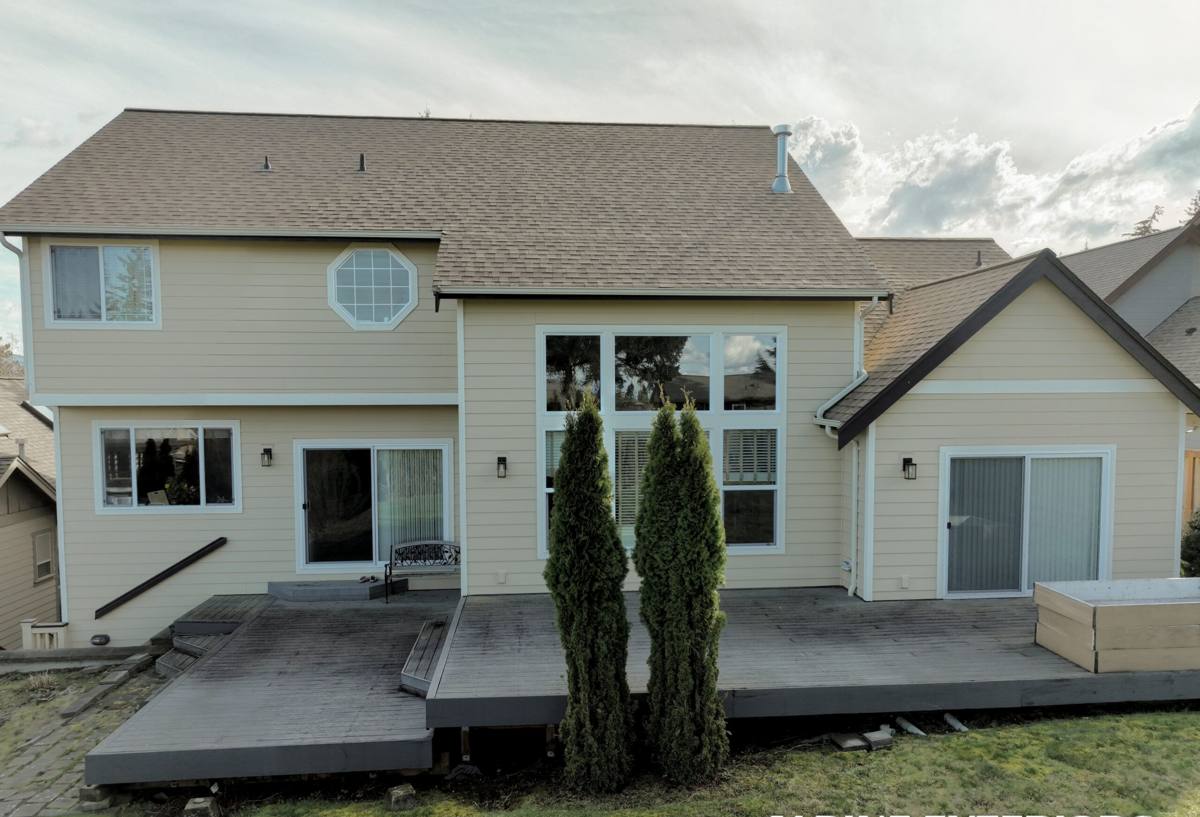
What Sehome Homes Actually Need From a Deck
Framing and Fasteners That Won't Corrode Early
Standard electro-galvanized screws and joist hardware look fine going in and start failing within a few wet seasons in a coastal-influenced climate. We spec stainless steel or heavy hot-dip galvanized fasteners and connectors rated for coastal/salt exposure, not the minimum-code galvanized hardware that's fine two hundred miles inland but marginal here. This matters most at the ledger board, the stair stringers, and any joist hangers buried under decking where a corroding fastener won't be noticed until it fails.
Drainage That Actually Moves Water Off
Whatcom County doesn't get occasional downpours — it gets sustained, driving rain for days at a time. A deck surface with poor slope, tight board spacing, or no path for water under the structure just holds moisture against the framing. We build in proper drainage slope away from the house, adequate board gapping for the material chosen, and — where the deck sits over living space or a patio below — a real under-deck drainage system rather than a tarp-and-hope approach.
Ledger Attachment and Flashing
The ledger board — where the deck ties into the house — is the single most common failure point on older decks in this region, and it's almost always a flashing problem, not a framing problem. Water gets behind an improperly flashed ledger, saturates the rim joist, and rots the connection from the inside where you can't see it until the deck feels spongy or starts to pull away. We flash every ledger connection to shed water past the house structure, not into it.
Moss and Algae Resistance
A long moss season means anything shaded or slow to dry — north-facing decks, areas under trees, low spots that hold water — will grow moss and algae faster than homeowners expect. Surface texture, board spacing, and even the direction boards run all affect how fast a deck dries out after rain, which directly affects how much moss and algae take hold.
Decking Material Comparison
There's no single "best" decking material for Sehome — the right choice depends on budget, how much upkeep you want to do, and how exposed the deck is to rain and shade. Here's how the common options actually compare in this climate:
| Material | Moisture/Moss Behavior | Maintenance | Typical Lifespan Here |
|---|---|---|---|
| Pressure-treated wood | Absorbs water, needs sealing or moss takes hold within a season or two | Annual cleaning + sealing recommended | 10-15 years with upkeep |
| Cedar | Naturally rot-resistant but still needs periodic sealing in this rainfall | Sealing every 1-2 years | 15-20 years with upkeep |
| Composite decking | Doesn't absorb water like wood; still grows surface algae/moss film if not cleaned | Periodic washing, no sealing | 25-30 years (manufacturer-dependent) |
| PVC/capped polymer | Fully moisture-resistant surface; least prone to moss staining | Occasional washing | 25-30+ years |
We install all of these and will tell you honestly which fits your budget and how much maintenance you're realistically willing to do. Composite and PVC cost more up front but remove the sealing cycle entirely, which matters a lot in a climate where a skipped sealing year shows up fast as moss and gray weathering.
Our Process for a Sehome Deck Project
1. On-Site Assessment
We walk the site, check sun and shade exposure, look at drainage around the foundation, and — for a deck replacement — inspect the existing ledger, framing, and footings to see what's salvageable and what's not. Rot hiding under old decking is common enough that we always plan to find some.
2. Design and Permitting
Deck size, height, and railing requirements are governed by Whatcom County building code, and permits are required for most attached decks. We handle the permit process and design the deck to meet code for load, railing height, and stair geometry rather than guessing and hoping it passes inspection.
3. Framing and Ledger Work
This is where climate-appropriate fasteners, proper ledger flashing, and correct footing depth (below frost line) get built in — the parts of the deck you won't see again once decking goes down, and the parts that determine whether it lasts.
4. Decking, Railing, and Stairs
We install the decking material you've chosen with proper board spacing for drainage and airflow, along with code-compliant railings and stairs.
5. Final Walkthrough and Inspection
We walk the finished deck with you, confirm everything meets code for the county inspection, and go over what maintenance — if any — the material you chose requires.
Signs an Existing Deck Needs Attention
If you're not sure whether your current deck needs repair or full replacement, these are the warning signs we look for first:
- Soft, spongy, or springy spots when you walk across the deck
- Visible gaps or staining where the ledger board meets the house
- Rust streaks running down from fasteners or hardware
- Thick moss or algae buildup that returns quickly after cleaning
- Stair stringers or railing posts that feel loose or wobble
- Wood that's gone gray and fibrous, or that a screwdriver sinks into easily
- Standing water on the deck surface after rain instead of draining off
Any one of these alone might just mean a repair. Several together, especially near the ledger, usually means the framing has been compromised and a full rebuild is the honest answer rather than patching around a structural problem.
What Drives Deck Project Cost
| Factor | Why It Matters |
|---|---|
| Size and shape | Multi-level decks, curves, and built-in features add material and labor |
| Decking material | Composite/PVC costs more upfront than wood but less over the deck's life |
| Height and footings | Taller decks need engineered railings and stairs, and deeper footings |
| Ledger and structural condition | Replacing rotted rim joist or framing found during demo adds cost, but skipping it isn't an option |
| Railing style | Cable, glass, and custom railing systems cost more than standard baluster railing |
| Site access | Steep lots or limited equipment access around Lake Whatcom-adjacent properties can affect labor time |
We give straightforward, itemized estimates so you can see where the money goes and where you have room to adjust — like phasing a deck to add a pergola or built-in seating later rather than paying for everything at once.
Maintenance That Actually Matters Here
Whatever material you choose, a few habits go a long way in a climate this wet:
- Clean moss and algae off the surface at least once a year, ideally before it establishes a foothold in spring
- Keep gutters and downspouts clear so roof runoff isn't dumping extra water onto or under the deck
- Check fastener heads periodically for early rust streaking, especially near the ledger and stairs
- Trim back overhanging branches that keep sections of the deck shaded and slow to dry
- For wood decking, don't let sealing lapse — a missed cycle in this rainfall lets moss and gray weathering set in fast
Why It Matters That We Already Work in Sehome
A crew that's worked decks in and around Sehome and Sudden Valley already knows which fastener grade holds up to the salt air here, how to detail flashing for driving rain instead of occasional showers, and how Whatcom County's permitting and inspection process actually runs. That's not something you get from a crew that mostly builds decks somewhere drier. It shows up in the parts of the deck you can't see after it's finished — the ledger flashing, the fastener choice, the footing depth — which are exactly the parts that determine whether you're calling someone about repairs in five years or twenty.
If you're planning a new deck or wondering whether your current one needs repair or replacement, we're happy to take a look and give you a straight answer. Reach out below for a free, no-pressure estimate.