 Sudden Valley Siding
 Why Siding Repair Looks Different in Columbia
Homes in Columbia and the surrounding Sudden Valley area sit in one of the wetter, shadier corners of Whatcom County. Tree cover, lake-basin humidity, and long stretches of overcast weather mean siding here doesn't fail the way it does in a drier climate. It's rarely one dramatic event. It's a slow accumulation of moisture cycling in and out of the same boards, season after season, until a small problem becomes a soft spot, a stain, or a section that's started to pull away from the wall.
Add in driving rain that comes sideways off wind gusts, the marine-influenced air that moves through this part of Washington, and a moss season that can run from fall through spring, and you've got a set of conditions that punishes any siding with a weak point — a bad caulk joint, an unpainted cut edge, a spot where water can sit instead of shed. Repairing siding correctly in Columbia means understanding all of that, not just patching the visible damage.
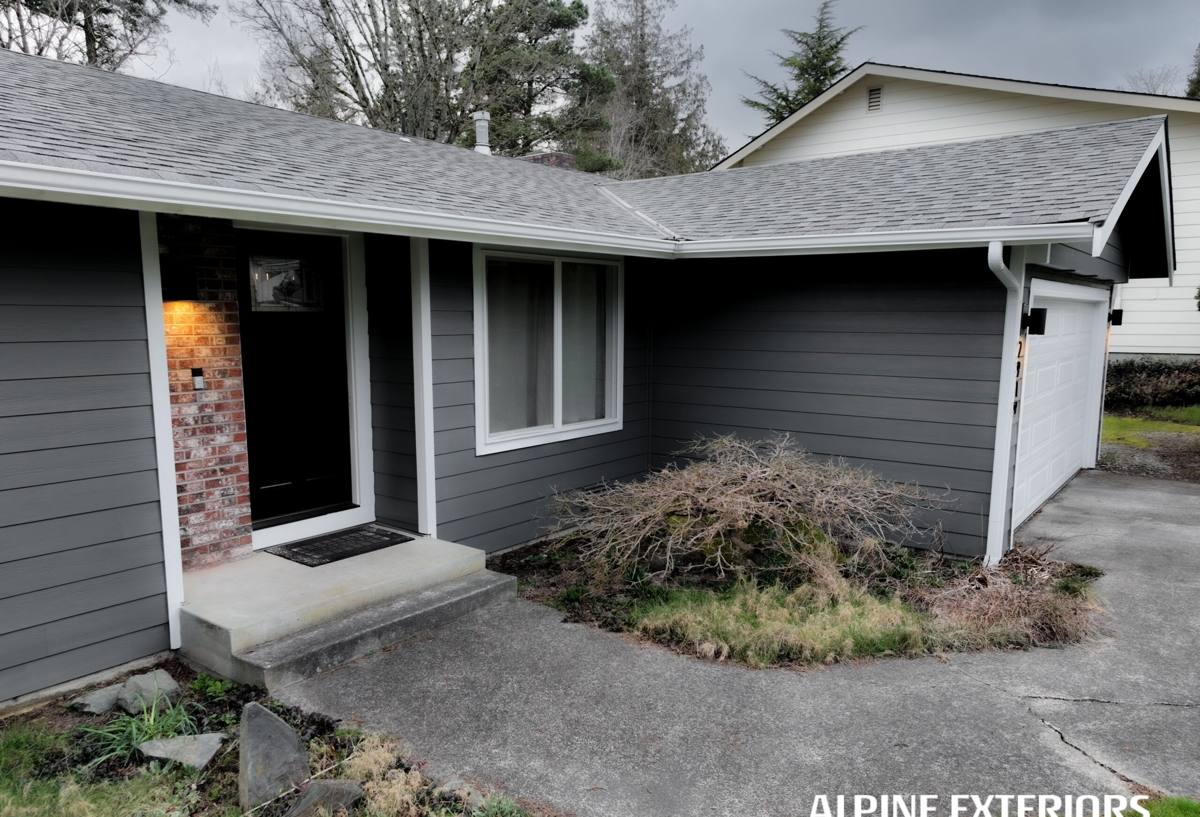
Signs Your Columbia Home Needs Siding Repair
Most siding repair calls we get start with something small the homeowner noticed on a walk around the house. Catching these early is almost always cheaper than waiting.
- Soft or spongy spots when you press on the siding, especially near the bottom courses and around window trim
- Visible gaps, cracks, or separation at seams and corners
- Persistent moss or algae staining that keeps coming back even after cleaning
- Peeling, bubbling, or chalky paint on painted wood or fiber cement siding
- Warping, buckling, or boards that look wavy instead of flat
- Discoloration or dark streaking below window sills, which usually points to a flashing or caulk failure
- Small holes, pest damage, or impact damage from storms or falling branches
- A musty smell or interior wall staining that suggests moisture is getting behind the siding
Any one of these on its own might be minor. Several together, especially clustered on the north or shaded side of a Columbia home, usually mean moisture has been working on that wall longer than it looks.
What a Correct Repair Actually Involves
Diagnosing the Real Cause, Not Just the Symptom
The biggest mistake in siding repair isn't a bad patch — it's patching over a problem that's still active. If water is getting behind the siding through a failed flashing detail, a gap at a penetration, or grade that slopes toward the house, replacing the damaged board without fixing the entry point just buys a year or two before the same spot fails again. A correct repair starts by finding out how water is getting in, not just where it's showing up.
Matching Materials and Finish
Once the cause is addressed, the repair itself has to match the existing siding in profile, exposure, and finish — or it stands out and, worse, creates a new seam where water can get behind the wall. On fiber cement siding this means matching the plank width and reveal, using the correct fasteners, and either color-matching factory finish or repainting the repaired section to blend. On older or discontinued siding, an exact match isn't always possible, which is one of the honest conversations we have with homeowners before starting work.
Repair vs. Replacement: How We Decide
Not every siding problem needs a full re-side, and we don't push replacement when a repair will genuinely hold up. The decision usually comes down to how much of the wall is affected, what's causing the damage, and how old the existing siding is.
| Factor | Repair Usually Makes Sense | Replacement Usually Makes Sense |
|---|---|---|
| Extent of damage | Isolated to one or two sections or walls | Spread across multiple walls or the whole house |
| Cause | A single fixable source, like a flashing or caulk failure | A systemic issue, like poor original installation or missing water-resistive barrier |
| Age of siding | Under 15-20 years, still structurally sound elsewhere | At or past its expected service life, or already patched multiple times |
| Material match | Matching product is still available | Original siding is discontinued or badly faded |
| Underlying sheathing | Dry and solid when opened up | Soft, rotted, or showing mold when opened up |
We open up the affected area before quoting either option. Guessing from the outside leads to underbidding the job or, worse, closing a wall back up over a problem that's still there.
Why We Repair and Rebuild With James Hardie Fiber Cement Only
We install and repair with James Hardie fiber cement exclusively — we don't work in vinyl, LP SmartSide, or other engineered wood siding. That's a deliberate standard, not a limitation on what we're capable of installing. Fiber cement doesn't absorb water the way engineered wood products can, it's non-combustible, and James Hardie's ColorPlus factory finish holds up to the region's moss and moisture cycles far better than field-applied paint. When we repair a wall, we want the fix to outlast the rest of the siding around it, and in a climate like Columbia's, fiber cement gives us that confidence in a way other products haven't.
When a repair calls for a small section replacement, we use Hardie boards and Hardie touch-up or ColorPlus repair products so the patch performs the same as the original installation, not just looks similar for a season or two. If your home currently has a different siding product and needs more than a small patch, we'll be straightforward with you about what we can and can't do, and why we'd recommend transitioning that section — or eventually the whole wall — to fiber cement.
Our Process for a Columbia Siding Repair Call
- Inspection: We walk the exterior, check the areas you're concerned about, and look for related issues you may not have noticed — most damage isn't isolated.
- Diagnosis: Where needed, we open up a section to see what's happening behind the siding before we quote anything.
- Written scope: You get a clear explanation of what's being repaired, why, and what it will cost — no vague allowances.
- Source fix first: We correct flashing, caulking, or drainage problems before any new siding goes on, so the repair actually holds.
- Repair or replace: Damaged sections are removed and replaced with matched materials, properly fastened and sealed.
- Finish and walkthrough: We match paint or factory finish as closely as possible and walk the repair with you before we consider the job done.
What This Costs: Factors That Move the Number
Every repair is different, but a few things consistently drive the cost up or down:
- Size of the affected area — a single board versus a full wall section
- Accessibility — second-story walls, tight side yards, or areas near landscaping take longer
- What's behind the siding — dry sheathing is a straightforward swap; rotted sheathing adds carpentry work
- Material availability — a current Hardie profile in stock repairs faster than a discontinued product needing a custom match
- Finish work — factory ColorPlus matching versus field painting
Small, isolated repairs on a Columbia home are often a few hundred dollars; larger sections with underlying damage cost more once carpentry and refinishing are added in. We won't give you a real number until we've actually looked at the wall — anything else is a guess.
Why Hiring Local Experience in Columbia and Sudden Valley Matters
A crew that already works in Sudden Valley and neighborhoods like Columbia has seen how homes here actually age — which walls take the worst of the driving rain, where moss builds up fastest under tree canopy, and which older siding products are common enough in this area that we already know their quirks. Many homes in Sudden Valley are part of an established homeowner association, and repairs that blend cleanly with neighboring homes tend to go more smoothly when the crew doing the work already understands that context, rather than treating every job as a blank slate.
It also means we're not learning the local climate on your dime. We already know that a repair here needs to account for a longer wet season than most of the state sees, and we price and plan the work accordingly.
Maintaining Your Siding After the Repair
A good repair buys you years, but a little maintenance stretches that further, especially in a moss-prone, shaded area like Columbia:
- Keep gutters clear so overflow doesn't run down the siding face
- Trim back vegetation and tree limbs that keep walls shaded and damp
- Rinse moss and algae buildup off before it stains or holds moisture against the surface
- Re-caulk joints and trim as they age — this is the cheapest insurance against a repeat repair
- Walk the exterior once or twice a year and catch small issues before winter rains find them
If you're noticing soft spots, staining, or gaps on your Columbia home, we're happy to take a look and give you an honest read on whether it's a repair or something bigger. Reach out for a free, no-pressure estimate using the form below.