 Sudden Valley Siding
 Why Barkley Homes Need a Siding System Built for This Climate
Barkley sits in a part of Whatcom County where the weather doesn't do siding any favors. You've got salt-laden air drifting in off the water, long stretches of driving rain in the fall and winter, and a moss season that can run most of the year on the shaded sides of a house. Any siding product will look fine in a showroom or on a sunny install day. The real test is what it looks like after five winters of wind-driven rain, a decade of damp shade, and the slow, constant exposure to moisture-carrying air that's normal here. That's the lens we use on every Barkley project, and it's why we're selective about what we'll put on a home.
Salt Air and Coastal Moisture
Salt-tinged, moisture-heavy air accelerates corrosion on fasteners and trim, and it keeps wood-based products damp longer than they'd stay in a drier inland climate. Siding that can't shed that moisture, or that swells and softens when it stays wet, starts breaking down years before it should.
Driving Rain and Wind-Driven Water
Rain here doesn't just fall straight down — it gets pushed sideways into wall assemblies during storms. Every seam, joint, and butt edge on a home's exterior is a potential entry point if it isn't detailed correctly. A siding product's water resistance matters less than how the whole assembly — siding, flashing, house wrap, and gaps — is put together.
Moss, Mildew, and Shade
Mature trees and long gray stretches mean plenty of Barkley homes have north- and west-facing walls that rarely see direct sun. Those areas grow moss and mildew fast, and siding that absorbs moisture gives both a place to root in. A dense, factory-finished material sheds that growth far more easily than a porous or field-painted one.
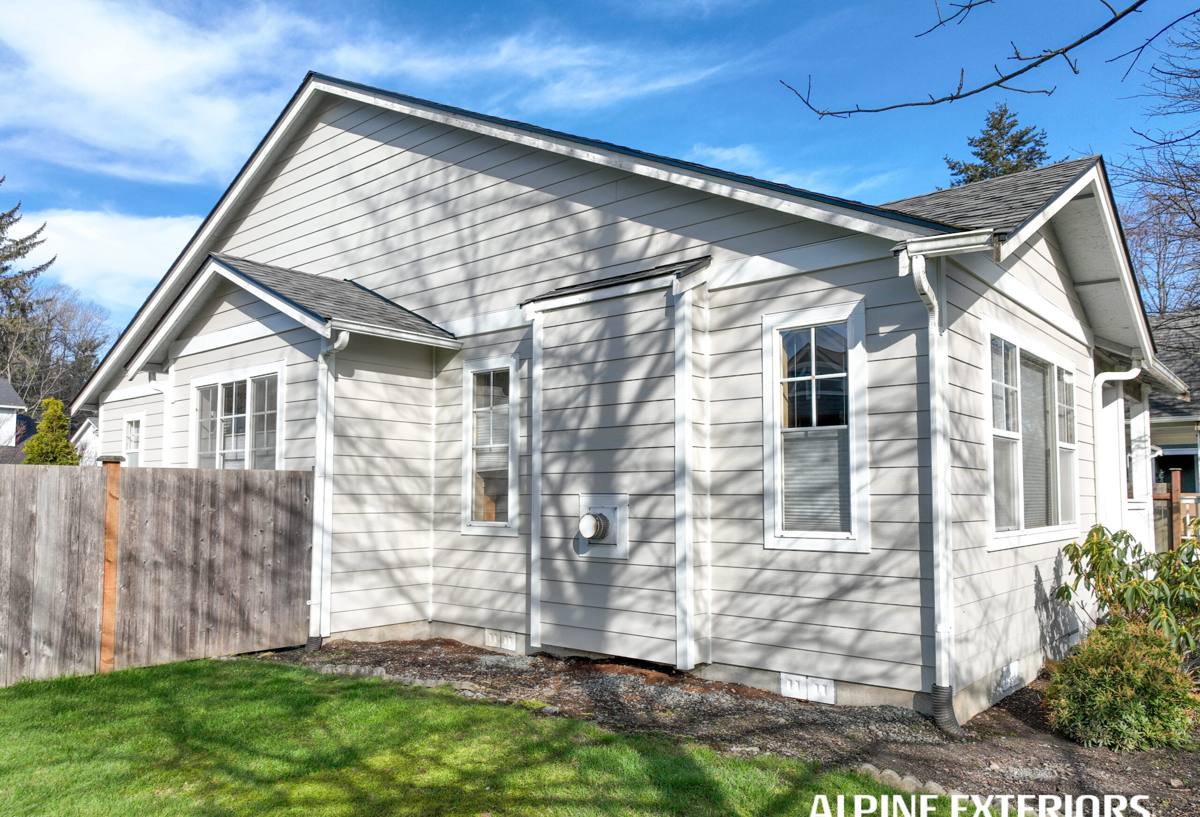
Why We Install Only James Hardie Fiber Cement
We don't offer vinyl, LP SmartSide, primed spruce, cedar, or off-brand fiber cement like Cemplank or Allura. That's not a marketing angle — it's a standard we hold because of what we've seen these products do, and not do, in exactly this kind of climate.
James Hardie's fiber cement is a cement, sand, and cellulose fiber composite. It doesn't have an organic wood component that can rot, swell, or feed fungal growth the way wood-based siding can. It's also non-combustible, which matters more each year as wildfire smoke seasons stretch further north. Hardie's HZ5 product line is specifically engineered for wetter, cooler regions like ours, with moisture management built into the manufacturing process rather than added on afterward.
The factory-applied ColorPlus finish is the other piece. It's baked on under controlled conditions, so it resists fading, chipping, and peeling far better than a coat of paint applied on-site in variable weather — which is exactly the kind of weather Barkley gets most of the year. Combined with a strong transferable warranty, it's the system we're comfortable standing behind long after the crew leaves.
What a Correct Fiber Cement Installation Involves
Fiber cement siding is only as good as its installation. The product can be excellent and still fail early if it's hung wrong — and in a climate with this much wind-driven rain, the margin for error is small. Here's what separates a correct install from a shortcut one:
| Detail | Correct Practice | Common Shortcut |
|---|---|---|
| Rainscreen gap | Furring strips or drainage wrap create an air gap behind the siding so any moisture that gets in can drain and dry | Siding nailed flush against the wall with no drainage path |
| Flashing | Head flashing over windows, doors, and trim boards, integrated with the house wrap | Caulk used in place of flashing |
| Fastening | Corrosion-resistant fasteners, correct spacing and depth per Hardie's install specs | Standard fasteners driven too deep or too shallow |
| Clearances | Proper gap from grade, roofline, and decks so siding never sits in standing water | Siding installed tight to grade or roof flashing |
| Joints and seams | Butt joints sealed and backed correctly, or eliminated with longer boards where practical | Unsealed or poorly backed joints |
Every one of those details is invisible once the job is done and the house looks good from the street. The problems they cause don't show up until years later, usually as trapped moisture, staining, or siding that's failed from behind.
Our Process for a Barkley Siding Replacement
- On-site assessment. We walk the exterior, check for existing moisture damage, evaluate trim and window flashing, and look at sun/shade exposure on each wall.
- Product and color selection. We help you choose the right Hardie panel or lap profile and ColorPlus color for your home's style and exposure.
- Tear-off and inspection. Removing the old siding lets us check sheathing and framing underneath for rot or moisture damage before anything new goes up.
- Weather barrier and drainage plane. We install or repair house wrap and furring as needed to give the assembly a proper drainage path.
- Flashing and trim. Windows, doors, and roof intersections get flashed correctly before siding goes over them.
- Installation to manufacturer spec. Fastening, clearances, and joint treatment follow James Hardie's published installation requirements, not shortcuts.
- Final walkthrough. We review the finished work with you and confirm warranty registration.
Choosing the Right Hardie Line for Barkley's Conditions
James Hardie makes several product lines, and the right one depends on the home's exposure and style, not just budget. Homes with heavy shade and moss pressure benefit from paying close attention to color choice, since ColorPlus finishes vary in how visibly they show biological growth over time. Homes on more exposed lots facing weather head-on benefit most from getting the lap size, panel type, and trim details right the first time, since those are the areas most exposed to driving rain. We'll walk through the options for your specific home and exposure rather than defaulting to one product for every house.
Cost Factors for Fiber Cement Siding in Barkley
Every home is different, but the same handful of factors drive most of the cost variation we see on local jobs:
| Factor | Why It Matters |
|---|---|
| Existing sheathing condition | Rot or moisture damage found during tear-off requires repair before new siding can go on |
| Home size and wall complexity | More corners, dormers, and trim details mean more cutting, flashing, and labor time |
| Siding profile chosen | Panel systems, wider laps, and specialty trim cost more than standard lap siding |
| Access and site conditions | Steep lots, mature landscaping, or limited staging space can add labor time |
| Current siding removal | Some materials come off faster and cleaner than others |
We give honest, itemized estimates after seeing the home in person — broad ranges without an on-site look aren't useful to you or accurate for us.
Living With Hardie Siding in Barkley: What Maintenance Actually Looks Like
One reason we standardized on Hardie is how little upkeep it needs compared to wood-based alternatives, but "low-maintenance" isn't "no-maintenance." Here's what keeping it looking right actually involves:
- Rinse the exterior once or twice a year, focusing on shaded, moss-prone walls
- Keep gutters clear so overflow doesn't run down the siding face
- Trim back vegetation that keeps walls damp and shaded
- Re-caulk trim joints and penetrations as part of normal home upkeep, just as you would with any exterior
- Inspect after major windstorms for any loose trim or fascia that could let water behind the siding
- Address any impact damage promptly rather than letting a chipped area sit exposed
That's a short list compared to what wood siding or field-painted products need to stay ahead of rot and repainting in this climate.
Why Hiring a Crew That Already Works in Barkley Matters
Installation quality is the single biggest variable in how siding performs here, and that's shaped by experience with this specific climate. A crew that's used to installing in drier regions may not think twice about rainscreen gaps or flashing details that matter enormously once wind-driven rain and long wet seasons are part of the equation. Knowing how Barkley's homes sit relative to sun, wind, and moisture — and having done the work here before — means fewer surprises during tear-off and a better outcome once the siding's up. It also means we're a phone call away if a warranty question or a storm-related concern comes up later, not a crew that worked the area once and moved on.
Signs It's Time to Replace Your Siding
Not every siding problem means a full replacement, but a few signs point that direction reliably in our experience with local homes:
- Soft or spongy spots when you press on the siding, especially near the bottom courses
- Persistent moss or dark staining that comes right back after cleaning
- Visible cupping, warping, or separation at seams
- Paint that won't hold anymore no matter how often it's redone
- Rising energy bills alongside visibly deteriorating siding, suggesting the wall assembly behind it is compromised
If you're seeing any of these, it's worth an inspection before the damage spreads to sheathing or framing, which turns a siding job into a much larger repair.
If your Barkley home is due for new siding, we'd be glad to take a look and give you a straightforward, no-pressure estimate — just fill out the form below to get started.