 Sudden Valley Siding
 Why Fairhaven's Roofs Wear Differently Than Roofs Inland
A roof in Fairhaven isn't fighting the same conditions as a roof twenty miles inland. Sitting close to Bellingham Bay puts homes here under a steady drift of salt-laden air, on top of the driving, wind-pushed rain that comes off the water during fall and winter storms. Add Whatcom County's long, damp shoulder seasons — the stretch from October through April when roofs rarely get a real chance to dry out — and you have a climate that shortens the useful life of a poorly installed or poorly maintained asphalt shingle roof faster than almost anywhere else in the region.
None of this means asphalt shingles are the wrong choice for Fairhaven. They're not. It means the installation details that get skipped on an easier job — underlayment choice, ventilation, flashing, fastening pattern — matter more here, not less. A roof that would perform fine for fifteen years in a dry inland climate can show granule loss, moss colonization, or leaks at half that age here if it was built to a generic spec instead of a coastal one.
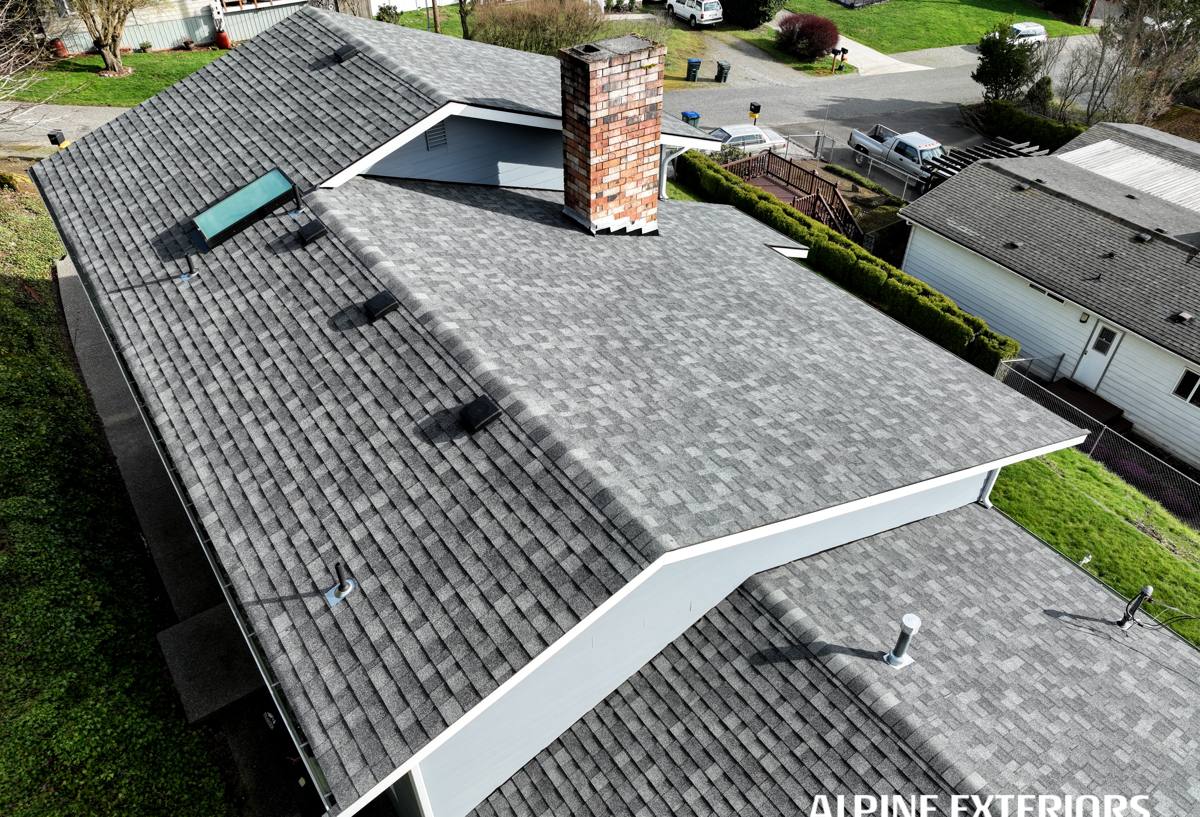
What Fairhaven's Climate Actually Does to a Shingle Roof
Salt Air
Salt air doesn't damage asphalt shingles directly the way it corrodes bare metal, but it does two things worth planning for: it accelerates corrosion on exposed fasteners, flashing, and drip edge that aren't rated for coastal exposure, and it keeps roof surfaces slightly damper for longer, which feeds the next problem.
Driving Rain
Wind-driven rain off the bay doesn't just fall straight down — it gets pushed sideways and up under shingle tabs, around penetrations, and into any gap in flashing that would never leak in calmer weather. Roofs here need underlayment and flashing details that assume water will try to travel uphill and sideways, not just down.
Moss and Algae Season
Shade, moisture, and mild temperatures are exactly what moss and algae need, and Fairhaven's tree cover combined with its damp winters gives them a long season to work with. Moss holds moisture against the shingle surface, lifts tabs as it grows, and works its way under the shingle edge — which is how a moss problem turns into a leak problem if it's ignored for a few seasons.
What a Correctly Built Asphalt Shingle Roof Needs Here
A roof built for this climate isn't a special product — it's a standard asphalt shingle system with every layer chosen and installed for the conditions it will actually face:
- Ice-and-water shield or high-quality synthetic underlayment at eaves, valleys, and around all penetrations, not just where code requires the bare minimum.
- Algae-resistant (AR) shingles with copper- or zinc-infused granules to slow algae and moss growth on shaded slopes.
- Corrosion-resistant fasteners and flashing rated for coastal exposure, not standard galvanized hardware that pits and streaks over time.
- Balanced attic ventilation (intake at the eaves, exhaust at the ridge) so moisture from inside the house doesn't condense against the roof deck from underneath.
- Proper valley and step flashing sized and lapped to handle wind-driven rain, not just gravity-fed runoff.
Skip any one of these and the roof will likely still look fine on installation day — the problems show up two, five, or ten years later, usually as a leak that traces back to a shortcut nobody can see from the ground.
Signs a Fairhaven Roof Needs Attention
Because moss and moisture damage build slowly, most homeowners don't notice a problem until it's already inside the attic. Worth checking for, especially after the wet season:
- Moss or dark algae streaking on north- or shade-facing slopes
- Granules collecting in gutters or at the base of downspouts
- Shingle tabs that look lifted, curled, or cupped at the edges
- Soft or discolored spots on interior ceilings, especially near exterior walls
- Visible daylight or staining around chimney, vent, or skylight flashing from inside the attic
- Rust streaking below metal flashing or fasteners
- Sagging or uneven roof lines, which can indicate deck moisture damage underneath
Any one of these on its own isn't necessarily an emergency, but they're worth a professional look before the next storm season rather than after a leak shows up on the ceiling.
Our Asphalt Shingle Roofing Process
- On-site inspection. We walk the roof and the attic, not just one or the other, to see both the surface condition and what's happening underneath — insulation, ventilation, deck moisture.
- Honest scope. We tell you plainly whether the roof needs full replacement, a targeted repair, or just maintenance, and explain why — no upsell to a full tear-off when a repair will genuinely hold.
- Tear-off and deck check. On replacements, we strip to the deck and inspect for soft spots or rot before anything new goes down, since covering damaged decking is how small problems become expensive ones.
- Underlayment and flashing first. These layers do most of the actual waterproofing work and get installed to the coastal spec described above, not a generic minimum.
- Shingle installation. Laid to manufacturer nailing patterns and exposure — the details that determine wind resistance and warranty validity, not just appearance.
- Ventilation check. We confirm intake and exhaust are balanced before we close the job out, since a beautiful new roof over bad ventilation still traps moisture against the deck.
- Final walkthrough. We show you what was done and what to watch for, particularly around moss prevention on shaded slopes.
Choosing a Shingle for This Climate
Most manufacturers now offer several tiers of asphalt shingle, and the right one for a Fairhaven home depends more on the site's shade and exposure than on budget alone.
| Shingle Type | Typical Lifespan | Moss/Algae Resistance | Best Fit |
|---|---|---|---|
| Standard 3-tab | 15–20 years | Low unless AR-rated | Budget-conscious jobs on sun-exposed, low-shade roofs |
| Algae-resistant (AR) 3-tab | 15–20 years | Moderate | Shaded slopes on a tighter budget |
| Architectural/laminate | 25–30 years | Moderate to good (usually AR-rated) | Most Fairhaven homes — better wind rating and thicker profile |
| Impact-rated architectural | 25–30+ years | Good | Homes wanting the strongest wind and hail performance |
We generally recommend algae-resistant architectural shingles for Fairhaven homes with any tree cover or shaded northern exposure, since the moderate upfront cost difference is small compared to the labor cost of dealing with moss removal or premature replacement down the line. We steer away from bargain-tier 3-tab shingles without AR granules on shaded lots specifically because of how fast moss establishes here — not because the product is defective, but because it's simply the wrong tool for this particular climate.
What Affects the Cost of a Shingle Roof in Fairhaven
| Factor | Why It Matters Here |
|---|---|
| Roof pitch and access | Steeper roofs and limited driveway/yard access add labor time and equipment needs |
| Number of layers to remove | Tear-off of old layers costs more than a single-layer strip |
| Deck condition | Rotted or soft decking found during tear-off requires replacement before shingles go down |
| Shingle tier chosen | 3-tab vs. architectural vs. impact-rated changes material cost per square |
| Flashing and ventilation upgrades | Bringing older flashing and ventilation up to a coastal-appropriate standard |
| Number and complexity of penetrations | Chimneys, skylights, and multiple vents each add flashing work |
Because every one of those factors varies by house, we don't quote a roof over the phone — we give real numbers after a walk-through, and we'll tell you honestly if a repair is the more sensible option instead of a full replacement.
Maintenance That Actually Extends Roof Life Here
Asphalt shingle roofs in this climate benefit from a small amount of regular attention far more than a one-time premium installation alone:
- Keep gutters clear so water doesn't back up under the shingle edge during heavy rain
- Trim back overhanging branches to reduce shade and debris buildup on the roof surface
- Have moss physically and gently removed rather than left to grow — pressure washing shingles can strip granules and should be avoided
- Schedule a walk-through inspection every year or two, ideally before the wet season starts
- Address small flashing or fastener issues right away, before they become deck-level leaks
Why Local Experience with Fairhaven Roofs Matters
A roofing crew that regularly works this stretch of Whatcom County already knows which slopes hold moss the longest, how far wind-driven rain can travel up under a poorly lapped valley, and which fastener and flashing grades actually hold up against salt air over time. That's not something you get from a generic install checklist — it comes from having done the work in these specific conditions, repeatedly, and having gone back years later to see what held up and what didn't.
It also means someone who understands that a roof here is one piece of the whole exterior system — siding, trim, ventilation, and drainage all interact, and a decision made on the roof can affect moisture behavior at the wall line below it.
If your Fairhaven home needs a new asphalt shingle roof, a repair, or just an honest inspection before the wet season, we're happy to take a look and give you a straightforward assessment. Reach out for a free, no-pressure estimate using the form below.