 Sudden Valley Siding
 Board & Batten Siding Built for Ferndale's Climate
Ferndale sits close enough to the Strait of Georgia and the Nooksack River lowlands that homes here deal with a specific combination of punishment: salt-tinged air rolling in off the water, long stretches of driving rain through fall and winter, and a moss season that can run most of the year on north- and west-facing walls. Board and batten siding — with its bold vertical lines and deep shadow reveals — is one of the most popular looks we install in Whatcom County right now, but it's also one of the least forgiving styles if the underlying material and installation aren't right for this environment.
This page is about that one job, done right, for Ferndale homes specifically. Not a general overview of board and batten as a style — the real considerations that matter when you're putting it on a house that has to survive Pacific Northwest coastal weather year after year.
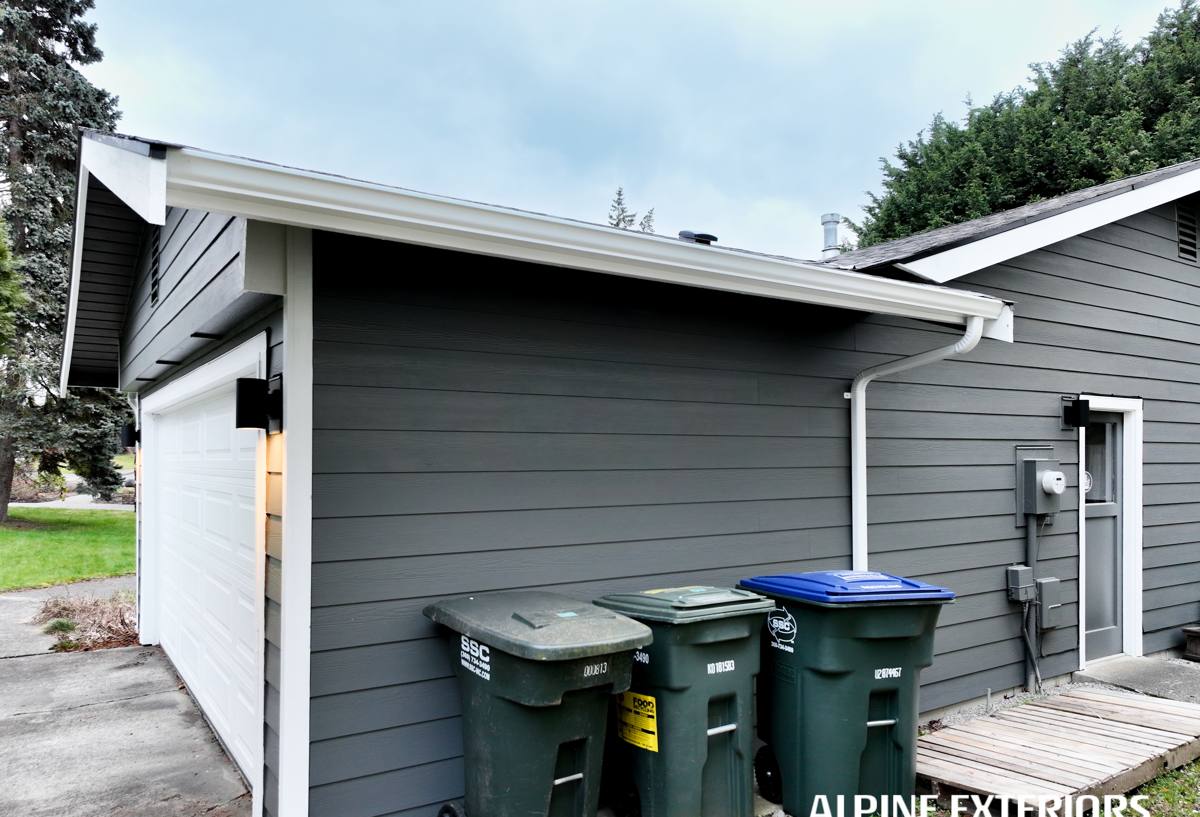
Why Board & Batten Is a Different Job Than Lap Siding Here
Traditional horizontal lap siding sheds water in a straightforward, gravity-driven way — each course overlaps the one below it. Board and batten works differently: wide vertical boards with narrow battens covering the seams, which means the water management strategy has to be engineered into the assembly rather than relying purely on overlap geometry.
In a climate like Ferndale's, where wind-driven rain doesn't always fall straight down, that distinction matters. A board and batten wall needs:
- A correctly detailed water-resistive barrier (WRB) behind the siding, lapped and taped so it drains rather than traps moisture
- Rainscreen furring strips to create a drainage gap between the siding and the WRB, letting any incidental moisture dry out instead of sitting against the wall
- Batten spacing and fastening that accounts for the wider vertical boards expanding and contracting with seasonal humidity swings
- Careful flashing at every horizontal transition — window heads, belt lines, roof-to-wall intersections — since vertical siding creates more of these transitions than a running horizontal course
Skip any of these and you don't get a dramatic failure right away. You get slow moisture intrusion that shows up two or three winters later as swelling, staining, or soft trim — right around the time most homeowners assume the siding is simply low-maintenance and stop checking it.
What Salt Air and Driving Rain Actually Do to Board & Batten
Salt Air
Ferndale isn't oceanfront, but it's close enough to Bellingham Bay and the Strait that airborne salt is a real factor, especially on homes with more open western or northern exposure. Salt accelerates corrosion on fasteners, flashing, and any exposed metal trim. It also tends to hold moisture against surfaces slightly longer than dry inland air would, which matters on a siding style with as many seams and battens as this one has.
Driving Rain
Whatcom County's rain rarely falls straight down. Wind off the water pushes it sideways into wall assemblies, which is exactly the scenario a rainscreen gap and correctly lapped WRB are designed to handle. Without that gap, driving rain gets forced into seams between boards and battens under pressure, and gravity alone won't push it back out.
Moss Season
Shaded, north-facing walls in Ferndale's tree-covered neighborhoods can stay damp for weeks at a stretch during fall and winter. Moss and algae don't just look bad — sustained organic growth holds moisture against the siding surface longer than bare material would, which is a slow but real threat to any product that isn't dimensionally stable and properly finished.
Why We Only Install James Hardie Board & Batten
We install James Hardie fiber cement exclusively — we don't offer vinyl board and batten, LP SmartSide, primed spruce, cedar, or other fiber cement brands like Cemplank or Allura. That's a deliberate standard, not a lack of options, and it matters more on board and batten than on almost any other siding style because vertical boards see more expansion, more direct rain exposure, and more seams per square foot than lap siding does.
| Material | How it holds up in Ferndale's climate |
|---|---|
| Vinyl board & batten | Lightweight and low cost, but it expands and contracts noticeably with temperature swings, can warp or bow over time, and offers no real fire resistance |
| Primed wood / cedar | Classic look, but wood is the material most vulnerable to sustained moisture and moss growth, and repainting/resealing is an ongoing maintenance cycle |
| LP SmartSide (engineered wood) | More stable than raw wood, but still wood-based — cut edges and any coating failure expose it to moisture absorption over time |
| James Hardie fiber cement | Dimensionally stable in wet and dry cycles, non-combustible, factory-applied ColorPlus finish resists the fading and peeling that repeated rain and salt exposure cause |
James Hardie's HZ5 product line is engineered specifically for climates with freeze-thaw cycles and sustained moisture exposure — which describes Whatcom County well. The factory-baked ColorPlus finish also matters more on board and batten than lap siding, because the deep shadow lines and vertical grain pattern are much more visible from the street, and a finish that's fading unevenly is far more noticeable on this style than on a flatter lap profile.
What a Correct Board & Batten Installation Involves
- Tear-off and substrate inspection — removing existing siding and checking sheathing for any hidden rot or moisture damage before anything new goes up
- Water-resistive barrier installation — a properly lapped, taped WRB that directs incidental moisture down and out, not into the wall cavity
- Rainscreen furring — vertical strapping that creates a drainage and drying gap behind the siding, standard practice for board and batten in this region
- Flashing at every penetration and transition — windows, doors, roof lines, and belt lines, sequenced so upper courses always overlap lower ones
- Board and batten installation to manufacturer fastening spec — correct nail spacing, embedment, and gapping so the boards can move seasonally without cracking the finish or pulling fasteners
- Caulking and touch-up limited to manufacturer-approved products — the wrong sealant at a seam can trap moisture instead of shedding it
Every one of these steps is invisible once the job is done. That's exactly why the installer's discipline matters more than the finished appearance in the first year — a poorly built wall assembly and a well-built one can look identical from the curb until the third or fourth Whatcom County winter starts finding the weak points.
Why Local Board & Batten Experience Matters in Ferndale
Board and batten installation isn't a one-size-fits-all process — the right rainscreen detailing, flashing sequence, and fastening schedule shift depending on exposure, elevation, and how much wind-driven rain and salt air a given wall actually sees. A crew that already works Ferndale and the surrounding Whatcom County communities has a working sense of which walls need the most conservative detailing and which trim and flashing choices hold up against moss and moisture over time in this specific environment — not a generic installation manual written for a drier climate.
That local pattern recognition shows up in small decisions: how tight to run batten spacing given seasonal humidity swings here, where extra flashing attention pays off on a shaded north wall, and which color choices in the James Hardie ColorPlus line actually hold up against years of moss exposure without showing it. None of that is guesswork — it's the product of doing this specific job, in this specific climate, repeatedly.
Signs Your Current Siding Is Already Losing the Battle
- Persistent moss or algae streaking that returns within weeks of cleaning
- Soft or spongy trim boards, especially around window heads and corners
- Visible gaps or separation between boards and battens
- Paint or finish that's peeling, bubbling, or chalking unevenly across the wall
- Staining below seams or flashing points that suggests water is finding a path behind the siding
Any of these on a board and batten wall usually points back to a water management detail — not the visible surface — and it's worth having someone look at the assembly, not just the paint.
What This Project Typically Involves
| Factor | What affects it |
|---|---|
| Scope | Full re-side vs. accent walls or gable features — board and batten is often used selectively alongside other Hardie profiles |
| Substrate condition | Whether tear-off reveals sheathing damage that needs repair before siding goes back up |
| Wall complexity | Window and door count, roof-to-wall transitions, and elevation height all affect flashing and labor time |
| Exposure | Walls facing prevailing wind and rain typically warrant more conservative rainscreen and flashing detailing |
| Color and trim selection | ColorPlus finish options and trim profile choices affect material cost and lead time |
We walk through all of these with you on-site before putting together a scope and quote — there's no accurate number without seeing the actual walls and current siding condition.
Get a Straightforward Look at Your Project
If you're weighing board and batten for a Ferndale home, we're happy to come take a look, explain what your specific walls need given their exposure and condition, and give you a straightforward, no-pressure estimate — no scare tactics, no upsell to a product we don't stand behind. Use the form below to get started.